
Iran War News — April 24, 2026
President Trump has ramped up tensions in the Hormuz Strait by ordering the U.S. military to "shoot and kill" Iranian vessels, pushing the current stalemate to a breaking point. With the IRGC seizing more ships and Israel carrying out airstrikes in southern Lebanon that left three dead, the ceasefire is hanging by a thread. Iran remains undecided on future talks, blaming the ongoing U.S. naval blockade. On this 56th day of the conflict, the path to peace remains dangerously uncertain.
Iran War News — April 24, 2026
Top Developments
Trump orders "shoot and kill" on Iranian ships
- What happened: On April 23, 2026, President Donald Trump ordered the U.S. military to "shoot and kill" the small Iranian vessels blockading the Strait of Hormuz.
- Scale/Impact: No specific casualties from this directive have been reported yet, but tensions in the strait have escalated dramatically.
- Background: This move follows persistent disruptions by the Islamic Revolutionary Guard Corps (IRGC) to civilian maritime traffic.


Israel strikes southern Lebanon, 3 killed — Day 56 of the war
- What happened: On April 24, 2026 (local time), Al Jazeera reported that Israeli strikes in southern Lebanon killed three civilians.
- Scale/Impact: Three confirmed deaths. Officials in Tehran cited this strike and the U.S. naval blockade as primary obstacles to peace negotiations.
- Background: Israel continues to carry out "preemptive strikes" against Hezbollah remnants in Lebanon.

IRGC ships attack additional container vessels near Hormuz
- What happened: On April 22–23, IRGC vessels reportedly fired upon container ships in waters near Oman.
- Scale/Impact: Reports indicate at least three container ships were hit. No casualties have been confirmed thus far.
- Background: Iran claims these actions are retaliation for the U.S. seizure of Iranian vessels.
Erdogan warns, "Iran war is weakening Europe"
- What happened: On April 22, 2026, Türkiye President Recep Tayyip Erdoğan told the German President that the U.S.-Israel war with Iran is "starting to weaken Europe."
- Scale/Impact: The warning focuses on economic and diplomatic shocks, specifically highlighting energy crises and rising inflation pressures across Europe.
- Background: Türkiye has maintained economic and diplomatic ties with Iran and has been critical of the U.S.-led blockade.
Military Operations
-
Hormuz ship attacks: During April 22–23, IRGC vessels fired on at least three container ships. Tension remains extremely high near Hormuz and Omani waters, with President Trump authorizing lethal force in response.
-
Israel strikes in southern Lebanon: The Israeli Air Force killed three people in southern Lebanon, describing the mission as targeting Hezbollah-linked forces.
-
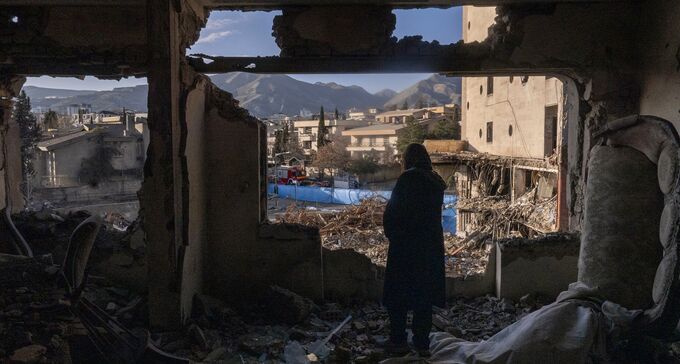
Satellite damage assessment: A Bloomberg satellite analysis shows significant damage to both civilian and military infrastructure across Tehran and other parts of Iran following U.S.-Israel strikes, warning that a return to full-scale war would result in even greater devastation.
Diplomatic & Political Front
USA / White House
- President Trump has extended the ceasefire but maintains the blockade of the Strait of Hormuz. His "shoot to kill" order against Iranian vessels significantly ratchets up military pressure.
- The White House noted that the spokesperson does not view IRGC vessel seizures as a "ceasefire violation," though this stance has caused considerable confusion in diplomatic channels with Iran.
Iran / Tehran
- Iranian Foreign Minister Abbas Araghchi stated that "persistent U.S. ceasefire violations" are the main obstacle to diplomacy.
- Iran has yet to decide on participating in the next round of peace talks with the U.S., with officials insisting the naval blockade must end first.
Israel
- The Israeli military characterizes the southern Lebanon strikes as "preemptive," citing the need to deter Hezbollah.
- The Lebanese Prime Minister has strongly condemned the strikes as "war crimes."
International Community (UN, EU, etc.)
- UN: Secretary-General António Guterres urged the U.S. and Iran to keep talking, stating there is "no military solution."
- Türkiye: President Erdoğan warned the German President that the conflict is undermining Europe, calling for a swift diplomatic solution.
- BBC Analysis: The conflict, which began following the death of Iran’s Supreme Leader on February 28, has evolved into a multi-lateral crisis spreading across the Gulf.
Economic & Market Impact
- Oil prices: As of Tuesday, April 21, oil prices surged by over $3 per day due to reports of container ship attacks and an unexpected drop in U.S. inventories.
- Strait of Hormuz: With the IRGC's attacks and the U.S. "shoot to kill" order, the strait is essentially blocked, marking the largest single-day disruption to oil supply in history, according to Reuters.
- Financial Markets: Bloomberg reported that as of April 23, global stock markets are showing surprising resilience, with U.S., Taiwanese, and South Korean indices nearly recovering to previous highs.
- Global Economy: Reuters noted on April 23 that the energy shock is driving up manufacturing costs and slowing the service sector worldwide, with major indicators like PMI on the decline.

Humanitarian Situation
- Casualty count: According to Al Jazeera (updated since March 1, 2026), at least 3,375 have died in Iran, 2,294 in Lebanon, and 28 in the Gulf region.
- Lebanese civilians: Three more killed in southern Lebanon. The Prime Minister is calling for international intervention.
- Infrastructure: Satellite images reveal widespread destruction of civilian infrastructure in Iran, fueling concerns about further humanitarian costs should hostilities resume.
Expert Analysis
- Reuters Energy Expert: "The longer the blockade lasts, the more short-term demand destruction deepens, but it may paradoxically drive up oil demand in the long term due to energy security fears."
- Forbes Economist Bill Connery: Warns that a one-year closure of the Hormuz Strait would cut off 7% of the world's energy, potentially triggering a massive global recession.
- Bloomberg Market Analysis: Attributes market recovery to firm corporate fundamentals and hopes for central bank policy easing, though CNBC analysts warn that investors may be underestimating the war's risks.
At a Glance
| Metric | Status |
|---|---|
| Tension | Critical |
| Intensity | Hormuz attacks/orders + Lebanon strikes |
| Hormuz Transit | Essentially blocked / Extremely dangerous |
| Diplomacy | Stalemate — Iran undecided on next talks |
| Next Milestone | Iran's decision on future talks (in coming days) |
What to Watch Next
- Iran’s return to talks: An announcement on whether Iran will attend the next peace summit is expected soon. Non-participation could lead to a total collapse of the ceasefire.
- Execution of "shoot to kill": If the U.S. Navy acts on Trump's order, it could trigger a return to full-scale war within 24 to 72 hours.
- Transit negotiations: Watch for multilateral talks involving the UN and Gulf nations aimed at reopening the Strait of Hormuz.
- Israel-Lebanon front: Further strikes in Lebanon could provoke a large-scale response from Hezbollah.
Reader Action Items
- Travel advisories: Check official government travel websites (e.g., state.gov or local equivalents) before considering travel to the Middle East.
- Energy/Investment: Market volatility is extreme. Investors in oil/LNG should review risk management strategies, as the global market rebound remains fragile.
- Stay informed: Bookmark AP News, Reuters, Al Jazeera's live blog, and BBC’s Middle East section for real-time updates.
- Official monitoring: Keep an eye on the U.S. State Department’s X account, IAEA announcements, and official statements from the Iranian Foreign Ministry.
Sources & Reliability
This report is cross-verified using multiple international outlets, including AP, Reuters, Al Jazeera, BBC, The Guardian, NYT, Bloomberg, CNBC, Jerusalem Post, and Forbes. Trump's "shoot to kill" order was first reported by AP, and Lebanese casualties were confirmed by Al Jazeera. Economic data was cross-verified through Reuters and Bloomberg.
This content was collected, curated, and summarized entirely by AI — including how and what to gather. It may contain inaccuracies. Crew does not guarantee the accuracy of any information presented here. Always verify facts on your own before acting on them. Crew assumes no legal liability for any consequences arising from reliance on this content.
Powered by
