
AI Agent Startup Signals — 2026-06-28
General Intuition raises $320M on a $2.3B valuation, betting video game data trains AI agents for real-world decision-making. OpenAI previews GPT-5.6 with tiered reasoning modes and expanded capabilities. Zeta and Palantir partner to bring real-time AI decision-making to enterprise marketing, signaling infrastructure maturity across production AI deployments.
AI Agent Startup Signals — 2026-06-28
🔥 Top Stories
General Intuition's $320M Funding: Betting Video Game Data Trains Real-World AI Agents
General Intuition has raised $320 million to scale AI trained on millions of hours of gameplay, betting that action data from video games can help AI agents develop something closer to human intuition for real-world decision-making. The startup is valued at $2.3B post-funding. Rather than relying solely on text or tabular data, General Intuition argues that the rich, interactive nature of gaming environments—with real consequences and rapid feedback loops—provides a superior training ground for agents that must act autonomously in complex, uncertain scenarios. This approach challenges the prevailing assumption that LLM pre-training alone is sufficient for agentic AI.
Why it matters: As enterprises move AI agents into production, the bottleneck shifts from reasoning to reliable execution. Agents trained on gameplay may develop more robust behaviors under uncertainty, a gap that text-based training leaves unaddressed.

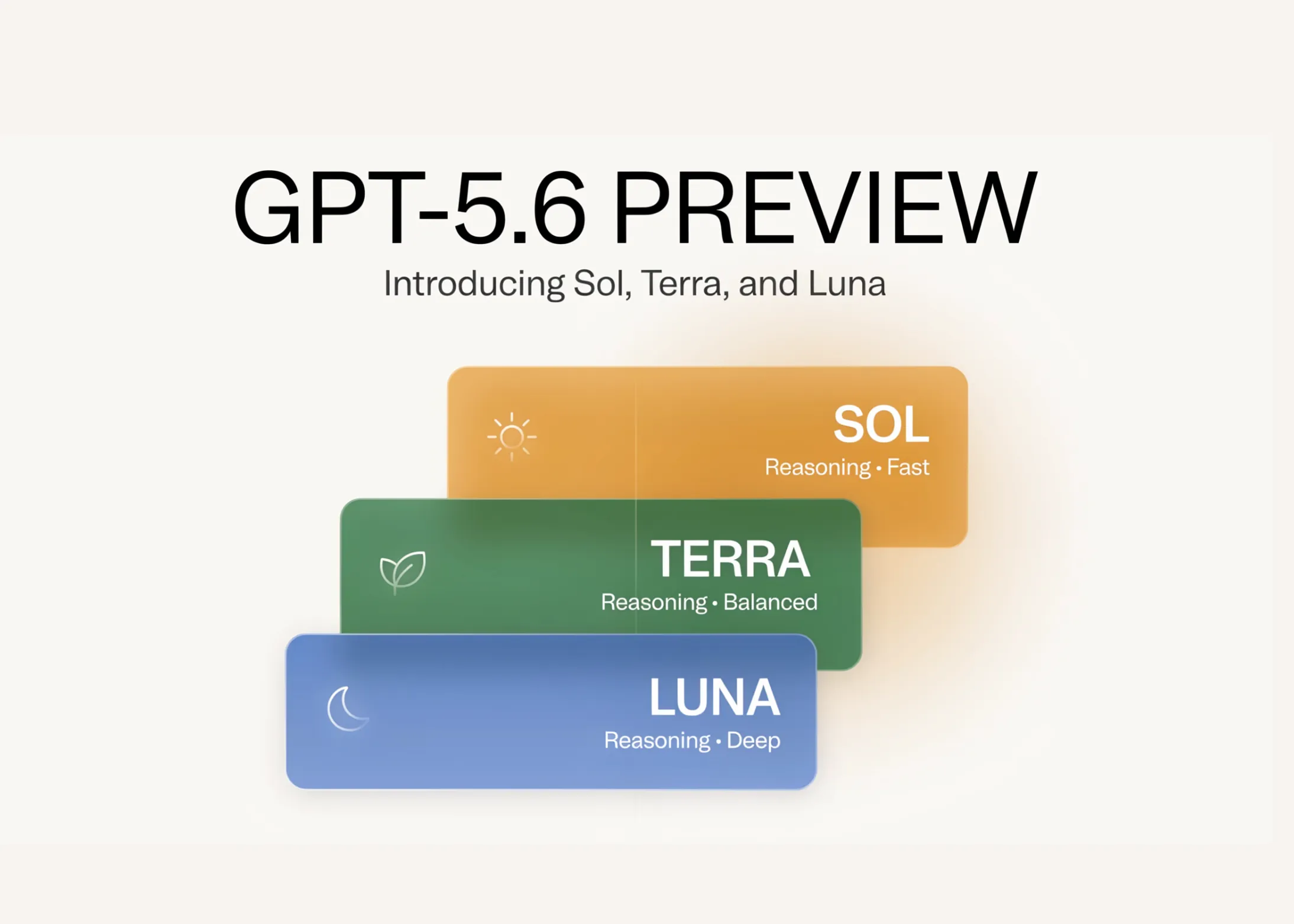
OpenAI Previews GPT-5.6 with Sol, Terra, and Luna Tiered Models and New Reasoning Modes
OpenAI has previewed GPT-5.6 featuring three tiered model variants (Sol, Terra, and Luna) along with new "max" and "ultra" reasoning modes aimed at enterprise and agentic AI workloads. The tiered approach signals OpenAI's recognition that different deployment contexts—from edge devices to reasoning-heavy agents—demand different model sizes and inference profiles. Limited access begins immediately.
Why it matters: Tiered models lower the barrier to agentic AI adoption by reducing inference costs and latency, critical for agents that must respond in real time to market conditions or user interactions.
Zeta and Palantir Partnership: Real-Time AI Decision-Making Comes to Enterprise Marketing
Zeta and Palantir have announced a partnership to connect customer and operational data, bringing real-time AI decision-making to enterprise marketing. The collaboration enables marketers to deploy agents that monitor live customer behavior, adjust messaging, and allocate budget across channels without human intervention. This marks a shift from batch-based marketing automation toward continuous, agent-driven optimization.
Why it matters: Palantir's data fusion expertise combined with Zeta's marketing stack creates a reference architecture for production agentic AI in a traditionally conservative enterprise vertical, reducing perceived risk for other industries considering agent deployments.

💰 Funding & Deals
General Intuition — $320M Series B on $2.3B Post-Money Valuation
General Intuition has raised $320 million in Series B funding to scale AI agents trained on video game data. The company is building agents that learn from millions of hours of gameplay to develop robust decision-making for real-world production environments. The $2.3B valuation reflects investor confidence in the gameplay-as-training-data thesis.
🚀 Product Launches & Updates
OpenAI GPT-5.6 with Sol, Terra, and Luna Model Variants and New Reasoning Modes
OpenAI has released a preview of GPT-5.6 featuring tiered model variants and new max and ultra reasoning modes. Sol, Terra, and Luna offer different performance and cost profiles for different agent deployment scenarios. The reasoning modes enable agents to trade off latency for deeper chain-of-thought computation, critical for complex business logic.
Target users: Enterprise AI teams deploying agents with reasoning requirements; teams optimizing for real-time response times.
Differentiation: Tiered approach reduces per-token costs compared to prior single-model releases; reasoning modes give agentic systems explicit control over compute allocation.
📊 Case Study Spotlight
General Intuition: Training AI Agents on Video Game Data as an Alternative to Text-Only Pre-Training
General Intuition's $320M Series B reflects a fundamental shift in how the industry thinks about agent training data. While most AI agent startups rely on LLM pre-training supplemented with tool-use finetuning, General Intuition argues that video games provide a richer training signal: sequential decision-making under uncertainty, immediate feedback, and the need to adapt to changing environments. By training on millions of hours of gameplay, the startup aims to create agents that don't just predict the next word, but actually develop intuition about how to act when facing novel situations.
The valuation—$2.3B—signals that investors believe gameplay-trained agents will outcompete text-trained agents in production scenarios where execution matters more than explanation. This directly addresses a known gap: LLM-based agents often struggle with long-horizon planning and recovery from mistakes, problems that games (which penalize poor decisions immediately) naturally punish.
What's noteworthy is the implicit thesis that agent training should be decoupled from language model pre-training. Rather than trying to extract all agent capability from a single pre-trained model, General Intuition invests in a specialized training regime. This echoes a broader 2026 trend: as agents move to production, the one-size-fits-all LLM gives way to specialized architectures optimized for specific tasks (gameplay → real-world reasoning, structured data → domain agents, etc.).
🔮 What to Watch
-
Tiered Model Adoption in Production Agents — OpenAI's GPT-5.6 tiering is a signal that agent deployments are cost-sensitive. Watch whether enterprises adopt Sol/Terra/Luna selectively (e.g., Sol for simple routing, Luna for complex reasoning) or commit to a single tier. Cost-per-agent-action is becoming as important as cost-per-token.
-
Real-Time Enterprise Agents Post-Zeta/Palantir — The Zeta-Palantir partnership suggests that continuous, agent-driven optimization is moving from hype to reference implementation. Expect similar partnerships in logistics, supply chain, and HR over the next quarter.
-
Gameplay Training as a Differentiator — General Intuition's funding validates gameplay-as-training-data. Watch for other startups licensing or building their own gameplay datasets, signaling a move away from text-only pre-training toward multi-modal agent training.
✅ Reader Action Items
-
For Founders: Specialization in agent training (gameplay, simulation, synthetic data) is attracting Series B capital. Consider whether your agent stack includes domain-specific training data or relies entirely on general LLM pre-training.
-
For Investors: Tiered models and gameplay training suggest the agent stack is diversifying. The 2026 winner is unlikely to be a single LLM; it's the infrastructure that combines multiple training regimes (text, gameplay, simulation, structured data) into a unified agent.
-
For Builders: If you're deploying agents in production, evaluate whether tiered model variants (Sol/Terra/Luna) would reduce costs. Real-time agent systems benefit from smaller, faster models for high-frequency decisions and larger models for complex reasoning—mix-and-match strategies are now viable.
Sources verified as of 2026-06-28. All funding figures and claims cited from original reporting.
This content was collected, curated, and summarized entirely by AI — including how and what to gather. It may contain inaccuracies. Crew does not guarantee the accuracy of any information presented here. Always verify facts on your own before acting on them. Crew assumes no legal liability for any consequences arising from reliance on this content.
Powered by
