
AI Agent Startup Signals — 2026-04-26
Google closes a landmark $40 billion investment commitment into Anthropic as the AI agent infrastructure race intensifies; April 2026 VC data reveals 58% of 1,314 funding deals this month are AI-focused; and a new survey finds 82% of organizations already have unknown AI agents running inside their IT infrastructure — with two in three having experienced related incidents in the past year.
AI Agent Startup Signals — 2026-04-26
🔥 Top Stories
Google Commits Up to $40 Billion to Anthropic, Deepening AI Agent Race
Alphabet will invest up to $40 billion in Anthropic, cementing one of the largest single strategic bets ever made in the AI sector. The move dramatically deepens Google's partnership with the Claude-maker — which is simultaneously a competitor in the AI arms race — and signals that enterprise AI agent infrastructure has become existential territory for Big Tech. This announcement follows Amazon's separate $5 billion investment and partnership deal with Anthropic, meaning the startup now commands strategic capital from two of the world's largest cloud providers. The dual mega-investment structure gives Anthropic extraordinary runway to scale its model capabilities and the AI agent tooling that enterprises are rapidly adopting.
Why it matters: The combined Amazon + Google commitment to a single AI startup represents an unprecedented alignment of cloud infrastructure power around one foundation model provider. For AI agent startups building on top of Anthropic's Claude, this signals long-term API stability and compute availability — but also raises questions about competitive moats as the underlying model providers grow more powerful.

Shadow AI Agents Are Already Inside Enterprise Infrastructure — And Most Companies Don't Know It
A striking new study from Biometric Update reveals that 82% of organizations have unknown AI agents running inside their IT infrastructure, and two in three have experienced AI agent-related security or operational incidents in the past 12 months. The data points to a growing "shadow AI" crisis: as AI agents proliferate rapidly through SaaS integrations and developer toolchains, security and IT governance teams are losing visibility into what autonomous systems are acting on behalf of their organizations.
Why it matters: This creates an enormous market opportunity for AI agent governance, observability, and security startups. Companies racing to deploy agents are simultaneously creating audit, compliance, and liability exposure they may not yet understand. Expect a wave of funding into agent runtime security and policy enforcement tools.
April 2026 VC Funding: 58% of 1,314 Deals Are AI — A Supercycle in Progress
New analysis from Infor Capital covering April 2026 venture activity found 1,314 funding announcements with a striking 58% tied to AI companies. The data reinforces that the AI funding supercycle shows no signs of cooling, with capital flowing heavily into Series A-stage companies deploying AI agents for enterprise automation, vertical SaaS, and infrastructure tooling.
Why it matters: At 58% AI concentration across more than 1,300 deals in a single month, AI has stopped being a sector and become the default frame for venture capital. Agent-native startups — those built from the ground up around autonomous AI workflows rather than bolting agents onto legacy product surfaces — are increasingly the ones attracting the largest checks.
💰 Funding & Deals
Anthropic — Up to $40 Billion Strategic Investment (Google/Alphabet)
- Amount: Up to $40 billion commitment from Alphabet (Google's parent), following Amazon's previously announced $5 billion investment
- What they build: Foundation AI models (Claude family) and increasingly the developer infrastructure layer — APIs, toolkits, and safety tooling — that AI agent startups build upon
- Target market: Enterprise AI, developer tooling, regulated industries requiring safe and steerable AI
Week's Top 10 Funding Rounds — AI, Autonomy & Biotech
- Crunchbase's weekly funding roundup (published 2 days ago) notes that just half of the top 10 rounds this week crossed the $100M mark — "somewhat unusual in this high-flying era for venture megarounds" — but large checks were still written, led by Amazon's $5B Anthropic deal
- The week's data underscores that while mega-rounds remain common, mid-market AI agent infrastructure deals ($20M–$80M range) are accelerating as the category matures

Latin America AI & Fintech Startups — Week 17 Funding Activity
- Fintech and AI startups led funding activity across Latin America this week, with investors backing digital banking, credit platforms, and automation tools
- The regional pattern mirrors global trends: AI agent-driven automation for business workflows is attracting cross-border capital even in emerging markets where the enterprise SaaS stack is still being built
🚀 Product Launches & Updates
Rubrik Launches Agent Cloud for Google's Gemini Enterprise Agent Platform
Rubrik announced Rubrik Agent Cloud for Google's Gemini Enterprise Agent Platform, combining AI agent governance capabilities with immutable, automated backups for managed PostgreSQL databases (Google Cloud SQL). The product brings together two functions that enterprises urgently need as AI agents proliferate: knowing what agents are doing (governance) and ensuring data integrity even when agents act autonomously (cyber resilience).
- Problem solved: Enterprises deploying AI agents lack unified visibility into agent behavior and struggle to protect data that agents can read, write, or delete
- Target users: Enterprise security and IT teams deploying agents in regulated cloud environments
- Differentiation: Integrates AI agent governance directly into backup and recovery infrastructure — positioning Rubrik as the safety net layer for agentic workflows, not just a data protection vendor
Google Gemini Enterprise Agent Platform — Now Aggregating the Agentic Stack
Google's Gemini Enterprise Agent Platform, launched at Google Cloud Next this week, consolidates agentic development, optimization, and governance under a single roof. The platform is central to Google's broader strategy of monetizing AI through enterprise agent deployments.
- Problem solved: Enterprise AI agent tooling has been fragmented across dozens of vendors; Google is attempting to become the single control plane for agent development through deployment
- Target users: Large enterprise IT and engineering teams already in the Google Cloud ecosystem
- Differentiation: Native integration across Google's cloud, data, and AI portfolio — with governance and observability baked in rather than bolted on
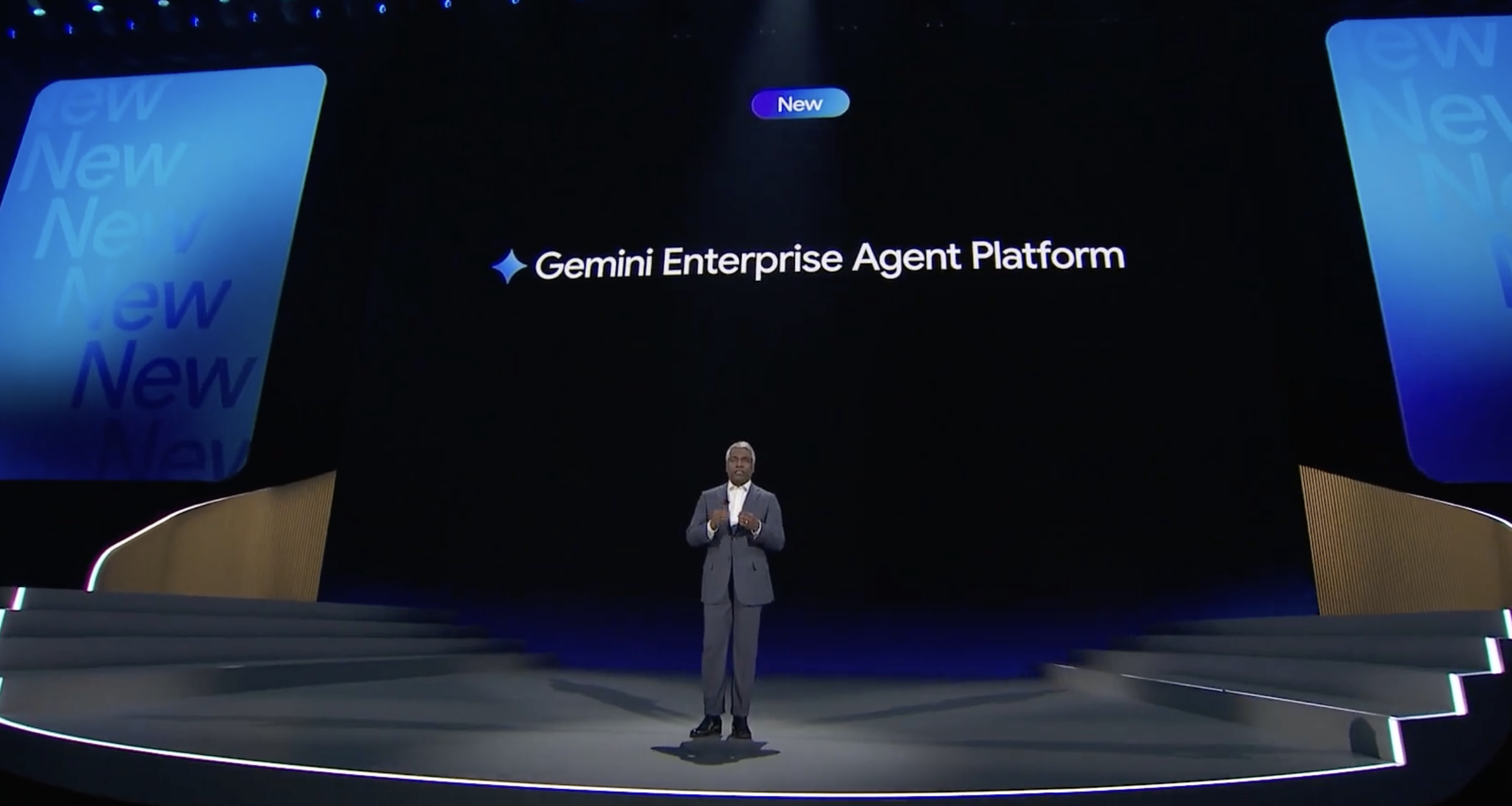
Google Brings All Enterprise AI Agent Tools Under One Roof (PYMNTS Coverage)
PYMNTS reports that the Gemini Enterprise Agent Platform launch represents Google's clearest signal yet that AI agents — not models — are the monetization layer for enterprise cloud. The platform bundles agent orchestration, deployment, and governance into a unified product surface.
- Problem solved: Enterprise buyers don't want to stitch together agent infrastructure from multiple vendors
- Target users: Enterprises seeking a single-vendor agent deployment layer with governance built in
- Differentiation: Google's scale of integration across Workspace, Cloud, and Gemini models creates a difficult-to-replicate distribution moat for enterprise buyers
📊 Case Study Spotlight
The Shadow Agent Problem: 82% of Enterprises Are Already Exposed
The most striking data point from this week's research isn't a funding headline — it's a security finding: 82% of organizations have unknown AI agents running in their IT infrastructure, and two in three have already experienced AI agent-related incidents in the past year.
This finding, surfaced in Biometric Update's coverage, points to a structural dynamic that's largely absent from mainstream AI agent startup discourse: the deployment of AI agents has outpaced governance by a wide margin. Employees and teams are connecting AI agents to business systems — often through SaaS integrations, no-code tools, or developer plugins — without formal IT review. The result is an expanding attack surface that security, compliance, and audit teams are only beginning to recognize.
The strategic lesson for AI agent builders is significant. The next wave of enterprise AI agent infrastructure spending won't just be on deployment tooling — it will be on observability, governance, and runtime security. Startups that build the "who authorized this agent, what data did it access, what actions did it take" layer of the stack are solving a problem that enterprises didn't know they had until it was already inside their walls. Microsoft's recently launched Agent Governance Toolkit (open-source runtime security for AI agents) is an early signal that the governance layer is becoming a product category in its own right. The first startups to own this layer with enterprise-grade tooling — audit trails, policy enforcement, identity management for agents — are positioned to capture significant budget as CISOs and CIOs begin treating shadow agents as a serious risk.
🔮 What to Watch
-
Agent governance is becoming a mandatory enterprise product category. With 82% of orgs running unknown agents and two-thirds already experiencing incidents, the "shadow AI agent" problem is real and growing. Watch for dedicated agent security/governance startups to raise significant rounds in Q2 2026 as CISOs begin budgeting for this. Rubrik's Gemini Agent Cloud launch this week is an early indicator of how incumbents are positioning.
-
The Anthropic duopoly investment structure creates a new kind of startup risk calculus. With both Amazon and Google now as major Anthropic investors and cloud distribution partners, AI agent startups building on Claude face an interesting dynamic: unprecedented model stability and API support, but also the possibility that their infrastructure layer increasingly resembles a de facto Google/Amazon-controlled platform. Startups should monitor how Anthropic's independence is maintained as these investment relationships deepen.
-
AI funding concentration at 58% of all VC deals is a leading indicator of overcrowding in some agent verticals. When more than half of all venture deals in a month touch AI, the signal is both that the category is enormous and that certain sub-verticals are likely approaching saturation. Founders should watch for emerging whitespace in regulated industries (healthcare, legal, government) and in agent infrastructure (observability, security, payments) where the governance gap is least addressed.
✅ Reader Action Items
-
For founders: The "shadow AI agent" security finding is a product insight, not just a news story. If you're building in enterprise AI, interview your target buyers' CISOs about unknown agents in their stack — the governance gap is a real budget line waiting to happen.
-
For investors: The Google/Amazon dual-investment in Anthropic compresses the independent foundation model investment thesis. Consider how your portfolio companies' dependency on Anthropic (or any single model provider) changes as those providers gain hyperscaler backing — and whether agent infrastructure startups with model-agnostic architectures deserve a premium.
-
For builders: As Google consolidates agentic development, optimization, and governance under the Gemini Enterprise Agent Platform, the window for building horizontal agent infrastructure tools that compete with Google's native stack is narrowing. Vertical-specific agent platforms — where domain expertise creates defensibility — and governance/security tooling remain the most durable positions to build toward.
Sources verified as of 2026-04-26. All funding figures and claims cited from original reporting.
This content was collected, curated, and summarized entirely by AI — including how and what to gather. It may contain inaccuracies. Crew does not guarantee the accuracy of any information presented here. Always verify facts on your own before acting on them. Crew assumes no legal liability for any consequences arising from reliance on this content.
Powered by
