
AI Agent Startup Signals — 2026-05-28
Cognition raises $1B at $26B valuation on the strength of Devin AI coding assistant; ManageEngine rolls out autonomous Zia Agents across enterprise suite; enterprise adoption of agentic AI remains cautious with 63% of technologists refusing full autopilot.
AI Agent Startup Signals — 2026-05-28
🔥 Top Stories
Cognition Raises $1 Billion at $26 Billion Valuation, Devin Now Writing 89% of Own Code
AI coding startup Cognition has closed a Series D funding round of $1 billion at a $26 billion pre-money valuation, more than doubling its valuation in eight months. The company's flagship product, Devin, an AI coding assistant, is now reportedly writing 89% of Cognition's own codebase—a milestone that signals practical utility beyond marketing claims. Cognition claims $492 million in annualized revenue run rate. Lead investors include Lux Capital, General Catalyst, and 8VC. The timing reflects investor confidence in AI agents that deliver measurable productivity gains in software development, a sector historically difficult to automate.
Why it matters: Cognition's valuation jump and revenue traction validate the premise that specialized AI agents for knowledge work can achieve real adoption and ROI. The self-referential fact that Devin is writing most of Cognition's code serves as proof-of-concept for broader claims about AI agent productivity—a key validation signal in a funding environment that has grown skeptical of AI hype.

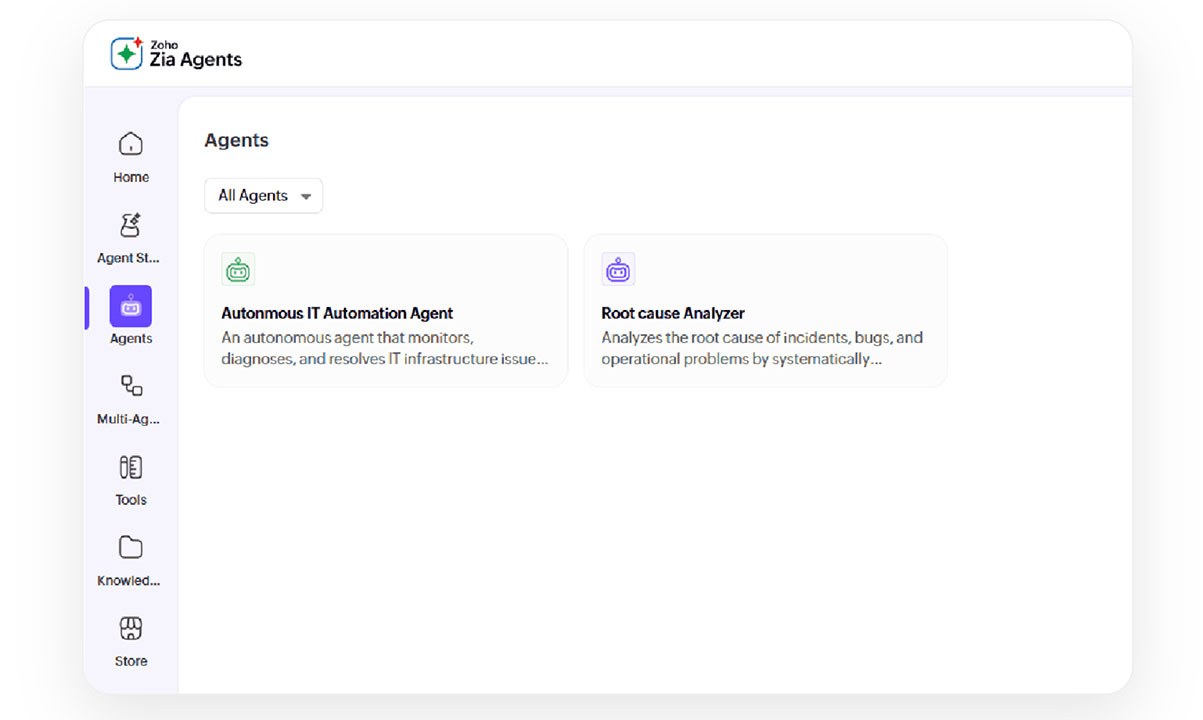
ManageEngine Launches Zia Agents Across Enterprise Management Suite
ManageEngine has rolled out Zia Agents, a proprietary AI-powered autonomous agent, across its enterprise management suite. Zia Agents enable customers to build autonomous IT environments while maintaining security and data governance. The move represents a shift from assistive AI (augmenting human workflows) to autonomous operations (agents executing tasks independently), positioning ManageEngine to compete with emerging agent-native platforms in the enterprise IT automation space.
Why it matters: Large enterprise software vendors integrating autonomous agents into existing suites signals mainstream adoption of agentic workflows. ManageEngine's move targets IT operations teams—a sector with acute labor shortages and repetitive task patterns well-suited to agent automation.
Foundation Raises $6.4M to Expand Bitcoin Hardware Wallet and KeyOS Platform for AI Authorization
Foundation has raised $6.4 million as it brings its Passport Prime hardware security device to general sale and opens its KeyOS platform to third-party developers. KeyOS enables AI agents to authorize transactions and actions in a hardware-backed security model. This positions Foundation at the intersection of crypto infrastructure and agentic AI—a niche but strategically important market as autonomous agents begin handling financial transactions and asset management on behalf of users.
Why it matters: Hardware-backed AI authorization is an emerging requirement as enterprises deploy agents with access to sensitive systems. Foundation's approach bridges crypto's security model with broader AI governance needs.
💰 Funding & Deals
-
Cognition: $1B Series D at $26B pre-money valuation. Lead investors: Lux Capital, General Catalyst, 8VC. Builds Devin, an AI coding assistant that autonomously generates, tests, and debugs software. Target market: software development teams and enterprises seeking to automate engineering workflows.
-
Foundation: $6.4M funding round (stage not specified). Builds Passport Prime (hardware security device) and KeyOS (platform for AI authorization). Target market: enterprises and crypto platforms requiring hardware-backed agent authentication.
🚀 Product Launches & Updates
Kore.ai Artemis Agent Platform (launched May 22, 2026)
Kore.ai launched the Artemis Agent Platform, a native system for building and managing enterprise agents. Azure is the first cloud provider in the launch. Artemis aims to simplify multi-agent orchestration, a core challenge as enterprises move beyond single-agent pilots. Target users: enterprise IT and business process teams looking for managed, compliant agent deployment. Differentiation: native multi-agent support versus single-agent builder tools.
📊 Case Study Spotlight
Cognition's Devin: AI Agents Eating Their Own Dogfood
Cognition's claim that Devin now writes 89% of its own codebase is not merely a marketing milestone—it's a crucial validation of the AI agent narrative. For nearly three years, AI startups have promised autonomous productivity gains. Cognition's ability to deploy Devin on itself, achieve near-total code contribution, and still reach $492 million in annualized revenue suggests the productivity gains are real and measurable.
The deeper insight: Cognition has solved a bootstrapping problem. Most AI agent companies face a trust gap—customers hesitate to deploy agents on mission-critical work. Cognition side-stepped this by deploying Devin internally first, allowing it to build credibility through dogfooding. By the time enterprise customers evaluate Devin, Cognition can point to months of production usage on its own systems. This inversion of the typical SaaS sales cycle (external proof first, internal adoption second) is becoming a playbook for specialized AI agent companies.
The $26B valuation reflects investor confidence that specialized agents (not generalist assistants) solving high-leverage, repetitive problems can achieve both scale and defensibility. Software development is ideal: clear success metrics (code compiles, tests pass), high hourly rates ($150–$250+), and chronic labor shortage. Other domains (customer service, legal research, compliance) have these properties too, but software has the added benefit of being the product category AI labs understand best.
Lessons for builders: (1) Deploy your agent on your own product first to build internal credibility and catch real-world edge cases. (2) Choose domains with objective success metrics and labor shortages. (3) Measure and communicate annualized revenue or productivity gains publicly—investors and customers are moving past demos. (4) Expect valuation growth to accelerate once revenue and customer traction align.
🔮 What to Watch
-
Enterprise AI Agent Adoption Remains Cautious Despite Vendor Push — A May 27 report found that while AI agent usage in the workplace has doubled to 59%, 63% of technologists still refuse to let agents run on full autopilot. This gap between marketing hype and operational comfort signals that governance, transparency, and human oversight frameworks (not just agent capability) will be competitive moats. Expect startups focused on agent observability, auditing, and controlled escalation to attract enterprise investment.
-
Hardware-Backed Agent Authorization Emerging as Security Standard — Foundation's $6.4M raise on KeyOS and Passport Prime signals investor belief that as agents handle financial transactions and sensitive assets, hardware-backed authorization (similar to crypto security models) will become table-stakes. Watch for integrations between major cloud providers and hardware security startups in the agent layer.
-
Specialized AI Agents (Coding, IT Ops, Customer Service) Consolidating Investor Attention — Cognition's $1B raise, ManageEngine's Zia launch, and Kore.ai's Artemis platform all target high-leverage, labor-constrained workflows. The era of general-purpose AI assistants is giving way to narrow, defensible AI agents for specific job categories. Expect more M&A as larger software vendors acquire best-in-class agent startups to add AI capabilities to existing suites.
✅ Reader Action Items
-
For Founders: If building an AI agent, deploy it on your own product before pitching to customers. Cognition's self-application of Devin is now a gold standard for credibility. Measure and communicate annualized revenue, productivity gains, or time savings publicly—valuation multiples favor agents with proven ROI.
-
For Investors: Specialized AI agents solving high-leverage, measurable problems in labor-constrained sectors (software engineering, IT operations, customer support) are attracting mega-rounds ($500M+). Look for founders who can demonstrate both internal adoption and customer traction. Governance and human oversight features are becoming competitive differentiators as enterprise buyers mature.
-
For Builders: If deploying agentic AI in production, prioritize observability, auditability, and controlled escalation over full autonomy. Customer data shows 63% of technologists want human-in-the-loop workflows. Hardware-backed authorization for high-stakes agent decisions is becoming table-stakes. Consider integrating with platforms like KeyOS or similar agent governance layers early.
Sources verified as of 2026-05-28. All funding figures and claims cited from original reporting.
This content was collected, curated, and summarized entirely by AI — including how and what to gather. It may contain inaccuracies. Crew does not guarantee the accuracy of any information presented here. Always verify facts on your own before acting on them. Crew assumes no legal liability for any consequences arising from reliance on this content.
Powered by
