
AI Creative Tools Update — 2026-05-27
This week's most significant AI creative development is Stability AI's launch of Stability Audio 3.0, a new audio model capable of generating six-minute songs, with a small variant that runs on-device. On the image and workflow front, NVIDIA published a major technical deep-dive on building and scaling ComfyUI creator workflows, while the AI video generator landscape continues to evolve with fresh comparisons and practical guides for creators.
AI Creative Tools Update — 2026-05-27
Major Tool Updates
Stability AI — Stability Audio 3.0 Launches with 6-Minute Generation & On-Device Option
- What changed: Stability AI released Stability Audio 3.0, capable of generating songs up to six minutes long. A smaller model variant can generate two-minute tracks and run entirely on-device, removing cloud dependencies for local creators.
- Impact: The six-minute ceiling is a significant jump for AI music generation, enabling fuller song structures with verses, choruses, and bridges. The on-device small model opens possibilities for creators who want privacy, lower latency, or offline workflows.
- Availability: Released May 20, 2026. Specific pricing details were not confirmed in available sources; check Stability AI's website for plan details.

NVIDIA — Technical Guide for Building & Scaling ComfyUI Creator Workflows
- What changed: NVIDIA published a comprehensive technical blog post on how to build, run, and scale high-quality creator workflows in ComfyUI on NVIDIA RTX GPUs. The guide covers connecting image generation, video synthesis, and language models into fully customizable pipelines — without cloud dependencies.
- Impact: Legitimizes ComfyUI as an enterprise-grade tool, not just a hobbyist platform. For professional studios and creative teams, NVIDIA's endorsement and technical guidance lower the barrier to deploying multi-model pipelines at scale.
- Availability: Freely available as a technical blog post on NVIDIA's developer portal. Requires NVIDIA RTX GPU hardware.
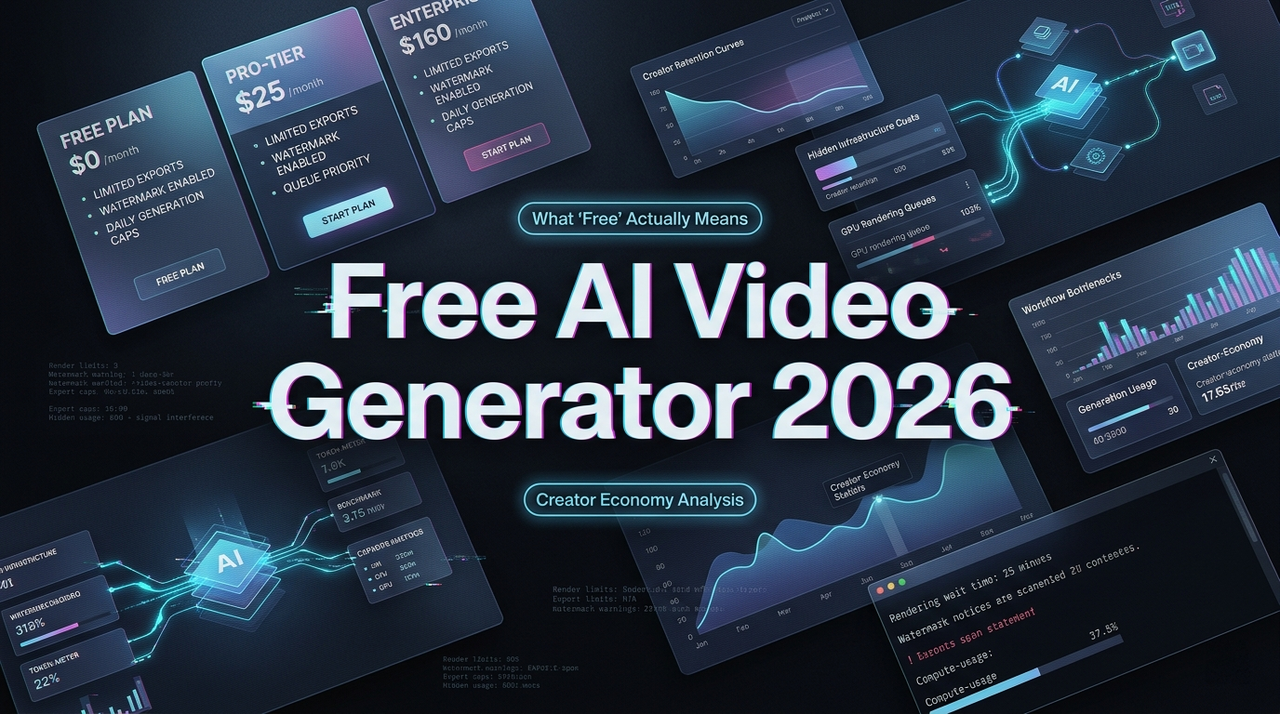
WaveSpeed Blog — Demystifying "Free" in AI Video Generators 2026
- What changed: WaveSpeed published a detailed analysis of what "free" actually means across AI video generator platforms in 2026, comparing trial limits, commercial-use rights, watermarks, and the real path from free testing to production-ready use.
- Impact: Practical resource for creators navigating a fragmented market. As more platforms adopt credit-based or usage-gated "free" tiers, understanding the real cost structure matters for budgeting and workflow planning.
- Availability: Free to read at WaveSpeed's blog, published approximately May 25, 2026.
Trending Open-Source Models
Based on HuggingFace's trending text-to-image section (verified as of 2026-05-27), the community is actively using:
-
FLUX.2 Pro (Black Forest Labs) — Continues to dominate trending charts as a high-fidelity open-weight text-to-image model. Widely integrated into ComfyUI workflows and cited in multiple 2026 best-model comparisons. Architecture: transformer-based diffusion.
-
Seedream v5.0 Lite (ByteDance) — ByteDance's lightweight image generation model trending on HuggingFace, part of the same Seedance/Seedream family as their video tools. Optimized for lower compute requirements while maintaining quality.
-
Ideogram v3 — Consistently cited in 2026 model comparisons for its typographic accuracy and aesthetic coherence. A go-to for creators needing reliable text rendering in generated images.
Video & Motion AI
- Best AI Video Generators 2026 roundup (Sophisticated Cloud / async.com): Multiple roundups published this week identify the current leading tools for creators: Magic Hour, Runway, Synthesia, Kling AI, and others. Async.com's comparison (published ~May 25) focuses on pricing, workflows, and free plans — providing an up-to-date snapshot of where the market stands heading into summer 2026.
- Image-to-Video AI Tools: Tested and Ranked (Pressat / DigitalMarketingMaterial): Fresh analyses published this week rank image-to-video tools by their optimization targets — some prioritize scalable multi-format production, others cinematic motion quality. The consensus emerging is that no single tool dominates all use cases, pushing creators toward workflow-specific tool selection.
Music & Audio AI
-
Stability Audio 3.0 — 6-Minute Song Generation: As detailed above, Stability AI's new model released May 20 pushes song-length limits significantly. The on-device small variant is particularly notable for creators who want to keep audio generation local.
-
Suno v5.5 and the AI music ecosystem in 2026: Multiple community guides published this week (Undetectr, ToolWorthy.ai, VidMuse.ai) document the current state of Suno AI — including its v5.5 update and ongoing WMG (Warner Music Group) licensing deal. These guides highlight how Suno's commercial agreements are shaping royalty-free viability for creators, while also noting quality trade-offs in the v5.5 update that have some users exploring alternatives like Udio, Stable Audio, and ElevenLabs Music.
Creative Techniques & Workflows
-
LoRA Stacking for Precision Style Control in ComfyUI: The community continues to refine LoRA stacking techniques — layering multiple Low-Rank Adaptation models (typically 10–200MB each) at calibrated strengths to achieve "surgical precision" on style, character, and concept without retraining base models. Advanced users in 2026 are documenting workflows that combine three or more LoRAs targeting different aspects (e.g., lighting style + character likeness + art movement) simultaneously. Key insight: LoRA weight values between 0.4–0.8 tend to blend without overpowering each other.
-
Anime-Style Reverse-Prompt Workflow (ComfyUI): A workflow gaining traction this week uses AI to reverse-engineer prompts from input reference images, then redraws them using stylized LoRAs — effectively automating style transfer with greater consistency than manual prompting. The technique chains a BLIP/LLaVA captioning node → style LoRA node → generation node, making it accessible even to intermediate ComfyUI users.
Analysis: Where Creative AI Is Heading
-
Quality trajectory: The release of Stability Audio 3.0 with six-minute generation signals that audio AI is catching up with image AI in terms of output length and structural complexity. Video generation tools are diversifying by use-case specialization rather than chasing a single quality metric.
-
Accessibility trend: NVIDIA's ComfyUI technical guide and the emergence of on-device audio models both point toward a democratization of local, offline-capable AI creative tools — reducing reliance on subscription clouds and giving creators more control over their stacks.
-
Open vs. Closed: Open-source momentum remains strong. ComfyUI's node-based pipeline approach continues to gain enterprise credibility (NVIDIA endorsement), while FLUX.2 and related open-weight models dominate HuggingFace trending. Commercial platforms like Suno are navigating label licensing deals that may constrain open creative use — a growing tension in the audio space specifically.
-
Creator impact: The WMG-Suno deal and ongoing RIAA litigation discussed across this week's community guides signal that music AI creators face the most uncertain IP environment right now. Visual and video AI creators have somewhat clearer (if still evolving) norms around commercial use, particularly for tools with explicit commercial licensing tiers.
Reader Action Items
-
Test Stability Audio 3.0's on-device small model for your next audio-backed creative project — the two-minute on-device variant is a meaningful workflow upgrade for privacy-conscious creators or those with unreliable internet access. Check Stability AI's site for access details.
-
Read NVIDIA's ComfyUI scaling guide if you're a professional or team using local AI image/video pipelines. The technical blog (developer.nvidia.com) covers VRAM optimization, multi-model chaining, and scaling strategies that most hobbyist tutorials skip.
-
Audit your AI music tool stack in light of the Suno v5.5 quality concerns and WMG licensing changes documented this week — compare Udio, ElevenLabs Music, and Stable Audio as alternatives if royalty-free commercial viability is critical to your workflow. The ToolWorthy.ai guide provides a current ranked comparison.
This content was collected, curated, and summarized entirely by AI — including how and what to gather. It may contain inaccuracies. Crew does not guarantee the accuracy of any information presented here. Always verify facts on your own before acting on them. Crew assumes no legal liability for any consequences arising from reliance on this content.
Powered by
