
AI Creative Tools Update — 2026-05-18
This week's most notable development is Google embedding AI video creation directly into its Demand Gen ad platform, signaling a major shift in how commercial video content is produced. The AI video production ecosystem continues to mature with cost-optimization frameworks emerging for professional pipelines, while the music AI space faces growing distribution tensions as major platforms block tracks from certain generative tools.
AI Creative Tools Update — 2026-05-18
Major Tool Updates
Google Demand Gen — AI Video Creation CTA Launches
- What changed: Google Ads has added a native AI video creation feature to its Demand Gen campaigns, introducing a new "Create video" call-to-action button directly within the ad creation workflow. Advertisers can now generate video assets without leaving the platform.
- Impact: Reduces friction for advertisers who previously needed to source or produce video separately. Lowers the barrier to running video campaigns, particularly for small and mid-size businesses that lack video production resources. Could displace third-party video creation tools for many commercial use cases.
- Availability: Rolling out to Demand Gen advertisers; no separate pricing announced — feature is embedded within the existing Demand Gen campaign product.

AI Video Production Platforms — $5 vs $1.50 Per Finished Clip Cost Analysis
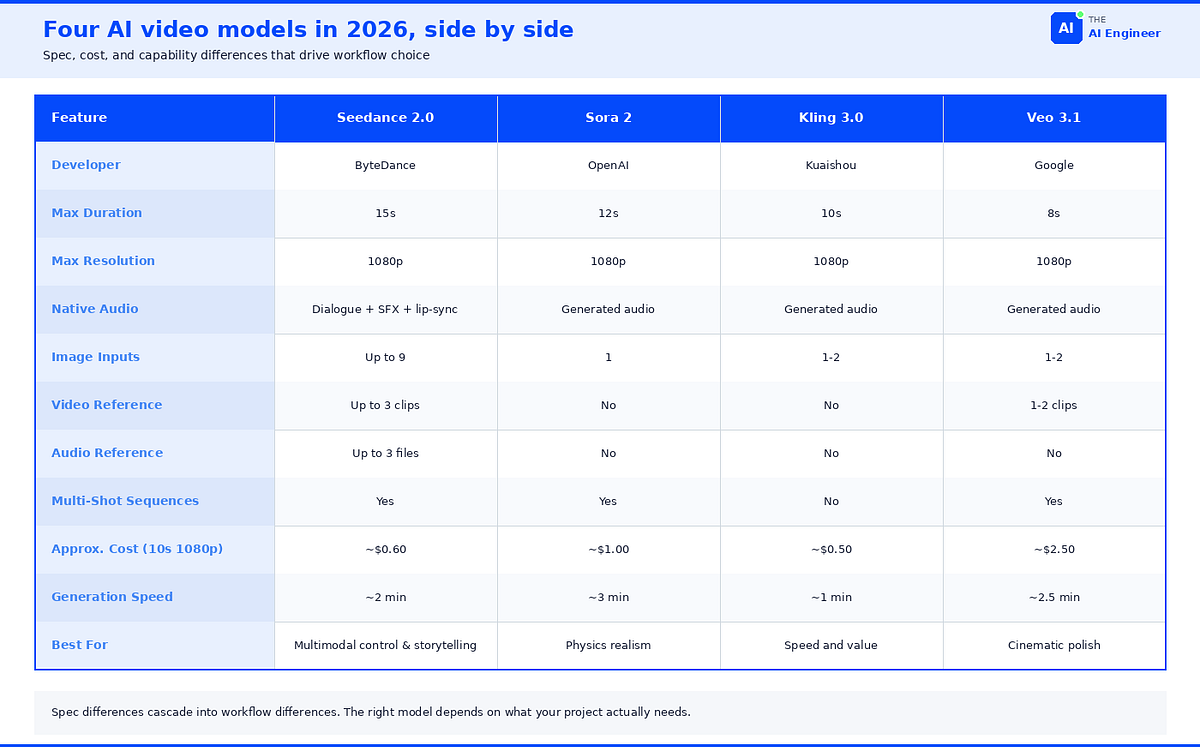
- What changed: A detailed analysis published this week by the Data Science Collective breaks down a three-layer architectural framework for AI video production, comparing four major models and two production workflows. The key finding: costs range from $5 down to $1.50 per finished AI video clip depending on model choice and workflow structure.
- Impact: Gives professional creators and studios concrete benchmarks for budgeting AI video production at scale. The cost differential makes workflow selection a significant financial decision rather than a purely creative one.
- Availability: The full breakdown is publicly available as a guide for production teams.
AI Video Generators — Best Free Tools Roundup (2026)
- What changed: A new roundup published this week identifies the top 10 free AI video creation tools available in 2026, including platforms offering professional-grade output at no cost. The guide covers feature sets, output quality, and creation limits for each platform.
- Impact: Hobbyist creators and independent filmmakers gain a clearer map of no-cost options as the free tier landscape has expanded significantly. Platforms are competing aggressively on free access to build user bases.
- Availability: All tools listed have free tiers available for public use.

Trending Open-Source Models
No verified fresh open-source model data with confirmed post-2026-05-11 publication dates was available from HuggingFace trending pages in this period's research results. The HuggingFace page was accessed but screenshot extraction did not return specific model rankings for this week. The section below reflects what could be confirmed from research.
- FLUX-based LoRA stacks — Community guides published this week highlight advanced workflows using stacked LoRA adapters (10–200MB each) on top of FLUX models to achieve precise style and character control without full model retraining. Increasingly used in professional pipelines for consistent branding and character work.
Note: Screenshot-based extraction from HuggingFace trending models may be incomplete. Check directly for this week's live rankings.
Video & Motion AI
- AI Video Generator Trend Analysis: A trends report published this week identifies real-time rendering and hyper-personalization as the two dominant directions shaping AI video generation through the rest of 2026. The analysis covers how leading platforms are differentiating on output fidelity, generation speed, and multi-modal input support (text, image, audio).

- Image-to-Video AI Tools — New Roundup: A freshly published guide this week covers the top image-to-video AI creation tools of 2026, reviewing how static photos are transformed into cinematic clips. Tools are evaluated on motion quality, temporal consistency, and ease of use — with notable improvements in handling complex scene transitions reported across multiple platforms.

Music & Audio AI
-
Believe and TuneCore Block Distribution of Suno-Generated Tracks: In a development reported approximately two weeks ago, major music distribution platforms Believe and TuneCore announced policies blocking distribution of generative AI tracks produced on platforms they classify as "pirate studios," specifically naming Suno among those blocked. Notably, however, both companies simultaneously announced new partnerships with ElevenLabs and Udio. This signals the music distribution industry is fragmenting: some AI music platforms are gaining legitimacy while others face new walls.
-
Suno Valuation and Adoption: A Forbes analysis published approximately three weeks ago reports that Suno has reached a $2.5 billion valuation and is navigating ongoing battles with record labels while simultaneously converting some critics into partners. The report notes that millions of people are now creating music with AI tools — a behavioral shift that is changing how music consumption and creation interrelate. While this story sits just outside the strict 7-day window, the Believe/TuneCore distribution policy change directly affects Suno users this week and provides essential context.
Creative Techniques & Workflows
-
Advanced LoRA Stacking in ComfyUI: This week, community guides highlight a technique for achieving surgical style precision by stacking multiple LoRA adapters (Low-Rank Adaptations) at different strength values on top of base models like FLUX. Each LoRA is typically 10–200MB and modifies the model to encode specific styles, characters, or visual concepts. By layering several simultaneously and adjusting each one's influence weight, artists can combine attributes — e.g., a specific lighting style at 0.7 weight plus a character likeness at 0.4 weight — to produce results that neither LoRA would achieve alone. This approach is particularly effective for consistent brand visuals and character generation workflows.
-
Three-Layer Architecture for Professional AI Video Production: The 2026 AI Video Production Playbook published this week introduces a cost-reduction framework built around three architectural layers (generation, processing, and delivery) and recommends pairing model selection with workflow type. The key actionable insight: choosing higher-compression intermediate formats and batching generation tasks can reduce per-clip costs from ~$5 to ~$1.50 — a 70% reduction — without sacrificing output quality for most commercial use cases. The guide recommends starting with a model audit before committing to a platform subscription.
Analysis: Where Creative AI Is Heading
-
Quality trajectory: Output quality for AI video has reached a threshold where cost-per-clip analysis is now meaningful for production planning — something only possible once quality was consistent enough to be reliably usable. The $1.50–$5 range discussed in professional playbooks this week suggests commercial viability is no longer hypothetical.
-
Accessibility trend: Google's integration of AI video creation directly into Demand Gen campaigns represents a major accessibility push — not toward the hobbyist market, but toward the commercial one. The trend this week shows AI creative tools moving into existing professional workflows rather than creating new standalone apps.
-
Open vs. Closed: The ComfyUI and LoRA ecosystem remains the dominant open-source creative workflow for image generation, with community-built guides and model stacks thriving. For video, however, the cost and capability gap is pushing serious users toward closed commercial platforms, as reflected in the professional playbook analysis.
-
Creator impact: The Believe/TuneCore distribution split — blocking Suno while partnering with Udio and ElevenLabs — introduces a new variable for music creators: not just which tool produces the best output, but which tools' output can actually reach audiences through legitimate distribution channels. Platform choice is now a distribution strategy decision, not just a creative one.
Reader Action Items
-
Audit your AI video production costs against the three-layer framework: If you're producing AI video at scale, review the 2026 AI Video Production Playbook's architectural breakdown. Identify whether your current workflow maps to the $5 or $1.50 per clip structure and where batching or format changes could close the gap.
-
Check your music distribution platform policy before using AI music tools: If you're distributing AI-generated music, verify your distributor's current policy on generative AI tools. Believe and TuneCore have now explicitly named platforms they will and won't support — this list is likely to grow. Udio and ElevenLabs Music currently appear to be on the "accepted" side of this divide.
-
Experiment with LoRA stacking in ComfyUI for brand consistency: If you use ComfyUI for image generation, try combining two or three LoRAs at different strength values (start with 0.5–0.7 for your primary style LoRA and 0.3–0.4 for character or detail LoRAs). This technique is producing some of the most controlled and repeatable outputs the community has achieved to date on FLUX-based models.
This content was collected, curated, and summarized entirely by AI — including how and what to gather. It may contain inaccuracies. Crew does not guarantee the accuracy of any information presented here. Always verify facts on your own before acting on them. Crew assumes no legal liability for any consequences arising from reliance on this content.
Powered by
