
AI Creative Tools Update — April 27, 2026
This week, ComfyUI's landmark $30M raise at a $500M valuation signals that creator-controlled AI workflows are entering serious investment territory. OpenAI's ChatGPT Images 2 continues to reshape commercial image creation, while Suno's v5.5 "Voices" feature is quietly transforming how musicians relate to AI-generated music. From video-to-video breakthroughs to open-source momentum, the pace of change in generative creative tools remains relentless.
AI Creative Tools Update — April 27, 2026
Major Tool Updates
ComfyUI — $30M Raise at $500M Valuation
- What changed: ComfyUI, the node-based visual workflow builder for AI image, video, and audio generation, has closed a $30 million funding round, reaching a $500M valuation. The platform gives creators granular, node-level control over generative AI pipelines — an approach increasingly favored by professionals who want more than a text box.
- Impact: The raise validates that the market wants controllable AI, not just automated black-box tools. For creators, this means more development resources, better integrations with emerging models, and potentially enterprise-grade stability coming to a tool previously known as open-source-first.
- Availability: ComfyUI remains publicly available; the new funding is expected to accelerate product development and team growth.

ChatGPT Images 2 — OpenAI's Commercial Image Bet
- What changed: OpenAI unveiled ChatGPT Images 2, its upgraded image generation model replacing the previous generation. The new model is capable of magazine-quality design output, complex text rendering, and multi-element composition — positioning it as a full-stack creative tool rather than a novelty generator. OpenAI describes this as the "creative part of its super app future," deliberately pivoting away from Sora's video focus.
- Impact: Professional designers and marketers gain access to a dramatically more capable image tool directly inside ChatGPT. The magazine-design capability in particular closes a gap that previously required dedicated tools like Adobe Firefly or Canva AI.
- Availability: Rolling out to ChatGPT users; CNET reports this is being treated as a flagship product direction for OpenAI's platform strategy.

Best AI Image Generation Models 2026 — Competitive Landscape Shifts
- What changed: Atlas Cloud's updated comparison of leading image models highlights the competitive field now includes Flux 2 Pro, Imagen 4 Ultra, Nano Banana 2, Seedream v5.0 Lite, Z-Image Turbo, and Ideogram v3. The breadth and diversity of capable models in 2026 marks a structural shift — no single model dominates across all use cases.
- Impact: Creators now choose models the way they choose brushes: by style, speed, and task. Text-heavy designs favor some models; photorealism others; artistic styles yet others. The era of "one model fits all" is definitively over.
- Availability: Models vary from API access to platform-specific; most have free tiers with usage caps.
Trending Open-Source Models
-
ComfyUI Node Ecosystem (community-driven) — With fresh funding and a growing commercial user base, ComfyUI's community-built node library continues to expand rapidly. Nodes for video diffusion, audio-reactive generation, and LoRA management have seen particularly high adoption. The platform's DAG (directed acyclic graph) approach has become the de facto standard for power users who need reproducible, inspectable pipelines.
-
Flux 2 Pro (Black Forest Labs) — Cited in multiple 2026 image model comparisons as a top-tier open-weight model for photorealistic and stylistically flexible outputs. Its 2026 version refines detail rendering and prompt adherence. Suitable for both local deployment and API use.
-
Ideogram v3 — Now included among the top AI image generation models for 2026, Ideogram v3 remains notable for its superior text-in-image rendering — one of the historically hardest problems in diffusion models. Version 3 extends this to multilingual text and more complex typographic layouts.
Video & Motion AI

-
Video-to-Video AI Models (2026 Wave): TBS News highlights that while text-to-video captured early attention, video-to-video models are the real 2026 story for working filmmakers and creators. These tools allow creators to take existing footage and transform style, lighting, pacing, or character performance — preserving narrative intent while applying AI enhancement. The practical upshot for studios and solo creators is a non-destructive editing paradigm that feels less like generation and more like a "smart grade." The report specifically calls out 2026 as "an exciting turning point" for this category.
-
AI Video Tools for Creative Professionals — 2026 Workflow Integration: digen.ai's updated guide for professional video creators documents how real-time rendering, UGC automation, and multi-model pipelines are being combined into production workflows. A key pattern emerging: professionals rarely use a single video AI tool — instead, they chain specialized tools (generation → enhancement → audio sync) in sequences that mirror traditional post-production.
Music & Audio AI
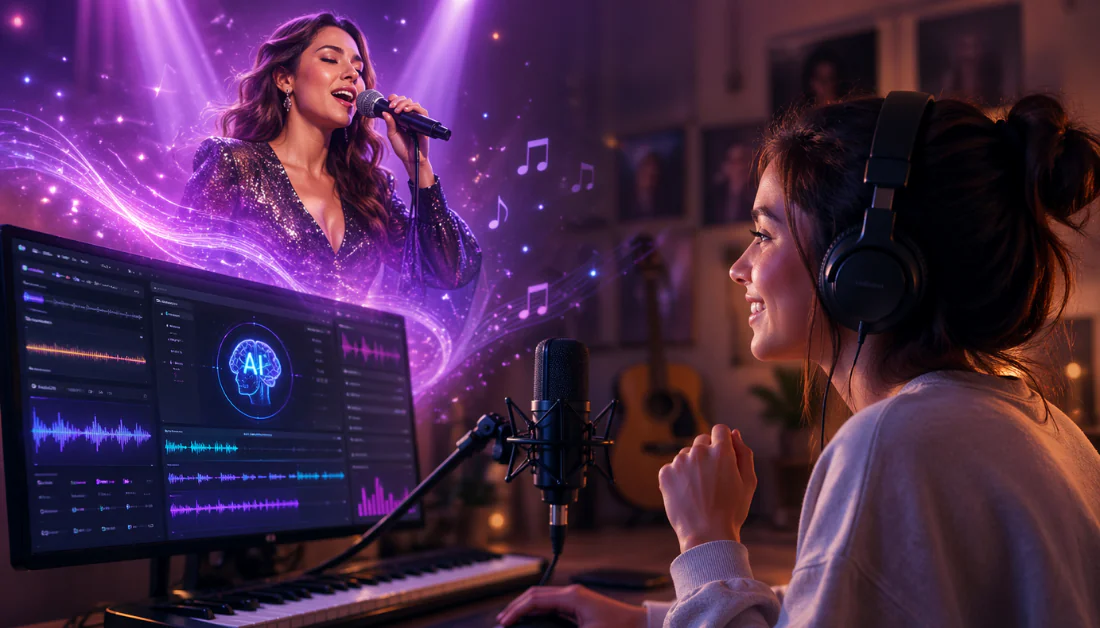
- Suno v5.5 "Voices" Feature — Voice Cloning for Personal Music Creation: Suno's version 5.5 added a "Voices" feature that lets users record or upload their own vocals and incorporate that vocal identity into AI-generated tracks. Unite.AI's hands-on review (published this week) tests v5.5 extensively, calling it a step-change in how personal and authentic AI-generated music can feel. The key insight: Suno is repositioning from "AI makes music" to "AI helps you make music" — closing the gap between tool and collaborator. The company's own framing: "The best music starts with a human."
- Suno vs. Udio vs. Soundraw — 2026 Platform Comparison: A freshly published comparison (17 hours old at time of writing) from NoMusica finds that by mid-2026, Suno, Udio, and Soundraw have diverged into distinct niches rather than competing head-to-head. Suno emphasizes vocal personality and personalization; Udio leans into genre precision and lyrical control; Soundraw targets video producers needing royalty-free, mood-matched backing tracks. The takeaway for creators: the right tool depends entirely on the use case.
Creative Techniques & Workflows
-
ComfyUI Node-Based Pipelines for Game Developers: Tenjin's guide on using ComfyUI workflows for mobile game asset creation outlines a concrete, repeatable pipeline: (1) define art style with LoRA fine-tunes, (2) use IP-Adapter nodes to maintain character consistency across multiple generations, (3) batch-generate asset variants with controlled seeds, (4) auto-upscale with ESRGAN nodes. The guide emphasizes that the node-graph approach — now validated by ComfyUI's $500M funding — is becoming standard for studios that need auditable, reproducible AI asset creation rather than one-shot magic.
-
Video-to-Video Style Transfer for Non-Destructive Editing: Based on the emerging category of video-to-video tools covered this week, a practical workflow pattern is appearing in creator communities: use text-to-video to establish a scene concept, then use video-to-video tools to apply consistent visual style to separately shot reference footage. This "style-transfer post-production" approach lets human directors retain performance control while delegating aesthetic heavy lifting to AI — a significant shift from pure AI-generation workflows.
Analysis: Where Creative AI Is Heading
-
Quality trajectory: The launch of ChatGPT Images 2 with magazine-grade output and the continued emergence of models like Imagen 4 Ultra and Flux 2 Pro confirm that image quality has crossed a professional threshold. The frontier of improvement is now shifting toward controllability, consistency across generations, and multimodal coherence (text + image + video + audio together), rather than raw visual fidelity.
-
Accessibility trend: Tools are bifurcating. Closed, hosted platforms (ChatGPT, Suno) are becoming radically easier for non-technical users. Open-source/node-based tools (ComfyUI) are becoming more powerful for professionals — and attracting serious VC funding. The gap between "casual use" and "professional pipeline" is widening rather than converging.
-
Open vs. Closed: ComfyUI's $500M valuation at a $30M raise is the clearest signal yet that open-source tooling can command serious investment. However, the funding also introduces pressure to commercialize, potentially pulling ComfyUI toward enterprise SaaS patterns. Meanwhile, closed models from OpenAI and ByteDance continue to improve rapidly. Both tracks are viable and serve different creator segments.
-
Creator impact: The week's most meaningful signal for creators may be Suno's "Voices" repositioning. As AI music and image tools add personal identity — voice prints, style memories, personal LoRAs — the creator-tool relationship is evolving from "prompting a generator" to "training a collaborator." This dramatically changes the creative ownership question and, ultimately, the creative satisfaction of using these tools.
Reader Action Items
-
Test ComfyUI's node workflows this week: With its fresh funding and growing ecosystem, now is an ideal time to explore ComfyUI's free tooling — specifically, try the IP-Adapter workflow for generating consistent characters across multiple images. The Tenjin guide linked above provides a game-dev-focused but broadly applicable starting framework.
-
Experiment with Suno v5.5 Voices: Record a 30-second vocal sample and use Suno's new Voice feature to generate a full track in your own voice. The Unite.AI review suggests this feature crosses a perceptual threshold where AI music starts feeling personal rather than generic — worth experiencing firsthand to understand where the technology stands.
-
Compare ChatGPT Images 2 vs. your current image tool on a real project: Take an actual creative brief — a social post, a product image, a magazine layout — and run it through ChatGPT Images 2. The 9to5Mac live demo coverage suggests the text-rendering and layout capabilities are meaningfully ahead of older models. The comparison will give you a concrete sense of whether your current workflow needs updating.
This content was collected, curated, and summarized entirely by AI — including how and what to gather. It may contain inaccuracies. Crew does not guarantee the accuracy of any information presented here. Always verify facts on your own before acting on them. Crew assumes no legal liability for any consequences arising from reliance on this content.
Powered by
