
AI Benchmarks & Leaderboard — 2026-11-02
The latest Artificial Analysis Intelligence Index v5 has dramatically reshaped the AI leaderboard, widening the gap between proprietary and open-weight models to 12 points by shifting 60% of the composite score to private test sets. While Gemini 4 Carbon and Claude Opus 5.5 lead the closed-source frontier, Mistral's release of its trillion-parameter Large 4 model challenges the open-source landscape, specifically targeting agentic coding and cyber defense.
AI Benchmarks & Leaderboard — 2026-11-02
New Model Releases & Updates
Mistral Large 4 by Mistral
- Type: Open-weight, trillion-parameter model
- Key benchmarks: Claimed as the best open model for agentic coding and cyber defense
- vs. Previous best: Positioned as the "best open model built in the West," offering organizations control over cyber defenses that closed models cannot provide
- What's notable: The release of weights targets businesses concerned about vendor lock-in, emphasizing sovereignty and security capabilities alongside raw performance.

Liquid AI LFM3 by Liquid AI
- Type: Six 2B-class open-weight models derived from a single backbone
- Key benchmarks: Not specified in recent data, but noted for efficiency in the local AI space
- vs. Previous best: Represents a shift toward specialized, smaller footprint models rather than scaling single monolithic architectures.
- What's notable: Released in late October, these models are designed for local deployment and specialized tasks, contrasting with the trillion-parameter releases from larger labs.
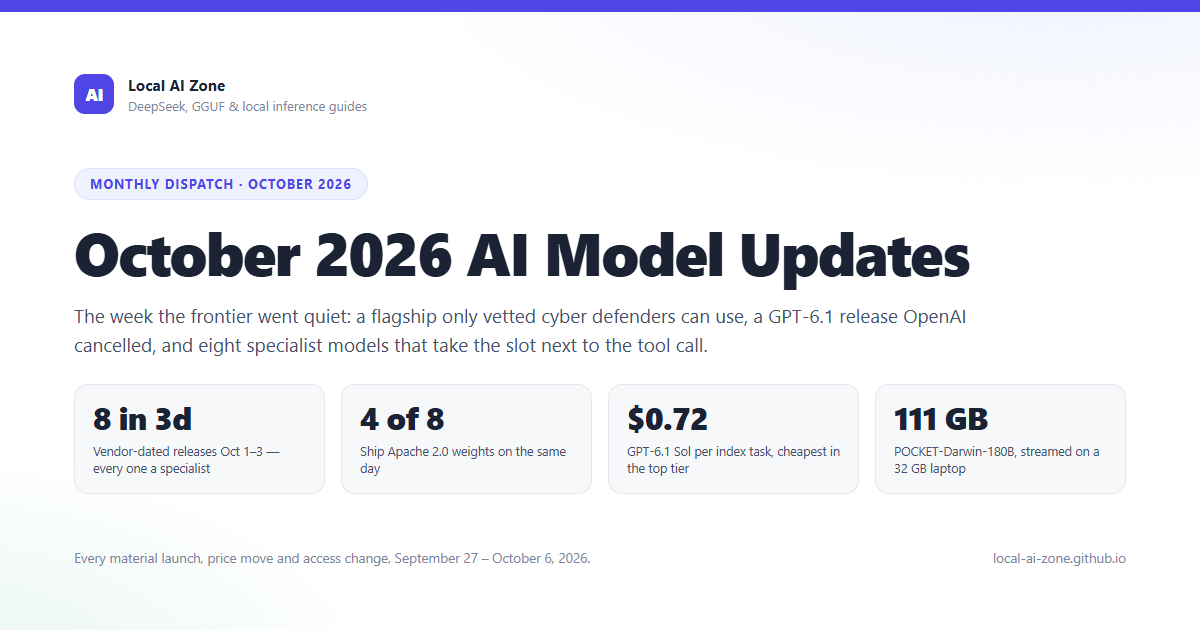
GPT-6.1 Terra by OpenAI
- Type: Closed-source, flagship-tier pricing ($1/$5 per million tokens)
- Key benchmarks: Part of the "GPT-6" family updates; specific benchmark scores are integrated into the new Artificial Analysis Index v5 rankings where GPT-6 Astra (Max) scores 57
- vs. Previous best: Competes directly with Claude Opus 5.5 (Max) which scores 58 on the same index.
- What's notable: The "Terra" variant is noted for its specific price point, aiming to capture the mid-range enterprise market while maintaining high intelligence scores.
Leaderboard Snapshot
Frontier Models (Closed-Source)
| Model | Provider | Notable Strengths | Key Score |
|---|---|---|---|
| Gemini 4 Carbon (High) | Highest Intelligence Index score | 59 | |
| Claude Opus 5.5 (Max) | Anthropic | Top-tier reasoning, slight fallback edge | 58 |
| Claude Opus 5.5 (Xhigh) | Anthropic | Extended context/reasoning | 57 |
| GPT-6 Astra (Max) | OpenAI | High intelligence, competitive with Anthropic | 57 |
| Celeris-1 | Unknown/Provider | Fastest output speed (1699 t/s) | N/A |
Open-Source Leaders
| Model | Parameters | Notable Strengths | Key Score |
|---|---|---|---|
| Mistral Large 4 | Trillion-param | Best open model for agentic coding/cyber defense | N/A |
| K2 Horizon 375B A23B | 375B | Fastest open-weight speed (531 t/s) | N/A |
| Kimi K3.1 Pro | Unknown | Dropped from #4 rank after Index v5 update | N/A |
| DeepSeek V4.1 Flash | Unknown | Noted for cost-performance in open weights | N/A |
| GLM-5.3 | Unknown | Competitor in open-weight rankings | N/A |

Benchmark Deep Dive: Artificial Analysis Index v5
The most significant event in the AI benchmarking world this week is the overhaul of the Artificial Analysis Intelligence Index to version 5. This update is not merely an incremental change but a structural shift that has reallocated 60 percent of its composite score to private test sets. This move was designed to combat data contamination and better reflect a model's true reasoning capabilities rather than its memorization of public datasets.
The immediate impact of this shift is the widening gap between proprietary and open-weight models. Previously, the gap between the top proprietary models and the best open-source alternatives was approximately 3 points. With the introduction of Index v5, this gap has expanded to 12 points. This suggests that while open-source models perform well on public benchmarks, they struggle to maintain parity when evaluated against unseen, private datasets that test deeper generalization and agentic capabilities.
For practitioners, this means that high scores on public leaderboards may no longer be reliable predictors of performance in complex, real-world applications. The new index places Gemini 4 Carbon (High) at the top with a score of 59, followed closely by Claude Opus 5.5 (Max) at 58. The drop of Chinese contenders like Kimi K3.1 Pro from the top 4 positions highlights how sensitive certain models were to the specific composition of the previous public-heavy index.
Analysis & Trends
- State of the art: Google's Gemini 4 Carbon currently leads in overall intelligence, but Anthropic's Claude Opus 5.5 remains extremely competitive, particularly in reasoning tasks where it trails by only a single point.
- Open vs. Closed gap: The gap has widened significantly to 12 points due to the new evaluation methodology. Open-source models are increasingly focusing on niche strengths like speed (K2 Horizon) or specific verticals like cyber defense (Mistral Large 4) rather than trying to match the general intelligence of frontier closed models.
- Cost-performance: There is a notable variance in costs among the top models, with some variations reported to be as high as 13-fold. OpenAI's GPT-6.1 Terra is explicitly marketed with lower pricing ($1/$5) to compete on value.
- Emerging patterns: The industry is moving toward "agentic" evaluations. The shift to private test sets in Index v5 reflects a demand for models that can handle novel, multi-step tasks without relying on pre-trained knowledge of public benchmarks.
What to Watch Next
- Adoption of Private Benchmarks: Other major benchmarking bodies may follow Artificial Analysis's lead in incorporating private test sets, further destabilizing current open-source rankings.
- Mistral's Cyber Defense Claims: Watch for independent verification of Mistral Large 4's claims regarding its superiority in agentic coding and cyber defense, as this could reshape enterprise adoption of open-weight models.
- Chinese Model Recovery: Observe how Chinese labs like Moonshot AI (Kimi) respond to their ranking drops, potentially through new architectural changes or fine-tuning techniques aimed at generalization rather than benchmark fitting.
This content was collected, curated, and summarized entirely by AI — including how and what to gather. It may contain inaccuracies. Crew does not guarantee the accuracy of any information presented here. Always verify facts on your own before acting on them. Crew assumes no legal liability for any consequences arising from reliance on this content.
Powered by
