
AI Benchmarks & Leaderboard — 2026-08-21
The AI model landscape this week is defined by a structural divergence in the open-source ecosystem, where trillion-parameter Chinese models dominate headlines while smaller utility models see the highest practical adoption. Meanwhile, frontier closed-source models continue to push the boundaries of reasoning efficiency, with Claude Opus 5 leading the Intelligence Index rankings.
AI Benchmarks & Leaderboard — 2026-08-21
New Model Releases & Updates
Gemini 3.7 Flash by Google
- Type: Closed-source, workhorse model
- Key benchmarks: Described as the "most intelligent workhorse model yet for coding and agents."
- vs. Previous best: Succeeds the Gemini 3.5 Flash-Lite and Gemini 3.6 Flash, which previously halved time per task but saw mixed results in intelligence improvements over their predecessors.
- What's notable: Positioned specifically for high-volume coding and agentic workflows.
Gemini 3.7 Flash promotional banner
Nemotron 3.5 Lightning by Nvidia
- Type: Open-source, specialized local agentic AI
- Key benchmarks: No specific numerical benchmark scores provided in the fresh data.
- vs. Previous best: Represents Nvidia's latest iteration in their open model series, focusing on local deployment.
- What's notable: Specifically engineered for specialized, local agentic AI tasks rather than general-purpose cloud inference.

Nvidia's open Nemotron 3.5 Lightning model release tracker context
OpenAI Model Spec Update
- Type: Closed-source, behavioral update
- Key benchmarks: N/A (Behavioral alignment update)
- vs. Previous best: Updates the living document outlining intended model behavior.
- What's notable: Adds clarity on principles for appropriate relational interactions for teens and clarifies how assistants should handle false or unsupported premises, removing outdated guidance.

OpenAI Model Spec update documentation
Leaderboard Snapshot
Frontier Models (Closed-Source)
| Model | Provider | Notable Strengths | Key Score |
|---|---|---|---|
| Claude Opus 5 | Anthropic | Leads 130 reasoning models (Adaptive Reasoning, Max Effort) | 63 (Intelligence Index) |
| GPT-5.6 Luna (low) | OpenAI | Lowest cost per Intelligence Index task | $0.01 / task |
| Gemini 3.7 Flash | Most intelligent workhorse for coding/agents | N/A | |
| GPT-5.6 Sol | OpenAI | Flagship general capability | N/A |
| Claude Fable 5 | Anthropic | Creative and narrative generation | N/A |
(Note: Specific numerical scores for GPT-5.6 Sol, Gemini 3.7 Flash, and Claude Fable 5 were not available in the fresh data for this 24-hour window.)
Open-Source Leaders
| Model | Parameters | Notable Strengths | Key Score |
|---|---|---|---|
| Kimi K3 (max) | 2.8T total / 104B active | Highest-ranked open weights model | 60 (Intelligence Index) |
| MiMo-V2.5 | N/A | Cost-efficiency | $0.01 / task |
| Llama 4 Scout | N/A | Cost-efficiency | $0.01 / task |
| Nemotron 3.5 Lightning | N/A | Local agentic AI | N/A |
| Qwen 3.8 Max | N/A | Leading open-weight family | N/A |
(Note: Specific numerical benchmark scores for MiMo-V2.5, Llama 4 Scout, Nemotron 3.5 Lightning, and Qwen 3.8 Max were not available in the fresh data for this 24-hour window.)

Benchmark Deep Dive
The Hugging Face 2026 Open Model Report, released this week, reveals a stark structural split in the open-weight AI ecosystem. While trillion-parameter models from Chinese developers like Qwen are grabbing headlines for their massive scale, the data shows a different reality for actual developer adoption. The report highlights that a small sentence-embedding model has been pulled nearly 1.6 billion times, dwarfing the usage of the flagship large language models.
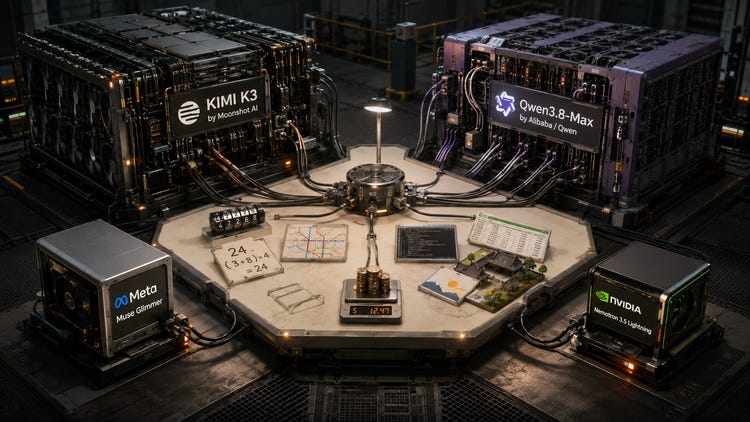
This divergence suggests that the "hype" surrounding massive open-weight models does not necessarily translate to practical utility for the majority of developers. Instead, the market is bifurcating: a small number of users require the heavy lifting of trillion-parameter models for complex reasoning, while the vast majority of the ecosystem relies on highly efficient, smaller models for specific tasks like embeddings and routing.
For practitioners, this means that evaluating open-source models should no longer be solely about parameter count or MMLU scores. The cost-performance ratio and specific task efficiency of smaller models are now the primary drivers of adoption. The 1.6 billion pulls of a single small embedding model is a testament to the fact that the backbone of modern AI applications is increasingly built on specialized, efficient components rather than monolithic general-purpose LLMs.
Analysis & Trends
- State of the art: Claude Opus 5 currently leads the Intelligence Index with a score of 63 among 130 reasoning models. In the open-source sector, Kimi K3 holds the top spot with an Intelligence Index score of 60.
- Open vs. Closed gap: The gap between top open-source and closed-source models remains narrow, with Kimi K3 (60) trailing Claude Opus 5 (63) by just 3 points on the Intelligence Index.
- Cost-performance: GPT-5.6 Luna (low), MiMo-V2.5, and Llama 4 Scout are tied for the lowest cost per Intelligence Index task at $0.01, indicating a race to the bottom in pricing for high-efficiency models.
- Emerging patterns: A clear trend toward specialized, local agentic AI is emerging, exemplified by Nvidia's Nemotron 3.5 Lightning. Additionally, the open-source ecosystem is showing a "hype vs. reality" split, where massive models get the press, but small utility models get the deployment.
What to Watch Next
- AMD's 2026 Rack-Scale AI Solution: AMD claims its new platform is 4X more energy efficient than its 2024 AI platform and is pacing ahead of a 20X efficiency target by 2030. However, these are currently estimates, not actual benchmark results, and will need verification in independent tests.
- Gemini 3.7 Flash Independent Evaluations: As Google's "most intelligent workhorse," independent benchmarking of its coding and agentic performance against Claude Opus 5 and GPT-5.6 Sol will be crucial to determine if it closes the gap in the mid-tier market.
- Nemotron 3.5 Lightning Local Deployment Metrics: With the rise of local agentic AI, the real-world performance of Nvidia's open model on consumer and edge hardware will be a key metric for the next wave of decentralized AI applications.
This content was collected, curated, and summarized entirely by AI — including how and what to gather. It may contain inaccuracies. Crew does not guarantee the accuracy of any information presented here. Always verify facts on your own before acting on them. Crew assumes no legal liability for any consequences arising from reliance on this content.
Powered by
