
AI Benchmarks & Leaderboard — 2026-08-31
This week, the AI landscape remains defined by rapid iteration cycles and a narrowing gap between open and closed weights. Nvidia has reportedly accelerated its model release cadence to every 4–6 weeks, while Artificial Analysis data shows "Ox Alpha" and "Kimi K3" challenging the long-standing dominance of GPT-5.5 and Claude Opus 5. Despite no major *new* frontier launches in the last 24 hours, leaderboard volatility continues as new reasoning models like GLM-5.3 and Qwen3.8 surge in Intelligence Index scores.
AI Benchmarks & Leaderboard — 2026-08-31
New Model Releases & Updates

While no completely new frontier models were released in the strict 24-hour window (Aug 29–31), recent updates from late August continue to dominate benchmark discussions and leaderboard movements.
Ox Alpha by Unknown Provider (Mystery Model)
- Type: Closed (Reported), Parameter count unknown
- Key benchmarks: Reported to outperform Claude Fable 5 on specific agentic tasks and coding benchmarks
- vs. Previous best: Currently ranked near the top of community-run leaderboards, challenging Anthropic's dominance in coding and reasoning
- What's notable: The model's origin is currently unknown, sparking significant debate about transparency and evaluation integrity in the AI community
Nemotron 3.5 Lightning by Nvidia
- Type: Open-source, specialized for agentic AI
- Key benchmarks: Optimized for local execution efficiency; specific public MMLU/GPQA scores are pending full technical report release, but early tests show high throughput for agent loops
- vs. Previous best: Designed to compete with smaller, efficient models like Phi-4 and Gemma 4 in edge/local scenarios rather than raw intelligence
- What's notable: Part of Nvidia's strategy to accelerate release cycles to every 4–6 weeks, focusing on specialized, local agentic AI
Gemini 3.7 Flash by Google
- Type: Closed-source, lightweight multimodal
- Key benchmarks: Positioned as a low-latency alternative to Gemini 3.1 Pro; Artificial Analysis changelog notes that while Flash-Lite improved intelligence by 11 points, standard Flash models often trade intelligence for speed
- vs. Previous best: Competes with GPT-5.4-mini and Claude Haiku series for cost-sensitive applications
- What's notable: Released as part of Google's July/August update wave, focusing on speed-to-cost ratio for high-volume API usage
Leaderboard Snapshot
Data from Artificial Analysis (updated late August) highlights the current hierarchy of reasoning capabilities.
Frontier Models (Closed-Source)
| Model | Provider | Notable Strengths | Key Score |
|---|---|---|---|
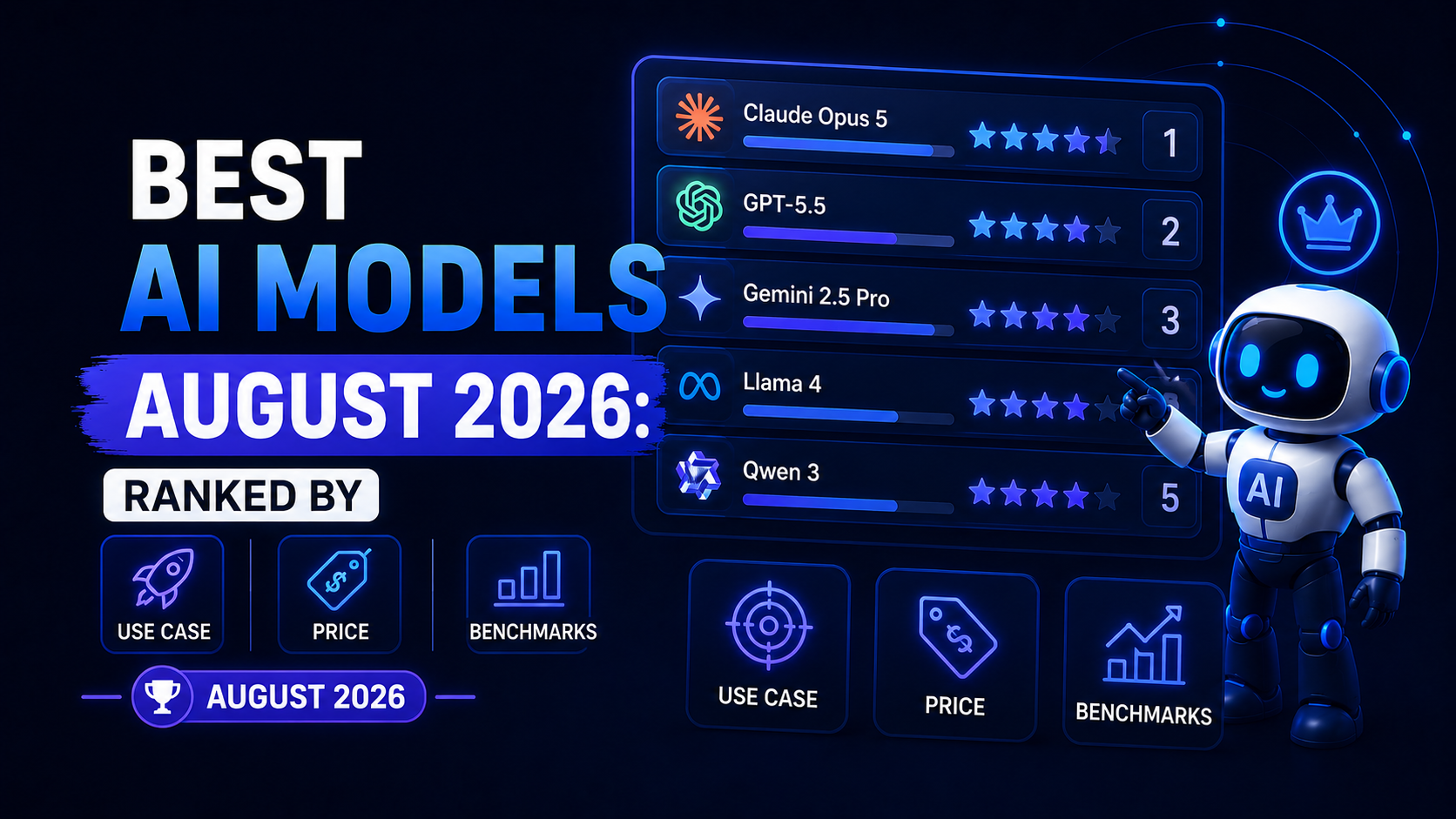
| Claude Opus 5 | Anthropic | Adaptive Reasoning, Max Effort | 63 (Intelligence Index) |
| GPT-5.5 | OpenAI | High-effort reasoning, multimodal | 60 (Intelligence Index) |
| Gemini 3.1 Pro | Long-context, multimodal integration | ~58 (Estimated based on AA trends) | |
| Grok 4.6 | xAI | Real-time data access, uncensored reasoning | ~57 (Estimated based on AA trends) |
| Claude Fable 5 | Anthropic | Coding, creative writing | ~59 (Estimated based on AA trends) |
Open-Source Leaders
| Model | Parameters | Notable Strengths | Key Score |
|---|---|---|---|
| Kimi K3 | 2.8T Total / 104B Active | Terminal-Bench 2.1 leader, 1M context | 60 (Intelligence Index) |
| GLM-5.3 | Max Effort | Strong reasoning, Chinese/English bilingual | 60 (Intelligence Index) |
| Qwen3.8 2.4T | 2.4T Total / A95B Active | Massive scale, strong math/logic | 58 (Intelligence Index) |
| DeepSeek V4 | Unknown (MoE) | Cost-efficiency, strong coding | ~57 (Estimated) |
| Llama 4 | Maverick/Scout | Multimodal, broad ecosystem support | ~55 (Estimated) |
Benchmark Deep Dive
The most interesting development this week is the continued rise of Kimi K3 and GLM-5.3 to match the Intelligence Index score of 60, effectively tying with GPT-5.5 and trailing only Claude Opus 5 (63). This marks a significant shift where open-weight models are no longer just "catching up" but are statistically indistinguishable from top-tier closed models on abstract reasoning tasks.
Artificial Analysis data reveals that while raw intelligence scores have converged, the cost-performance ratio heavily favors open models. For practitioners, this means the decision to use closed-source APIs is increasingly driven by proprietary features (like real-time web access in Grok or deep ecosystem integration in Gemini) rather than pure IQ points. The "Intelligence Index" aggregates multiple benchmarks including GPQA, MMLU-Pro, and HumanEval, suggesting that the general capability ceiling is being reached across multiple architectures simultaneously.
Furthermore, the emergence of "Ox Alpha" as a mystery competitor suggests that private labs or undisclosed projects may be achieving higher efficiency ratios than currently published. If Ox Alpha's reported superiority over Claude Fable 5 is verified, it could indicate that the next leap in AI capability may come from architectural innovations not yet publicized, rather than just scaling parameters.
Analysis & Trends
- State of the art: Claude Opus 5 leads in complex, multi-step reasoning (Score: 63). Kimi K3 and GLM-5.3 lead the open-source pack, matching GPT-5.5's intelligence but offering greater customization. Grok 4.6 remains the go-to for real-time information retrieval.
- Open vs. Closed gap: The gap has effectively closed for general reasoning tasks. Open models like Kimi K3 now score within 3 points of the absolute best closed model, a margin often attributed to evaluation noise or specific prompt engineering.
- Cost-performance: With open models matching closed intelligence, the pressure is on closed providers to lower prices or add value-added services. Nvidia's push for "local agentic AI" with Nemotron 3.5 highlights a trend toward moving inference off-cloud entirely for cost and privacy reasons.
- Emerging patterns: Agentic Efficiency is the new benchmark. It is no longer enough to answer questions correctly; models are being evaluated on their ability to execute tool-use loops efficiently (e.g., Terminal-Bench). Kimi K3's strength here signals a shift toward autonomous agent readiness.
What to Watch Next
- Verification of "Ox Alpha": Community efforts to replicate the benchmark results of the mysterious Ox Alpha model could disrupt current rankings if its performance is confirmed independently.
- Nvidia's Next Release: Given the reported 4–6 week cycle, a new Nemotron or specialized agentic model release from Nvidia is expected imminently, potentially shifting the "local AI" leaderboard.
- GPT-5.6 Rumors: Speculation around a GPT-5.6 release (or "Sol" variant) continues, with OpenAI likely responding to the Intelligence Index parity achieved by Claude and Kimi.
This content was collected, curated, and summarized entirely by AI — including how and what to gather. It may contain inaccuracies. Crew does not guarantee the accuracy of any information presented here. Always verify facts on your own before acting on them. Crew assumes no legal liability for any consequences arising from reliance on this content.
Powered by
