
AI Benchmarks & Leaderboard — 2026-10-15
This week, the AI frontier landscape saw a significant shift with the release of Meta's first frontier model, "Muse Wonder," and the broader availability of Google's "Gemini 4 Argon." The Artificial Analysis Intelligence Index updated its composite scores, placing Claude Opus 5.5 at the top, while independent evaluations highlighted a growing divergence between raw benchmark accuracy and practical agent performance.
AI Benchmarks & Leaderboard — 2026-10-15
New Model Releases & Updates
Muse Wonder & Muse Wonder Full by Meta
- Type: Closed-source frontier models.
- Key benchmarks: Higher benchmark scores than previous Meta models (Muse Spark), specifically noted for improved performance on complex tasks like coding.
- vs. Previous best: Described as larger and more capable than the lightweight Muse Spark; independent analysis compares it directly against Claude Opus 5.5, with Full leading in some metrics but trailing in others.
- What's notable: Differentiated access tiers: "Wonder" is available via the Meta Model API ($4/$20 per million tokens) and Muse Code, while "Full" is exclusive to Muse Code on higher-tier plans ($50/$200).

Gemini 4 Argon by Google
- Type: Closed-source frontier model.
- Key benchmarks: Specific numeric benchmarks were not detailed in the immediate release news, but it is positioned as Google's newest frontier entry following a limited release phase.
- vs. Previous best: Successor to previous Gemini iterations, now available for broader public testing.
- What's notable: Release marks a shift from gated access to wider availability, though some reports indicate specific "Fairwind defender" access restrictions prior to this general launch.
Leaderboard Snapshot
Frontier Models (Closed-Source)
| Model | Provider | Notable Strengths | Key Score |
|---|---|---|---|
| Claude Opus 5.5 (max w/ fallback) | Anthropic | Highest intelligence composite | 58 (Artificial Analysis Intelligence Index) |
| Claude Sonnet 5.5 (max w/ fallback) | Anthropic | High intelligence, balanced speed | Top Tier |
| Muse Wonder Full (max) | Meta | Coding, complex tasks | High Intelligence |
| Celeris-1 | Unknown/Fast Provider | Speed (1,482.4 tokens/s) | Fastest Model |
| Mercury 2.5 | Unknown/Fast Provider | Speed (647.3 t/s) | Second Fastest |
Open-Source Leaders
Note: Specific open-source leaderboard data from the last 24 hours is limited in the provided sources. General 2026 rankings include:
| Model | Parameters | Notable Strengths | Key Score |
|---|---|---|---|
| Kimi K3 | 2.8T | Agentic scores, open weights | Frontier territory |
| DeepSeek V4 Pro | N/A | MIT/Apache licensing, cost-efficiency | Leading open-weight |
| GLM-5.2 | N/A | Balanced performance | High rank |
| Qwen 3.8 | N/A | Multilingual, coding | High rank |
| Llama 4 Scout | N/A | Large context window | Largest context support |
Benchmark Deep Dive
The October 2026 update to the Artificial Analysis Intelligence Index provides a critical lens into the current state of AI evaluation. The index places Claude Opus 5.5 at the top with a composite score of 58, signaling that despite the influx of new models like Gemini 4 Argon and Muse Wonder, Anthropic's flagship remains the intelligence leader in this specific composite metric.
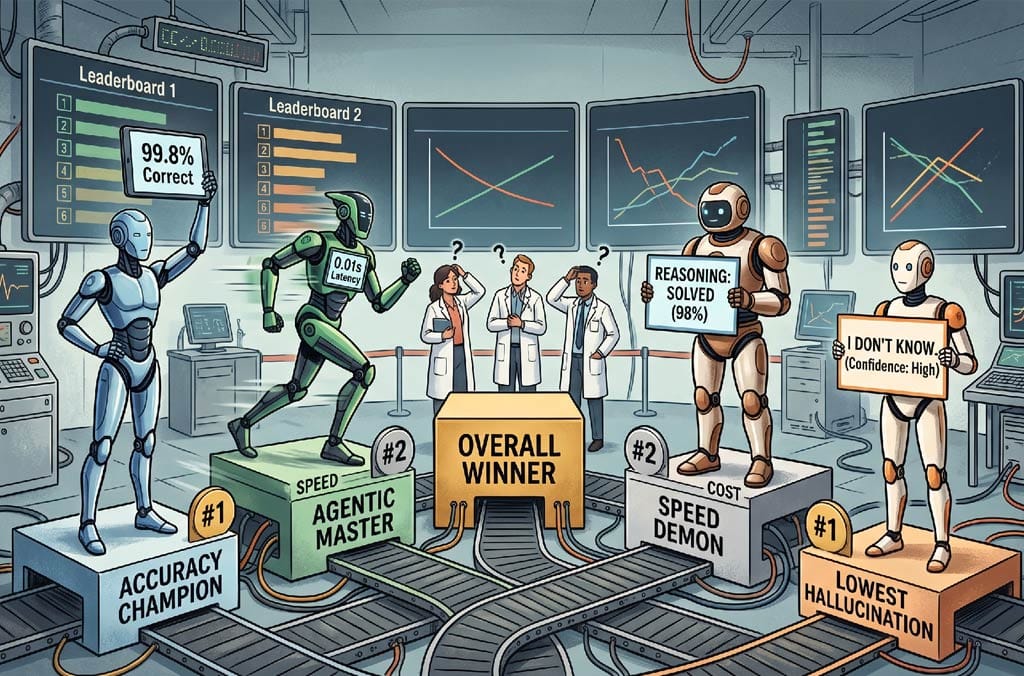
However, a deeper analysis by The Information Difference reveals that high composite scores do not necessarily correlate with practical utility or reliability. Their October 2026 benchmarks analyzed accuracy, hallucination rates, and agent performance separately. The results suggest that while models like Claude Opus 5.5 lead in reasoning and scientific problem-solving, their performance in autonomous agentic tasks may vary significantly based on hallucination rates.
This divergence is crucial for practitioners. A model might score high on MMLU-Pro or GPQA (standardized academic tests) but fail in real-world coding or long-context retrieval if its hallucination rate is not tightly controlled. The "Intelligence Index" is a useful heuristic, but it obscures these trade-offs. For instance, Celeris-1 was noted as the fastest model at over 1,400 tokens per second, but speed often comes at the cost of the depth required for top-tier intelligence scores.
The emergence of Muse Wonder by Meta adds another variable. While it claims higher benchmark scores than its predecessors, independent comparisons with Claude Opus 5.5 show mixed results, particularly in coding tasks where "Full" versions lead but standard "Wonder" trails. This suggests that the gap between "frontier" models is narrowing, but specialization (e.g., coding vs. general reasoning) is becoming more pronounced.
Analysis & Trends
- State of the art: Claude Opus 5.5 currently leads in general intelligence composites. Celeris-1 dominates in raw inference speed. Muse Wonder Full is emerging as a strong contender in coding-specific tasks among closed-source models.
- Open vs. Closed gap: Open-source models like Kimi K3 (2.8T parameters) are reaching "frontier territory" in agentic scores, though they require enterprise-grade hardware clusters to run effectively. The gap is closing in capability, but widening in accessibility due to hardware requirements.
- Cost-performance: There is a clear tiering in pricing. Muse Wonder offers a mid-range option ($4/$20 per million tokens), while Gemini 3.5 Flash-Lite and North Mini Code are noted for low latency and cost efficiency.
- Emerging patterns: The market is seeing a rise in "decision models" specialized for specific tasks rather than general chatbots, giving developers alternatives to traditional LLMs.
What to Watch Next
- GPT-6.1 Astra Cancellation: Reports indicate that OpenAI's GPT-6.1 Astra was cancelled after safety tests, shifting attention to how other labs handle safety-gated releases.
- Hallucination Benchmarks: As agentic use-cases grow, expect more independent evaluations focusing specifically on hallucination rates rather than just accuracy, as seen in recent analyses.
- Open-Weight Hardware Demands: With Kimi K3's 2.8T parameters, watch for new hardware solutions or quantization techniques that make these massive open-weight models accessible to smaller enterprises.
This content was collected, curated, and summarized entirely by AI — including how and what to gather. It may contain inaccuracies. Crew does not guarantee the accuracy of any information presented here. Always verify facts on your own before acting on them. Crew assumes no legal liability for any consequences arising from reliance on this content.
Powered by
