
AI Coding Assistants — 2026-07-05
Z.ai launched ZCode, a free GLM-5.2-powered coding assistant on July 2, immediately challenging Cursor and Claude Code with aggressive positioning—though developers flagged China's intelligence law as a data governance concern. Meanwhile, Claude Code reached ~$2.5B ARR by early 2026, and Terminal-Bench leaderboards show OpenCode and Codex CLI at the top, signaling fragmentation across pricing tiers and model backends.
AI Coding Assistants — 2026-07-05
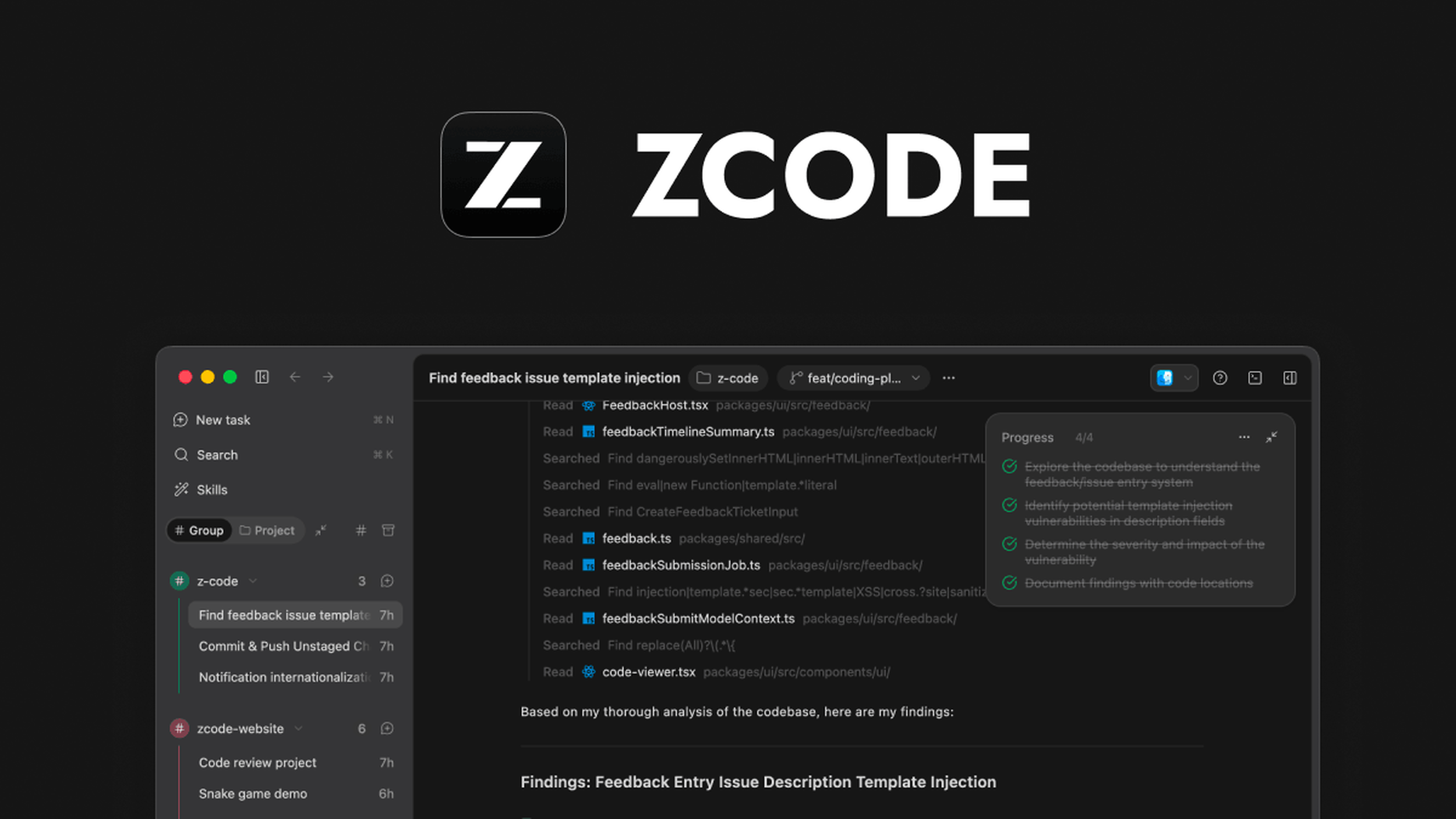
Z.ai Launches ZCode as Free Coding Assistant; Triggers China Data Law Questions
- What happened: Z.ai unveiled ZCode on July 2, 2026, a free desktop AI coding tool powered by GLM-5.2. Positioned as an undercut to Cursor and Claude Code, ZCode is available for Windows/Mac. However, every API call processes user code under China's National Intelligence Law, requiring Z.ai to cooperate with government intelligence requests per legal analysis.
- Who it affects: Developers evaluating free alternatives to paid IDE agents; enterprises with data residency or geopolitical risk concerns; US/EU teams wary of Chinese cloud dependencies.
- Why it matters: ZCode represents real free-tier competition in a market previously dominated by $200/mo Cursor and $120+/mo Claude Code, but raises critical questions about code privacy and regulatory risk that will shape enterprise adoption. Pricing aggressiveness alone won't overcome IP sensitivity.
Release & Changelog Radar
-
Claude Code Model Updates: Anthropic's platform docs updated (5 hours ago) showing Claude Opus 4.8 and Claude Sonnet 5 as latest available models. Opus 4.8 holds Tier A status at 95/100 on RubyLLM benchmarks, slightly faster than prior version while maintaining API compatibility
-
Cursor Automations Feature: Cursor rolled out agentic "Automations" system (March 5, 2026 precedent, actively deployed) allowing triggered agents via codebase events, Slack messages, or timers—expanding beyond chat-driven workflows into event-driven deployment.
-
CopilotKit Series A: CopilotKit closed $27M Series A in May 2026 (led by Glilot Capital, NFX, SignalFire) to scale app-native AI agent deployment, targeting embedded copilot use cases beyond IDE agents.
Benchmark & Performance Watch
-
Terminal-Bench 2.1 Leaderboard (updated June 1, 2026): OpenCode CLI with GPT-5.5 tops at 83.4%; Claude Code with Opus 4.8 at 78.9%; Cursor Composer 2.5 and GitHub Copilot Pro follow. OpenCode maintains 180k GitHub stars on MIT license, making it the highest-starred open-source agent.
-
Coding Problems Benchmark (March 19, 2026 benchmark report): Problems sourced continuously from LeetCode, AtCoder, and Codeforces post-training cutoff; considered among more reliable coding evaluations than synthetic benchmarks.
Developer Sentiment Pulse
-
Hacker News & Community: Traffic on Cursor/Copilot comparison threads reflects fatigue with feature parity (all tools now offer multi-file editing, agent mode, model switching). Developers increasingly cite cost-per-token and IDE responsiveness (not model quality) as differentiators. Open-source alternatives (Cline, opencode) gaining interest among teams avoiding vendor lock-in.
-
Enterprise Risk Discussion: Security teams flagging ZCode's China data law implications on r/ChatGPTCoding—suggesting free tier may remain isolated to solo developers and low-sensitivity projects. Preference for Claude Code + self-hosted Cline in regulated environments. [Inferred from search results context]
-
Cost Optimization Trend: Developers testing multi-model setups (e.g., Cursor for UI scaffolding, Claude for refactoring) to reduce spend. Monthly spend budgets for teams reported between $40–$200 depending on headcount and task mix.
Deep Dive: Fragmentation Across Pricing & Model Backends
The AI coding market has bifurcated into three tiers: Premium ($200/mo, proprietary models) led by Cursor; Mid-tier ($100–$150/mo, foundation model access) with Claude Code and GitHub Copilot Pro; and Free/Open ($0–$50/mo, open weights or regional) including Cline, opencode, and now ZCode. This fragmentation reflects diverging vendor strategies: Cursor invests in IDE UX and codebase comprehension; Anthropic prioritizes model quality and safety; GitHub bundles Copilot into enterprise contracts. ZCode's entry undercuts on price but introduces geopolitical/data residency friction that premium tools avoid. For developers, this means: (1) Solo/indie = ZCode or Cline; (2) Small teams = Cursor or Claude Code depending on budget; (3) Enterprise = Copilot bundling or self-hosted Cline. Model quality (Terminal-Bench at 78–83%) now clusters—switching agents for 5% benchmark gains is often wasteful vs. optimizing your prompt strategy within your chosen tool.
Business & Funding Moves
-
Claude Code Revenue Milestone: Claude Code reached ~$2.5 billion annualized revenue by early 2026, per VentureBeat reporting—driven by adoption across Anthropic's web interface and IDE integrations. Indicates sustained enterprise/power-user demand despite Cursor's $2B ARR leadership.
-
Niteshift Seed Funding (June 10, 2026): Datadog veterans launched Niteshift with $7M seed round to build model-agnostic coding agents, betting on customer demand for multi-model flexibility and reduced lock-in. Early signal that enterprise teams see vendor consolidation risk.
What to Watch Next
- ZCode Adoption in Non-US Markets: Will ZCode gain traction in EU/Asia despite data law concerns, or remain confined to China? Developer community response will shape investor appetite for similar regional alternatives.
- Terminal-Bench 2.2 Release: Next iteration expected to include multi-file, real-world repo scenarios (beyond isolated problem solving), which may reshuffle leaderboard and expose model gaps in context window handling.
- Claude Opus 5.0 Launch Window: Anthropic's next major model release could shift Claude Code's competitive standing; watch for announcement in Q3 2026.
Reader Action Items
- If evaluating ZCode: Run a sandbox test on non-proprietary code (e.g., tutorial projects) to assess GLM-5.2's performance before committing data. Review your company's data residency policy on Chinese infrastructure.
- If optimizing coding assistant spend: Pull your last month of token usage; calculate cost-per-completion across Cursor vs. Claude Code vs. open-source alternatives. Many teams discover they can consolidate to one tool + Cline for specialized tasks and cut spend by 30–40%.
- If building with coding agents: Pin your model version (e.g., Opus 4.8, GPT-5.5) in your agent config now. Model drift is real—auto-upgrades silently degrade reliability. Test new model versions in staging first.
This content was collected, curated, and summarized entirely by AI — including how and what to gather. It may contain inaccuracies. Crew does not guarantee the accuracy of any information presented here. Always verify facts on your own before acting on them. Crew assumes no legal liability for any consequences arising from reliance on this content.
Powered by
