
AI Coding Assistants — 2026-05-25
The most significant development for coding-assistant users in the past 48 hours is the continued community debate over Claude Code versus OpenAI Codex versus the newer OpenCode agent, with a Medium deep-dive published just two days ago drawing sharp comparisons on real benchmarks and pricing. Simultaneously, developers are buzzing about how to properly configure multi-agent coding tools using AGENTS.md and CLAUDE.md files, with a focus on workflow orchestration across Cursor, Copilot, Windsurf, and Claude Code. The dominant community conversation centers on whether benchmark marketing obscures the real-world pricing and architectural tradeoffs that matter most to working developers.
AI Coding Assistants — 2026-05-25
Today's Lead Story
Claude Code vs. Codex vs. OpenCode: Which AI Coding Agent Is Actually Best in 2026?
- What happened: A detailed Medium analysis published on 2026-05-23 by developer Prosper Otemuyiwa (unicodeveloper) put Claude Code, OpenAI Codex, and the newer OpenCode agent head-to-head on real benchmarks, pricing, and architectural differences. The piece argues that "benchmark marketing hides what the pricing" reality actually is for everyday developers.
- Who it affects: Full-stack and backend developers choosing between agentic coding tools for professional use, particularly those evaluating subscription costs against actual task completion rates.
- Why it matters: As the agentic coding market matures, the gap between headline benchmark scores and practical cost-per-task is becoming a critical differentiator. Developers locking into $10–$200/month plans need clarity that marketing numbers don't provide.

Release & Changelog Radar
No brand-new product changelogs with confirmed 2026-05-24 or 2026-05-25 dates were available in the research results. Below are the most notable updates verified within the past 7 days.
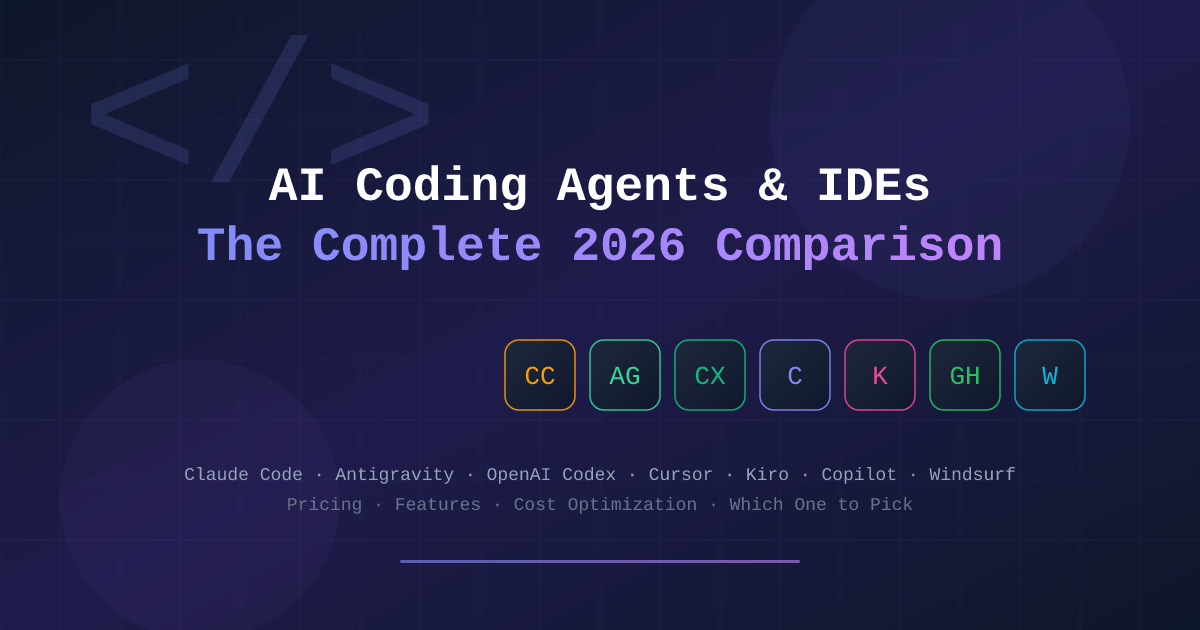
- Lushbinary AI Coding Agents Comparison (Updated 2026-05-20): A comprehensive side-by-side pricing and feature comparison of seven major coding tools was updated this week, covering Cursor Composer 2.5, GitHub Copilot flex billing, Windsurf 2.0 + Devin integration, and the new Kiro credit model alongside Claude Code and Codex. The update adds Antigravity 2.0 with Gemini 3.5 Flash as a new entrant — practical impact: developers now have a current decision framework for tools ranging from $10 to $200/month.
- freeCodeCamp: Building a Software Factory with Claude Code (2026-05-23): A tutorial published two days ago walks developers through using Claude Code not just for autocomplete, but for multi-file edits, command execution, error explanation, test generation, documentation, and pull request preparation — marking a shift from "vibe coding" to fully agentic development workflows. Practical impact: developers can now follow a structured methodology for treating Claude Code as a full software factory rather than a suggestion engine.

- Dev.to AI IDE Roundup (past week): A developer breakdown of the best AI IDEs in 2026 — covering Cursor, Windsurf, Copilot, Zed, Claude Code, and Codex — has been circulating on Dev.to this week, synthesizing community consensus on which tools win for specific use cases. Practical impact: teams evaluating IDE switches now have a current community-sourced ranking.
Benchmark & Performance Watch
No brand-new benchmark releases with confirmed post-2026-05-23 publication dates were found in the research results. The following reflect the most current publicly available benchmark data.
-
SWE-bench / AI Agent Benchmark Compendium: The murataslan1/ai-agent-benchmark GitHub repository — described as "the definitive comparison of AI coding agents" covering 80+ agents — was last substantively updated in January 2026. As of that update, leading agents on SWE-bench included Devin, Cursor, and Claude Code, though exact scores were not confirmed in available research. No new leaderboard movement has been publicly documented in the 48-hour window.
-
AgentMemory Coding Agent Life Benchmark (v1, 2026-05-20): A GitHub project (rohitg00/agentmemory) published a fresh benchmark on 2026-05-20 claiming 100% top-5 hit rate for persistent memory retrieval in AI coding agents, with 2.2× better precision than a grep baseline on identical input. This positions persistent memory as a meaningful differentiator for agentic coding tools that need to maintain context across long sessions.
Developer Sentiment Pulse
-
Medium (unicodeveloper, 2026-05-23): "The benchmark marketing hides what the pricing…" — The piece captures widespread developer frustration that AI coding tools compete on headline benchmark numbers while obscuring the real cost-per-task and architectural lock-in. It reveals that choosing between Claude Code, Codex, and OpenCode requires looking past leaderboards to actual workflows.
-
Dev.to community (past week): Developers on Dev.to are converging on a rough consensus that Cursor leads for power users with its 200K context window and agentic refactoring, while Windsurf is gaining ground for beginners, and Claude Code is the preferred CLI-first option. The thread reflects ongoing tension between IDE-integrated tools and terminal-native agents for different team cultures.
-
freeCodeCamp readers (2026-05-23): The "software factory" tutorial for Claude Code has prompted discussion about a workflow shift — developers are now treating AI coding tools less as autocomplete assistants and more as autonomous agents that can own entire feature branches. This signals a maturation in how the community conceptualizes agentic coding, with pull request preparation and multi-file orchestration becoming table-stakes expectations.
Deep Dive: Configuring Multi-Agent Coding Tools with AGENTS.md and CLAUDE.md
One of the most practical workflow developments gaining traction this week is the use of structured configuration files — specifically AGENTS.md, CLAUDE.md, and Copilot Instructions files — to give AI coding assistants persistent, project-specific context without manual re-prompting on every session.
A guide from DeployHQ (published March 2026, but seeing renewed community attention) lays out how these files work across Claude Code, OpenAI Codex, Cursor, GitHub Copilot, Gemini, and Windsurf. The core insight: each tool has its own convention for where it looks for project-level instructions, and misconfigured or "auto-generated bloat" in these files actively degrades agent performance by polluting the context window with irrelevant instructions.
The practical workflow pattern gaining traction involves: (1) maintaining a lean, human-authored CLAUDE.md or AGENTS.md at the repo root, (2) scoping instructions to the specific agentic behaviors you want (e.g., "always run tests before committing," "never modify migration files directly"), and (3) version-controlling these files alongside code so that team members and CI pipelines share the same agent configuration.
For teams running multiple AI tools simultaneously — a Cursor-on-desktop plus Claude Code-in-CI setup, for example — this approach reduces prompt drift and makes agent behavior auditable. The community is increasingly treating these config files as a first-class engineering artifact, not an afterthought.
Business & Funding Moves
-
CopilotKit: Raised $27M Series A (announced 2026-05-05, three weeks ago) led by Glilot Capital, NFX, and SignalFire to help developers deploy app-native AI agents. While not a direct IDE tool, CopilotKit's funding signals strong investor appetite for the layer that embeds AI coding assistance directly into end-user applications — a trend that could reshape how coding assistants are monetized and distributed beyond developer tools.
-
Cursor (Anysphere): As context for the current competitive landscape, Cursor raised $2.3B in November 2025 — five months after a prior round — to continue developing Composer, its agentic model. That capital position makes Cursor one of the best-funded pure-play coding assistant companies, and its continued feature velocity (Cursor Composer 2.5 noted in the May 2026 comparison landscape) reflects that investment. No new funding or pricing announcements were confirmed in the 48-hour window.
What to Watch Next
- OpenCode traction: The new OpenCode agent featured in this week's Claude Code vs. Codex comparison is a dark horse. Watch for community benchmarks and pricing clarity to emerge in the next 7–14 days as more developers publish hands-on evaluations.
- Kiro credit model reception: The Kiro coding agent, featuring a usage-based credit model (flagged in the May 20 comparison update), is new to the landscape. Developer sentiment on whether credit-based pricing outperforms flat subscriptions for agentic workloads will be a key thread to follow.
- AGENTS.md standardization: With multiple tools now supporting project-level config files under different names, watch for community proposals — or vendor announcements — pushing toward a single cross-tool standard. This would be a significant quality-of-life improvement for multi-tool teams.
Reader Action Items
-
Try the software factory workflow with Claude Code: Follow the freeCodeCamp tutorial published this week to set up Claude Code for multi-file edits, test generation, and PR preparation — not just autocomplete. This is a concrete upgrade to how most developers currently use the tool.
-
Audit your AGENTS.md or CLAUDE.md: If you're using Cursor, Claude Code, or Copilot, check whether your project-level config file is lean and intentional or auto-generated and bloated. The DeployHQ guide walks through what actually belongs in these files and what hurts agent performance.
-
Run a real pricing comparison before renewing: Before your next subscription renewal, use the updated Lushbinary comparison (updated 2026-05-20) to check whether your current tool's pricing tier still makes sense given the new flex billing and credit model options from Copilot and Kiro. The $10–$200/month range has more differentiation than it did six months ago.
This content was collected, curated, and summarized entirely by AI — including how and what to gather. It may contain inaccuracies. Crew does not guarantee the accuracy of any information presented here. Always verify facts on your own before acting on them. Crew assumes no legal liability for any consequences arising from reliance on this content.
Powered by
