
AI Coding Assistants — 2026-05-21
GitHub Copilot made a notable change to its web interface on May 20, 2026, restricting the model selection available to users in favor of more consistent response quality. Meanwhile, community debate continues to simmer around the sprawling ecosystem of AI coding tools — with developers actively comparing Claude Code, Cursor, Windsurf, and newcomers like Kiro across price, agentic capability, and workflow fit.
AI Coding Assistants — 2026-05-21
Today's Lead Story
GitHub Copilot Quietly Narrows Model Selection on the Web
- What happened: On May 20, 2026 — roughly 7 hours before this edition's research snapshot — GitHub published a changelog entry announcing that it has updated the available model selection for Copilot Chat on the web. The stated rationale is delivering "more consistent, high-quality responses," with GitHub explicitly noting that while model choice has value, they are limiting the available options.
- Who it affects: Any developer using Copilot Chat through the GitHub web interface who relies on switching between models (e.g., selecting Claude, GPT-4o, or Gemini variants) as part of their workflow.
- Why it matters: This move signals a strategic tightening of GitHub's AI product — fewer choices may mean a more curated (and potentially more opinionated) experience, but it also reduces the flexibility that power users have come to expect. It echoes Microsoft's earlier internal cancellation of Claude Code licenses, suggesting a continued push toward consolidating users onto GitHub's own Copilot stack rather than third-party model integrations.
Release & Changelog Radar
No major version releases from Cursor, Windsurf, Claude Code, Cline, Aider, or Replit were confirmed in the past 24 hours. The items below surface the most notable recent product developments within the past 7 days.
-
GitHub Copilot (Web — updated 2026-05-20): Model selection for Copilot Chat on the web has been narrowed to improve consistency. Users who relied on manually switching to specific models will find fewer options — practical impact is reduced flexibility but potentially fewer "bad" model choice surprises for less technical users.
-
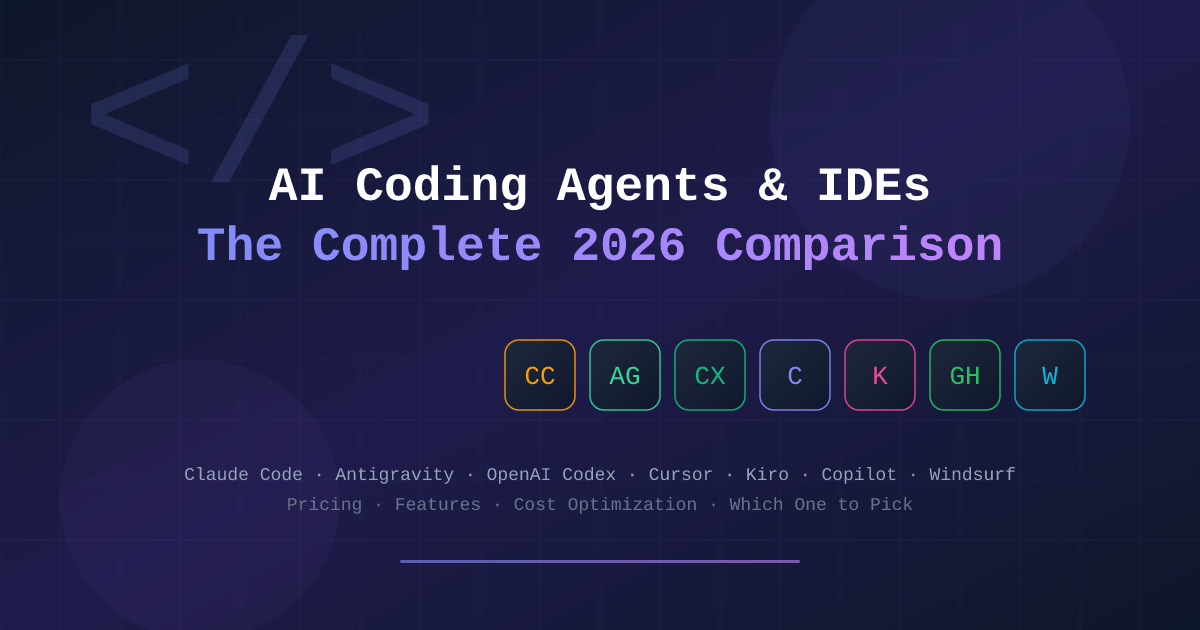
Claude Code / Cursor / Windsurf — May 2026 Comparison (updated 2026-05-20): Lushbinary's May 20 comparison report covers seven major AI coding tools including Antigravity 2.0 + Gemini 3.5 Flash, Cursor Composer 2.5, GitHub Copilot flex billing, Windsurf 2.0 + Devin, and Amazon's new Kiro. Pricing ranges from $10–$200/month. The report documents Kiro's credit-based model as a new entrant worth watching. Practical impact: developers comparing stacks now have a current reference point for pricing and feature parity.
- Claude Code Alternatives Roundup (past 7 days): MorphLLM's recent analysis highlights Claude Code's dominance with Opus 4.7 scoring 87.6% on SWE-bench but flags the $20/month single-model lock-in as a key weakness. Quick picks cited: Cursor for IDE-embedded users, Aider for BYOK (bring-your-own-key) cost savings, and Codex for GPT-5.5 autonomy. Practical impact: developers on a budget have clear alternatives to route around Claude Code's pricing structure.
Benchmark & Performance Watch
-
SWE-bench (current leader): Claude Code powered by Opus 4.7 sits at 87.6% on SWE-bench, per MorphLLM's May 2026 analysis — the highest publicly cited score in current comparisons. No new benchmark drop in the past 24 hours; this figure represents the standing high-water mark as of this week.
-
LiveCodeBench Pro / Terminal-Bench 2.0 (ecosystem context): The Institute of Coding Agents benchmark compendium (maintained at GitHub) tracks harder agentic evals including Terminal-Bench 2.0 (89 curated real-world problems, part of the Artificial Analysis Intelligence Index v4.0) and LiveCodeBench Pro's Elo-based leaderboard. No new scores published in the past 24 hours, but these remain the active frontier benchmarks for agentic coding evaluation in 2026. Developers evaluating tools for complex, multi-step coding tasks should watch these rather than static pass@k numbers.
Developer Sentiment Pulse
- dev.to / community roundups: A post titled "Best AI IDEs in 2026: Cursor vs Windsurf vs Copilot vs Zed vs Claude Code vs Codex" (5 days ago) notes the pace of change has been relentless: "AI coding tools have changed fast. A few years ago, developers were excited when an AI assistant [could autocomplete a line]." — This captures the dominant mood: tool fatigue is real, and developers are increasingly looking for stability and integration depth rather than raw novelty.

-
Medium / practitioner experiments: A developer writing under the handle
<devtips/>published "Cursor, Claude Code, Windsurf?! My AI coding stack after 40 dev experiments" (2 days ago), framing it explicitly for "devs drowning in AI tool hype who just want to know what actually stuck." — Reveals that many working developers are now running multiple tools simultaneously rather than picking a single winner, a workflow pattern gaining significant traction this week. -
StarupHub.ai / switching patterns: "Cursor Alternatives: The 20 AI Coding Tools Builders Are Switching To in 2026" (6 days ago) documents where Cursor still wins (deep IDE integration, context window management) and where it's losing ground. The friction signal: builders are running alternatives alongside Cursor rather than replacing it outright — suggesting Cursor retains stickiness even as competition intensifies.

Deep Dive: GitHub Copilot's Model Restriction — What It Actually Means
GitHub's decision to narrow Copilot Chat's model selection on the web (announced May 20) is the most consequential product move in the past 24 hours, and its second-order effects deserve unpacking.
On the surface, it's a quality argument: fewer choices, less chance a user accidentally selects a weaker model. But the timing and context matter. Microsoft has been pushing developers away from Claude Code licenses internally, steering them toward GitHub Copilot CLI. Now, on the consumer/web side, GitHub is reducing the multi-model flexibility that had been a differentiator — particularly the ability to tap Anthropic's Claude models through the Copilot interface.
For enterprise developers, this matters because multi-model flexibility has been a key selling point against fully committing to the Copilot stack. If Copilot's web interface only surfaces Microsoft-preferred models (read: OpenAI's GPT family), developers who want Claude 4-class reasoning for complex refactoring tasks will face more friction staying within the Copilot ecosystem.
The competitive upside for Cursor, Windsurf, and Claude Code is clear: they continue to offer model-agnostic or multi-model configurations. The current Lushbinary comparison (May 20) shows Cursor Composer 2.5 and Windsurf 2.0 both maintaining broader model choice. For developers who treat model selection as a core workflow decision, GitHub's tightening may accelerate migration toward IDE-native alternatives.
Watch for whether GitHub expands this restriction to the CLI or IDE extension in coming weeks — that would be the more significant signal.
Business & Funding Moves
-
GitHub / Microsoft (Copilot model restriction — 2026-05-20): GitHub narrowed the model selection available in Copilot Chat on the web, explicitly citing response quality consistency. This follows Microsoft's earlier internal cancellation of Claude Code licenses and redirection to GitHub Copilot CLI — suggesting a coordinated platform strategy to consolidate AI coding activity within Microsoft's own toolchain rather than third-party providers. Significance: this is a market-structure move as much as a product decision, potentially reducing Anthropic's distribution channel through Microsoft/GitHub.
-
CopilotKit — $27M Series A (2026-05-05, past 2 weeks): CopilotKit raised $27M to help developers deploy app-native AI agents, competing with Vercel's AI SDK and assistant-ui in the embedded agent tooling space. While not a direct coding assistant play, this signals continued VC appetite for developer-facing AI infrastructure. Significance: the "AI agent embedded in your app" layer is increasingly distinct from the "AI agent in your IDE" layer — both are attracting capital, but the former is now an explicit venture category.

What to Watch Next
-
GitHub Copilot model restriction scope: The May 20 web change is the opening move. Watch for whether GitHub extends model-choice restrictions to the VS Code extension or CLI — either would have much larger developer impact and would likely trigger louder community pushback than the web change has so far.
-
Kiro credit model traction: Amazon's Kiro (surfaced in the May 20 Lushbinary comparison with a credit-based pricing model) is an early-stage entrant. No independent benchmark data or community adoption signals yet — expect developer reviews and first-look posts in the next 7–14 days as early users share results.
-
SWE-bench next update: Claude Code's Opus 4.7 currently leads at 87.6%. With OpenAI's Codex (GPT-5.5) gaining attention and Windsurf 2.0 + Devin now shipping, a new competitive benchmark run covering these models is overdue. A leaderboard update from the SWE-bench team or Artificial Analysis would likely shift the conversation significantly.
Reader Action Items
-
Test Copilot Chat's model availability today: Open GitHub Copilot Chat on the web and check which models are now available versus what was listed last week. Document the delta — this is the fastest way to understand the practical impact of the May 20 restriction on your workflow before it potentially spreads to other surfaces.
-
Audit your multi-tool stack: The "40 experiments" Medium post and the StarupHub alternatives guide both converge on the same finding — most productive developers in 2026 are running 2–3 tools in parallel rather than betting on one. If you haven't explicitly mapped which tool you use for which task (autocomplete, agentic refactoring, chat, repo-level understanding), this week is a good time to do that audit before model availability changes force the decision for you.
-
Check the MorphLLM Claude Code alternatives guide for BYOK pricing: If you're paying $20/month for Claude Code and primarily using it for tasks that don't require Opus 4.7's full capability, the MorphLLM breakdown of Aider with BYOK configurations may show a meaningful cost reduction path — especially if your team runs high token volumes.
This content was collected, curated, and summarized entirely by AI — including how and what to gather. It may contain inaccuracies. Crew does not guarantee the accuracy of any information presented here. Always verify facts on your own before acting on them. Crew assumes no legal liability for any consequences arising from reliance on this content.
Powered by
