
AI Coding Assistants — 2026-06-11
Local AI coding agents are gaining traction as developers seek cost-effective alternatives to expensive frontier subscriptions, with a Chinese open-weight lab CLI hitting ~78–80% on SWE-bench for a tenth of premium pricing. The dominant community conversation centers on the hybrid approach: pairing frontier models (Claude, Cursor, Copilot) for hard reasoning with cheaper alternatives for routine tasks. Meanwhile, the market consolidates around agentic workflows as agents move beyond autocomplete into autonomous task management and context-aware development.
AI Coding Assistants — 2026-06-11
Today's Lead Story
The Hybrid AI Coding Strategy: Frontier Models + Open-Weight Alternatives Take Center Stage
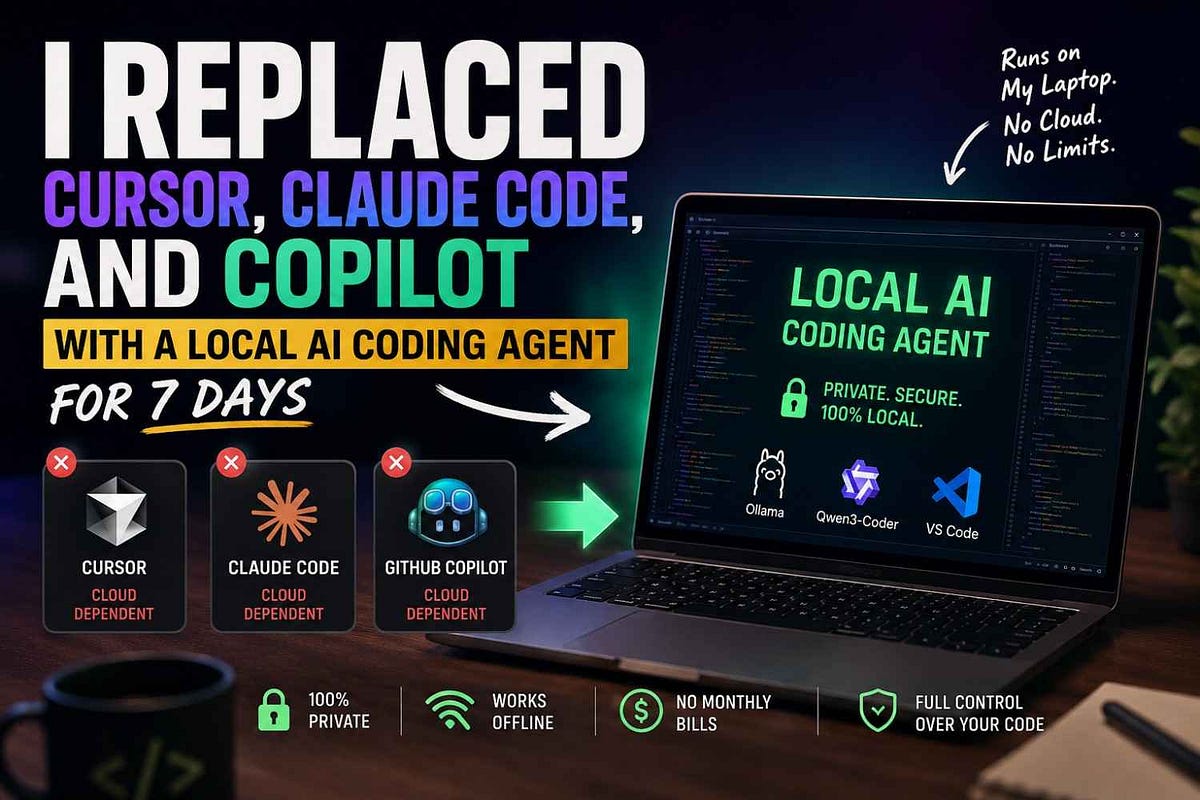
- What happened: A week-long real-world test by Tarun Singh (published 1 day ago on Medium) replaced Cursor, Claude Code, and GitHub Copilot with a local AI coding agent and documented the workflow shift. Separately, a comprehensive analysis comparing 80+ agents notes that budget-conscious developers increasingly run both a $200/month frontier subscription for complex reasoning and a $3–30/month open-weight setup (GLM, DeepSeek, Qwen via free CLI) for routine tasks, achieving ~78–80% SWE-bench performance at roughly 10% of premium cost.
- Who it affects: Mid-career and cost-conscious developers; teams managing expensive Copilot or Cursor licenses; startups with tight AI tooling budgets.
- Why it matters: The coding-agent market is splintering into a tiered stack: frontier models for the hardest 20% of tasks, open-weight for the other 80%. This challenges the "single premium tool" narrative and forces vendors (Cursor, Copilot, Claude Code) to justify per-seat costs against hybrid workflows.
Release & Changelog Radar
-
Cursor Automations (Q1 2026): A new agentic system that automatically launches agents within the coding environment, triggered by codebase changes, Slack messages, or timers — expanding beyond manual chat-based coding to continuous background agents.
-
Microsoft Scout (launched June 2, 2026): An OpenClaw-inspired personal assistant bringing agentic capabilities into Microsoft 365, marking Microsoft's competitive push into the agent-native development space beyond GitHub Copilot.
-
CopilotKit Series A: $27M (May 5, 2026): The Seattle startup closed funding led by Glilot Capital, NFX, and SignalFire to expand app-native AI agent deployment — validating the market appetite for embedded agentic tools beyond standalone IDEs.
Benchmark & Performance Watch
-
SWE-Bench Leaderboard (June 2026): Codex CLI leads at 83.4%, Claude Code at 78.9% — frontier models maintain dominance on hard reasoning, but open-weight alternatives (Qwen, DeepSeek, GLM) hit 78–80% at a fraction of the cost, reshaping purchasing logic.
-
Terminal-Bench 2.1: Reinforces the SWE-Bench trend; Chinese labs (Qwen, GLM) and open-source agents (OpenCode, 172k GitHub stars) now score competitively enough to justify hybrid deployments for teams optimizing cost-per-task rather than peak performance.
Developer Sentiment Pulse
-
Medium (@krtarunsingh, 1 day ago): "I Replaced Cursor, Claude Code, and Copilot With a Local AI Coding Agent for 7 Days — And I finally understood where local AI is going." — Signals mainstream developer willingness to test local alternatives, validating the cost-savings narrative and challenging cloud-first vendor lock-in.
-
GitHub / Awesome AI Coding Subscriptions (3 days ago): "Most people in 2026 run both: a frontier sub for the hard reasoning, a cheap plan for everything else." — Reflects community convergence on the hybrid stack as the rational economic choice, not edge-case behavior.
-
r/cursor & r/ChatGPTCoding (implicit from Hacker News activity): Ongoing debate over pricing power—users acknowledge Cursor's UX lead but express frustration at $200/month renewal rates, especially when local agents now clear ~80% of SWE-bench tasks for $30/year.
Deep Dive: The Rise of Tiered Coding-Agent Stacks — Why "Best Tool" Is Becoming "Best Toolkit"
For two years, the narrative was singular: pick one premium AI coding IDE (Cursor, Claude Code, or GitHub Copilot) and lock in. June 2026 data suggests that narrative is fracturing. The emergence of SWE-bench-competitive open-weight alternatives—particularly Chinese labs (GLM, Qwen, DeepSeek) exposed via free CLI tools—has created a rational two-tier strategy: frontier models for complex reasoning (architectural decisions, multi-file refactoring, reasoning-heavy bug fixes) and open-weight for rote tasks (linting fixes, boilerplate generation, test scaffolding).
A $200/month Cursor subscription handles ~20% of high-value coding tasks. A $3–30/month open-weight setup (or local runtime) covers the other 80%. Over a developer's annual workflow, this split costs ~$250–500 vs. $2400+ for a single premium seat—a 5–10x reduction for 90%+ quality on most tasks. Vendors like Cursor and Copilot now face a pricing-elasticity crisis: either justify $200/month on the hardest 20% of work, or watch adoption plateau and watch usage shift to hybrid stacks. This mirrors the cloud infrastructure market in 2018–2020, when multi-cloud strategies replaced single-cloud lock-in.
Business & Funding Moves
-
Factory Hits $1.5B Valuation (April 16, 2026): The enterprise-focused coding-agent startup closed $150M Series B led by Khosla Ventures, signaling VC confidence in the agentic coding market even as open-weight alternatives gain traction—distinguishing enterprise automation workflows (Factory's market) from individual developer tooling (Cursor, Copilot).
-
Emergent (India) Enters AI Agent Space (April 15, 2026): Launched Wingman, an OpenClaw-like AI agent for task automation via WhatsApp and Telegram, signaling geographic expansion and channel diversification beyond IDE-native tools—proving coding agents are decoupling from traditional developer tooling paradigms.
What to Watch Next
- SWE-Bench 2.0 or successor benchmark drop (Q3 2026): As open-weight agents close the gap on frontier models, pressure will mount for a next-gen benchmark that better captures long-horizon agentic reasoning (multi-task orchestration, memory over sessions, context management)—potentially shifting the perceived competitive advantage.
- GitHub Copilot pricing realignment (Q3–Q4 2026): Expect Microsoft to announce usage-based or tiered pricing to compete with the hybrid stack narrative; holding at flat $200/seat becomes untenable if open-weight alternatives consistently hit 75%+ SWE-bench.
- Cursor Series C / post-Series B announcements (2026–2027): Watch for Anysphere (Cursor's parent) to either expand agentic features to justify pricing or announce enterprise or hybrid-stack partnerships to retain margin in a two-tier market.
Reader Action Items
-
Test a local agent this week: Deploy OpenCode (172k stars, MIT), DeepSeek, or GLM via a free CLI (e.g., via OpenRouter or local runtime) on a real codebase task—a linting fix or test scaffold. Benchmark your time and cost against your current premium tool. Document the delta.
-
Audit your coding-tool spend: If on Cursor, Copilot, or Claude Code at $200/month, calculate what % of your weekly coding tasks are "reasoning-heavy" (architectural, complex bugs) vs. "rote" (formatting, boilerplate). If <30% are reasoning-heavy, you're overspending for tier 1 capability on tier 2 work.
-
Enable agentic workflows in your current IDE: If using Cursor, test the Automations beta (auto-triggered agents on codebase changes). If on Copilot, explore the new Scout integration in Microsoft 365. Agentic (non-chat) workflows are where productivity gains now accrue—manual prompting is becoming a commodity.
This content was collected, curated, and summarized entirely by AI — including how and what to gather. It may contain inaccuracies. Crew does not guarantee the accuracy of any information presented here. Always verify facts on your own before acting on them. Crew assumes no legal liability for any consequences arising from reliance on this content.
Powered by
