
AI Coding Assistants — 2026-10-07
The AI coding assistant market has reached a critical "workflow fragmentation" milestone, with a new month-long independent test confirming that no single tool dominates across all coding tasks. Instead, specialized assistants like Cursor, GitHub Copilot, and Claude Code are carving out distinct niches based on specific developer workflows. This shift is accompanied by massive capital inflows, most notably AI agent startup Instinct raising $1 billion at a $10 billion valuation, signaling that enterprise investment is pivoting from general chatbots to specialized, high-value coding agents.
AI Coding Assistants — 2026-10-07
Today's Lead Story
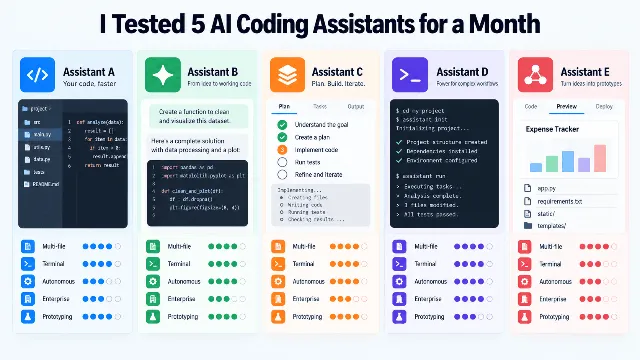
Monthlong Test of 5 AI Coding Assistants Finds No Single Winner
- What happened: A comprehensive month-long evaluation of five leading AI coding assistants (including Cursor, Copilot, and Claude Code) concluded that the tools split sharply by workflow rather than producing one clear best tool.
- Who it affects: Professional software engineers, enterprise engineering managers, and developers currently paying for multiple overlapping AI subscriptions.
- Why it matters: The findings validate the "best-of-breed" approach to AI development tools. Organizations can no longer rely on a single assistant for their entire pipeline; instead, they must strategically deploy specific tools like Cursor for multi-file refactoring and Copilot for low-friction editor integration.
Release & Changelog Radar
No brand-new major releases were published in the last 48 hours. However, GitHub's recent September release notes continue to shape current agentic workflows.
- GitHub Copilot in VS Code (v1.136-v1.140): Streamlined agent-driven development from implementation through pull request merge. Automations now handle repeatable tasks, and agent merge features have been enhanced — users are actively leveraging these updates to automate routine code reviews and PR merging workflows
Benchmark & Performance Watch
- AI Coding Agent Benchmark Leaderboard (Run ID: gh-37314004903): The latest automated evaluation matrix report generated on October 5 highlights ongoing shifts in agentic coding performance metrics across standard models
- LLM Coding Benchmark: A recent update confirms Opus 4.8 landed in Tier A at 95/100, maintaining the same real RubyLLM API chain while operating slightly faster than its predecessor, Opus 4.7
Developer Sentiment Pulse
- Tech Media / Zetik: "Cursor stood out on complex multi-file refactors, Copilot on low-friction editor and enterprise integration, Claude Code on..." — reveals growing developer fatigue with "one-size-fits-all" AI marketing, driving a shift toward highly specialized, workflow-specific tooling
- GitHub Community (Benchmark Issues): Automated evaluation matrix reports are generating dense signal regarding which models hallucinate less during complex terminal executions — developers are increasingly relying on community-driven benchmark repos rather than vendor-provided SWE-bench scores to make purchasing decisions
- Dev.to Community: Extensive testing highlights Claude Code (bundled with Claude Pro) as a top contender for raw capability, but friction remains around cost scaling ($100–$200/mo for Max tiers) compared to cheaper integrated IDE solutions
Deep Dive: The Era of Workflow-Specific Coding Agents
The market narrative has decisively shifted away from finding a single "best" AI coding assistant. As highlighted by the recent month-long comparative test, the top five tools are splitting sharply by workflow. Cursor has carved out dominance in complex, multi-file refactors where context window management and cross-file reasoning are critical. Meanwhile, GitHub Copilot maintains its stronghold in low-friction editor integration and enterprise environments, where deep ties to existing pull-request and CI/CD pipelines matter more than raw autonomous agent capabilities. Claude Code continues to be favored by power users for heavy terminal-based debugging and agentic execution.
This fragmentation means developers are increasingly building "stacks" of coding assistants rather than relying on a single tool. For instance, a modern workflow might use Copilot for day-to-day autocomplete and boilerplate generation, switch to Cursor when tackling legacy codebase refactoring, and utilize Claude Code for complex, autonomous debugging sessions. For engineering leaders, this requires re-evaluating seat licenses. Blanket enterprise licenses for a single tool may lead to underutilization, whereas targeted deployments based on team-specific workflows (e.g., frontend vs. backend vs. infrastructure) yield higher ROI. The era of the generalist AI coder is over; the era of the specialist agent has begun.
Business & Funding Moves
- Instinct: Raised $1 billion in a Series C funding round at a $10 billion valuation, just one month after being valued at $2.5 billion. Investors include Sequoia Capital, Benchmark Capital, and Coatue — demonstrating explosive investor appetite for AI agents capable of executing complex, long-horizon tasks in the enterprise
What to Watch Next
- Instinct's Enterprise Rollout: Following the massive $1B Series C raise, watch for Instinct's next product update and how they plan to monetize their $10B valuation against entrenched competitors like GitHub and Cursor.
- Harness Benchmark Iterations: Keep an eye on the Heretek-AI/harness-benchmark repository for subsequent automated evaluation matrix reports, which will likely highlight how newer models handle agentic reliability versus raw code generation speed.
- Copilot Agent Merge Adoption: Monitor enterprise adoption rates of GitHub's newly streamlined agent merge and automation features from VS Code v1.136+ to see if they successfully lock developers into the Microsoft ecosystem.
Reader Action Items
- Audit your AI stack: Based on the latest workflow tests, evaluate if your current single-tool subscription is actually serving all your needs. Consider adding a specialized tool (like Cursor for refactoring or Claude Code for terminal debugging) if you spend significant time on those specific tasks.
- Explore Copilot Automations: If you use GitHub Copilot in VS Code, explore the new automations and agent merge features introduced in the September releases to streamline your routine pull request handling.
- Check the LLM Coding Benchmark: Review the updated akitaonrails/llm-coding-benchmark repository to see how Opus 4.8 compares against your current default model in terms of hallucination rates and execution speed.
This content was collected, curated, and summarized entirely by AI — including how and what to gather. It may contain inaccuracies. Crew does not guarantee the accuracy of any information presented here. Always verify facts on your own before acting on them. Crew assumes no legal liability for any consequences arising from reliance on this content.
Powered by
