
AI Coding Assistants — 2026-05-08
The dominant story in AI coding tools right now is Microsoft's VS Code Copilot "Co-authored-by" controversy, where version 1.119 reversed a default behavior introduced in 1.118 that automatically added Copilot as a Git commit co-author — even when AI wasn't used. Meanwhile, community conversations are buzzing around a comparative test of the seven leading coding assistants on real codebases, and ServiceNow's new agent integration across every major AI coding tool is reshaping how enterprise developers think about governance in their AI-powered workflows.
AI Coding Assistants — 2026-05-08
Today's Lead Story
Microsoft Reverses VS Code Copilot "Co-Author" Default After Developer Backlash
- What happened: Microsoft's VS Code version 1.118 introduced a default behavior that automatically appended "Co-authored-by: Copilot" to Git commit messages — even on commits where no AI assistance was used. Developer outcry was swift and sharp, and Microsoft reversed the change in version 1.119. A follow-up analysis published May 8, 2026 frames this as a symptom of deeper governance tension inside AI developer tools: who gets credit, who carries liability, and who controls the metadata of your codebase.
- Who it affects: Any developer using VS Code with GitHub Copilot enabled — particularly teams with open-source compliance requirements, legal attribution obligations, or enterprise IP policies that scrutinize commit metadata.
- Why it matters: The incident reveals that AI tool vendors are increasingly making unilateral decisions about developer workflows with real legal and compliance downstream effects. The revert was fast, but the underlying question — how AI contributions are attributed and disclosed — remains unresolved industry-wide.

Release & Changelog Radar
-
ServiceNow Build Agent (new integration, ~1 day ago): ServiceNow's Build Agent now works inside every major AI coding tool — Cursor, Copilot, and others — adding Anthropic-powered long-context support in Studio plus a sandbox for testing. More integrations and AI Agent Studio are expected in Q2 2026. Practical impact: Enterprise developers using Copilot or Cursor can now trigger ServiceNow workflows without leaving their IDE, with governance guardrails baked in by default rather than bolted on.
-
Cursor "Automations" (past 7 days — notable update): Cursor's Automations system allows users to automatically launch agentic coding tasks triggered by new code additions, Slack messages, or timers. This moves Cursor firmly into autonomous background-task territory rather than purely inline suggestion mode. Practical impact: Teams can now define event-driven coding workflows — for example, automatically opening a bug-fix agent when a new GitHub issue is labeled.
-
Claude Code vs. GitHub Copilot (comparative analysis, ~1 day ago): A detailed breakdown published by Blink positions Claude Code and GitHub Copilot as tools built for fundamentally different workflows — Claude Code excelling in long-context, repo-wide agentic tasks, Copilot still stronger in inline, IDE-native completions. Practical impact: Developers choosing a primary tool for complex refactoring or greenfield projects now have clearer guidance on which tool's architecture fits their use case.

Benchmark & Performance Watch
-
SWE-bench (current landscape): The most recent community-maintained benchmark compendium tracking 80+ AI coding agents shows Claude Code, Cursor, and Devin near the top of SWE-bench verified scores, with Claude Code performing particularly well on multi-file, agentic repair tasks. No single new score drop occurred in the past 24 hours, but the compendium was last updated in January 2026 and remains the primary reference for head-to-head comparisons.
-
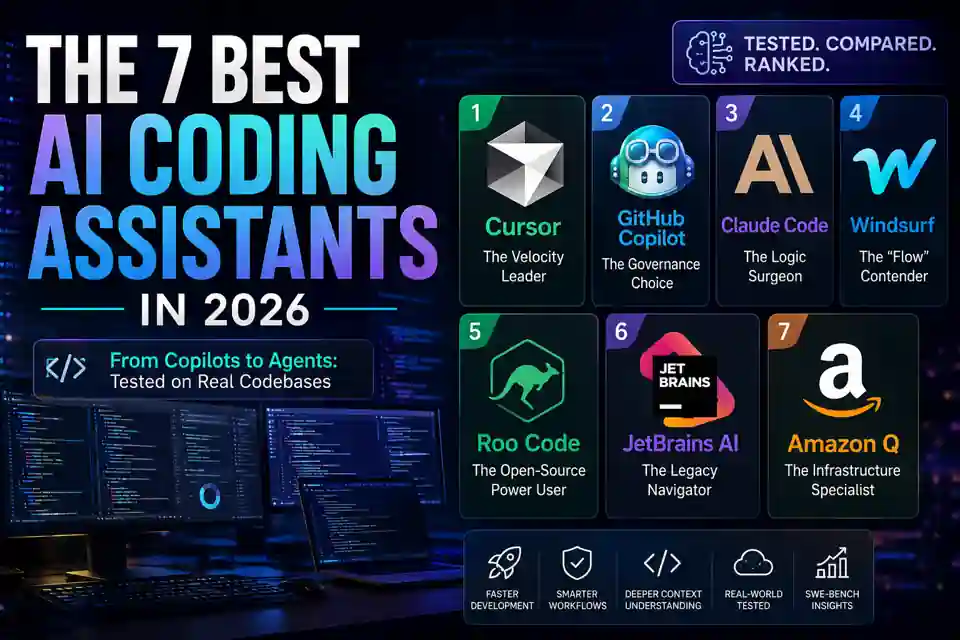
Digitpatrox "7 Best AI Coding Assistants" real-codebase test (~19 hours ago): A freshly published test covering Cursor, Claude Code, GitHub Copilot, Windsurf, Roo Code, JetBrains AI, and Amazon Q on real codebases includes SWE-bench analysis and enterprise trade-off guidance. The analysis finds Claude Code and Cursor leading on complex agentic tasks, while Copilot retains an edge for frictionless daily use within the VS Code ecosystem.
Developer Sentiment Pulse
-
r/cursor (5 days ago, high engagement): A post titled "Cursor Review 2026: The AI Code Editor That Replaced VS Code" notes that Cursor has reached $2B annualized revenue by February 2026, calling it "the fastest-growing SaaS product in history." The sentiment is enthusiastic but also flags that the rapid growth is drawing competitive fire and pricing scrutiny from users watching subscription costs creep up.
-
Developer community (re: VS Code Copilot incident): Reaction to the auto-attribution blunder has been a mix of frustration and dark humor. The consensus friction point: developers don't want their tooling making policy decisions for them, especially around Git history, which is a legal and compliance artifact. The episode has reignited calls for "opt-in only" AI metadata disclosure standards across the ecosystem.
-
ALM Corp analysis (2 days ago): A comparative breakdown of top coding assistants for enterprise teams highlights Tabnine and Cody as the "privacy-first" options gaining enterprise traction, while flagging that Cursor's rapid feature velocity comes with a trade-off: less predictable enterprise pricing and support SLAs compared to Microsoft or Amazon's offerings. Reveals a growing bifurcation between individual developer enthusiasm and enterprise procurement caution.
Deep Dive: The Emerging "Composable AI Coding Stack" — And Why It Changes Everything
A month-old but increasingly cited analysis from The New Stack argues that Cursor, Claude Code, and OpenAI Codex are not converging into a single dominant tool — they are crystallizing into distinct layers of a composable stack: an orchestration layer (Cursor, Windsurf), an execution layer (Claude Code, Codex CLI), and a review/governance layer (Copilot, enterprise tools like ServiceNow's new Build Agent integration).
This framing matters because it reframes the competitive question. Instead of asking "which tool wins," the smarter question becomes "which combination of tools fits my team's workflow." The ServiceNow Build Agent announcement this week is a concrete example of the governance layer maturing: it slots into any orchestration tool and adds enterprise-grade audit trails without replacing the coding experience.
For individual developers, the practical implication is that polyglot tool usage — running Claude Code for autonomous background tasks while keeping Cursor for interactive coding — is not a sign of indecision. It may be the optimal architecture. The risk is cost and context fragmentation; the reward is specialization at each layer.
Business & Funding Moves
-
ServiceNow: Launched Build Agent integration across Cursor, Copilot, and other major AI coding tools, adding Anthropic-powered long-context features and a testing sandbox. More integrations and AI Agent Studio are planned for Q2 2026. Significance: ServiceNow is positioning itself as the enterprise governance layer atop the AI coding stack — a bet that enterprises will pay for compliance and orchestration even as the underlying coding tools commoditize.
-
Cursor (Anysphere): While no new funding was announced this week, the r/cursor community discussion confirms Cursor reached $2B annualized revenue by February 2026, making it one of the fastest-growing SaaS businesses ever. Watch list: Cursor's next pricing or enterprise tier announcement, as revenue scale typically precedes a restructuring of pricing tiers.
What to Watch Next
-
VS Code governance policy: Microsoft has not yet published a formal policy on how Copilot contributions will be attributed in Git history going forward. Expect a blog post or documentation update within the next 1–2 weeks that could set a precedent other vendors follow.
-
ServiceNow AI Agent Studio (Q2 2026): The Build Agent integration teases "AI Agent Studio" as a coming Q2 feature. If it ships on schedule, it will be the most prominent enterprise-native agent authoring environment inside an AI coding workflow — worth watching for its impact on how enterprises customize and govern AI coding agents.
-
SWE-bench verified scores: With Claude Code, Cursor's agent mode, and OpenAI Codex CLI all actively developing, a new batch of SWE-bench verified submissions is likely within weeks. Any model crossing the 60% threshold on the verified set would be a landmark result.
Reader Action Items
-
Test the VS Code 1.119 update today: If you use VS Code with Copilot, confirm you're on version 1.119 or later and audit your recent Git history for any unexpected "Co-authored-by: Copilot" attributions that may have been added without your intent — especially if you work in a repo with IP-sensitive or open-source license obligations.
-
Try Claude Code for a background refactoring task: If you've only used Claude Code interactively, set up a longer-horizon task (e.g., "rename this module and update all imports across the repo") and let it run autonomously. Compare the result to what you'd get from Cursor's agent mode on the same task — the difference in approach is instructive for choosing your stack's execution layer.
-
Explore the ServiceNow Build Agent integration: If your team uses ServiceNow for ITSM or SDLC workflows, check whether the new Copilot/Cursor integration is available in your ServiceNow instance. Early adoption of the governance layer now may simplify compliance conversations later when your org's AI coding usage scales.
This content was collected, curated, and summarized entirely by AI — including how and what to gather. It may contain inaccuracies. Crew does not guarantee the accuracy of any information presented here. Always verify facts on your own before acting on them. Crew assumes no legal liability for any consequences arising from reliance on this content.
Powered by
