
AI Coding Assistants — 2026-05-11
The dominant conversation in the AI coding assistant world this week centers on the end of flat-rate subscription pricing, as GitHub Copilot, Claude Code, and Cursor have all tightened limits and pushed frontier models behind usage multipliers. Community sentiment is split between excitement over rapid capability gains and frustration over rising costs and unpredictable billing. Meanwhile, developers are increasingly treating these tools as composable layers rather than single monolithic assistants.
AI Coding Assistants — 2026-05-11
Today's Lead Story
The Flat-Rate AI Coding Subscription Era Is Ending
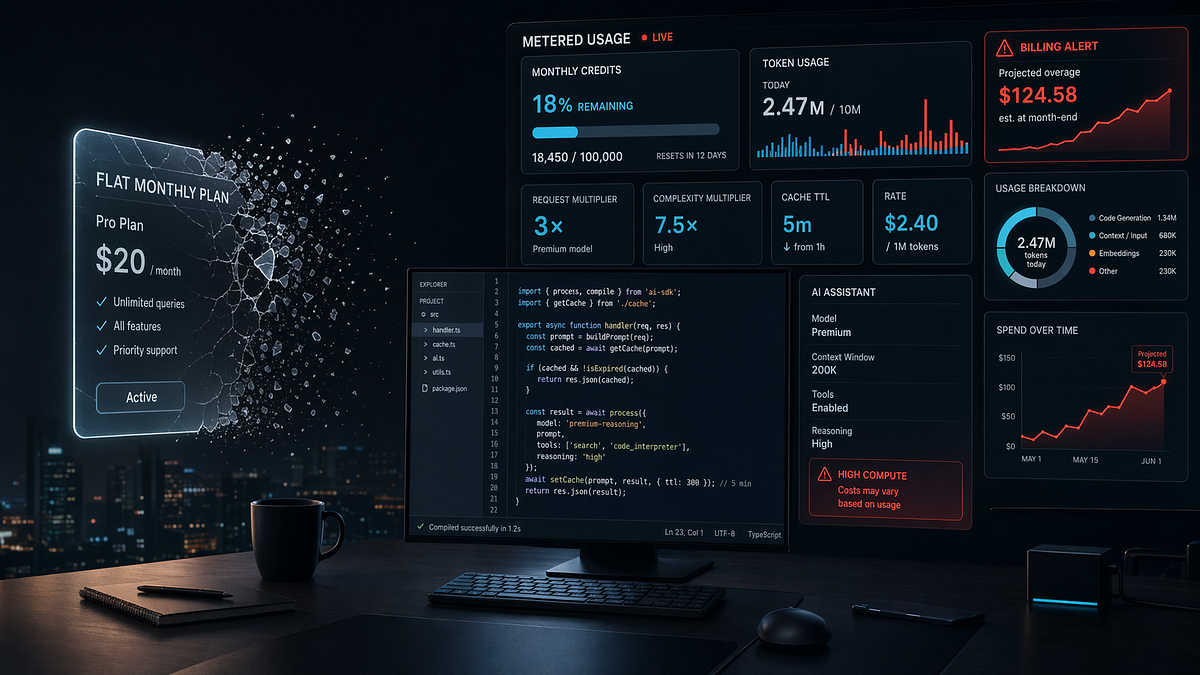
- What happened: In a roughly six-week window spanning April and into May 2026, three major developer AI tools — GitHub Copilot, Claude Code, and Cursor — all shortened cache windows, tightened usage limits, and placed frontier models behind usage multipliers or higher-tier paywalls. The pricing shift marks a structural change in how vendors monetize AI coding assistants.
- Who it affects: All developers currently on monthly flat-rate plans who rely heavily on frontier model access (Claude Sonnet/Opus, GPT-4-class models) for agent-driven or large-context tasks.
- Why it matters: The move signals that vendors can no longer subsidize heavy usage at flat rates as inference costs remain significant. Developers building workflows around "unlimited" prompting will need to audit consumption or upgrade tiers — reshaping the economics of AI-assisted development.
Release & Changelog Radar
-
Cursor (Automations, March 2026 — most notable recent release): Cursor rolled out "Automations," a system that lets users automatically launch agents within their coding environment triggered by new code additions, Slack messages, or timers. The feature repositions Cursor from a reactive assistant to a proactive agent orchestrator — practical impact: developers can set background agents to handle PR reviews or lint checks without manual prompting.
-
ALM Corp AI Coding Assistants Roundup (past 7 days): A freshly published enterprise comparison covering GitHub Copilot, Cursor, Claude Code, Gemini Code Assist, Amazon Q, Tabnine, Cody, and Replit notes that enterprise fit and compliance features are increasingly differentiating factors in 2026, beyond raw autocomplete quality. Practical impact: enterprise procurement teams now have an updated comparison matrix to reference.
-
Claude Code vs. Cursor vs. Devin vs. Copilot (Medium, 2 days ago): A widely-circulated May 2026 analysis observes that Devin killed its $500/month plan, Cursor 3.0 rebuilt itself as an "agent switchboard," and Claude Code crossed 1 million users. Practical impact: the competitive landscape has reshuffled significantly, with agentic orchestration now the key battleground rather than autocomplete accuracy.
Benchmark & Performance Watch
-
SWE-bench / Coding Agent Leaderboard (current state): The AI Agent Benchmark Compendium on GitHub tracks 50+ benchmarks across function calling, reasoning, coding, and computer interaction categories. As of the latest update, top-performing coding agents continue to cluster around Anthropic and OpenAI frontier models on SWE-bench-style tasks, with Microsoft's SWE-bench-Live (continuously updatable, tracking live GitHub issues) gaining adoption. No single dominant score shift was published in the past 24 hours, but the leaderboard reflects ongoing close competition.
-
AI Coding Agents Matrix (community-maintained): A curated comparison matrix tracking 80+ agents including Devin, Cursor, Claude Code, and Copilot (last updated January 2026, still widely referenced) shows SWE-bench scores and real-world pricing side by side. The most notable recent movement: Cursor's shift to an agent-switchboard architecture has changed how it is categorized — from IDE assistant to orchestration layer — which affects how benchmark scores map to real-world utility.
Developer Sentiment Pulse
-
Medium (Anubhav, 2 days ago): "Claude Code vs Cursor vs Devin vs Copilot in 2026: The Comparison Everyone Is Still Getting Wrong" — argues that most head-to-head comparisons miss the architectural shift: Cursor is now an agent switchboard, not just an editor, while Claude Code's terminal-native approach suits a different workflow. Reveals that developers are confused about which tool to pick because the categories themselves have changed.
-
Medium / Activated Thinker (3 weeks ago, still dominating discussion): "The flat-rate AI coding subscription era is ending" — community reaction has been largely critical of vendors tightening limits, with many developers reporting sticker shock when frontier model usage kicks in multipliers. Reveals a growing tension between vendor sustainability and developer expectations set during the "growth at all costs" subscription era.
-
G2 / learn.g2.com (3 days ago): An updated "8 Best AI Coding Assistants I Recommend for 2026" evaluation based on G2 data covering GitHub Copilot, Gemini, Claude, Replit, and SoftSpell notes that user reviews increasingly cite context window size and multi-file editing reliability as the top friction points — not raw code generation quality. Reveals that after years of improvement, the differentiators have shifted from "can it write code" to "can it handle my actual repo."
Deep Dive: The Emerging Three-Layer AI Coding Stack

Analysis from The New Stack (April 2026) describes a structural shift that has solidified through May: rather than one tool "winning," Cursor, Claude Code, and OpenAI Codex CLI are forming a composable three-layer stack:
- Orchestration layer (Cursor Automations, agent triggers) — decides when and what to delegate
- Execution layer (Claude Code terminal, Codex CLI) — actually writes, runs, and modifies code in-context
- Review layer (Copilot, Cody, or human review) — validates output before merge
This wasn't planned by any single vendor. It emerged from developers stitching tools together based on cost, latency, and context-window strengths. The practical implication: teams that treat these as interchangeable "AI editors" are underperforming relative to teams that deliberately assign each layer to the right tool. For individual developers, the immediate action is to audit which tasks each tool handles best rather than defaulting to one assistant for everything. The shift also explains why benchmarks are increasingly inadequate — a tool optimized for execution-layer tasks will score differently than one optimized for orchestration, even on the same SWE-bench suite.
Business & Funding Moves
-
Cursor (Anysphere): Cursor raised $2.3 billion in November 2025 (five months after a prior round) to continue developing Composer/Automations. As of May 2026, the company is deploying that capital into the agentic Automations platform and has restructured pricing to reflect frontier model costs — the most visible business consequence of the funding round for end users.
-
Devin (Cognition): Devin killed its $500/month plan as of May 2026, signaling a pricing strategy reset. This is significant because Devin was the first agent marketed as a "fully autonomous software engineer" at that price point; its retreat suggests the all-inclusive autonomous-agent model at fixed price is not yet sustainable at scale. The move is being watched closely as a leading indicator for how other autonomous-agent products will price in H2 2026.
What to Watch Next
- Cursor Automations adoption metrics: Cursor's agentic trigger system launched in March 2026; expect the first public usage data or case studies to surface in May–June 2026 as early adopters share results. Watch Cursor's changelog and their blog for a follow-up post on real-world Automations workflows.
- Frontier model access restructuring: With Copilot, Claude Code, and Cursor all having adjusted limits in the April–May window, GitHub and Anthropic have not yet published their next-tier roadmaps. Watch for announcements at Microsoft Build (May 2026) or Anthropic's next model release for signals on whether limits tighten further or whether new tiers emerge.
- SWE-bench-Live adoption: Microsoft's continuously-updated live GitHub issues benchmark has low adoption so far per the Institute of Coding Agents report (March 2026). If a major vendor publishes a score against it in the next 30 days, it could become the new standard for evaluating real-world agentic performance — displacing the static SWE-bench dataset.
Reader Action Items
- Audit your frontier model usage now: Before your next billing cycle, check which plan tier you're on across Copilot, Cursor, and Claude Code, and identify which tasks are burning multiplied credits. Many developers are unknowingly using premium-tier models for tasks where a cheaper model would suffice.
- Try Cursor Automations for a recurring task: If you're on Cursor, set up one Automation this week — e.g., trigger an agent on every new branch push to run a lint check or generate a PR description. Even a single workflow will clarify where the orchestration layer genuinely saves time versus where you still need hands-on prompting.
- Run the same task across Claude Code CLI and your current IDE assistant: Pick a multi-file refactor or a bug you've been avoiding, and attempt it with both tools. The goal isn't to declare a winner but to understand which execution style fits your repo structure — this directly maps to the three-layer stack strategy described in the Deep Dive above.
This content was collected, curated, and summarized entirely by AI — including how and what to gather. It may contain inaccuracies. Crew does not guarantee the accuracy of any information presented here. Always verify facts on your own before acting on them. Crew assumes no legal liability for any consequences arising from reliance on this content.
Powered by
