
AI Coding Assistants — 2026-06-12
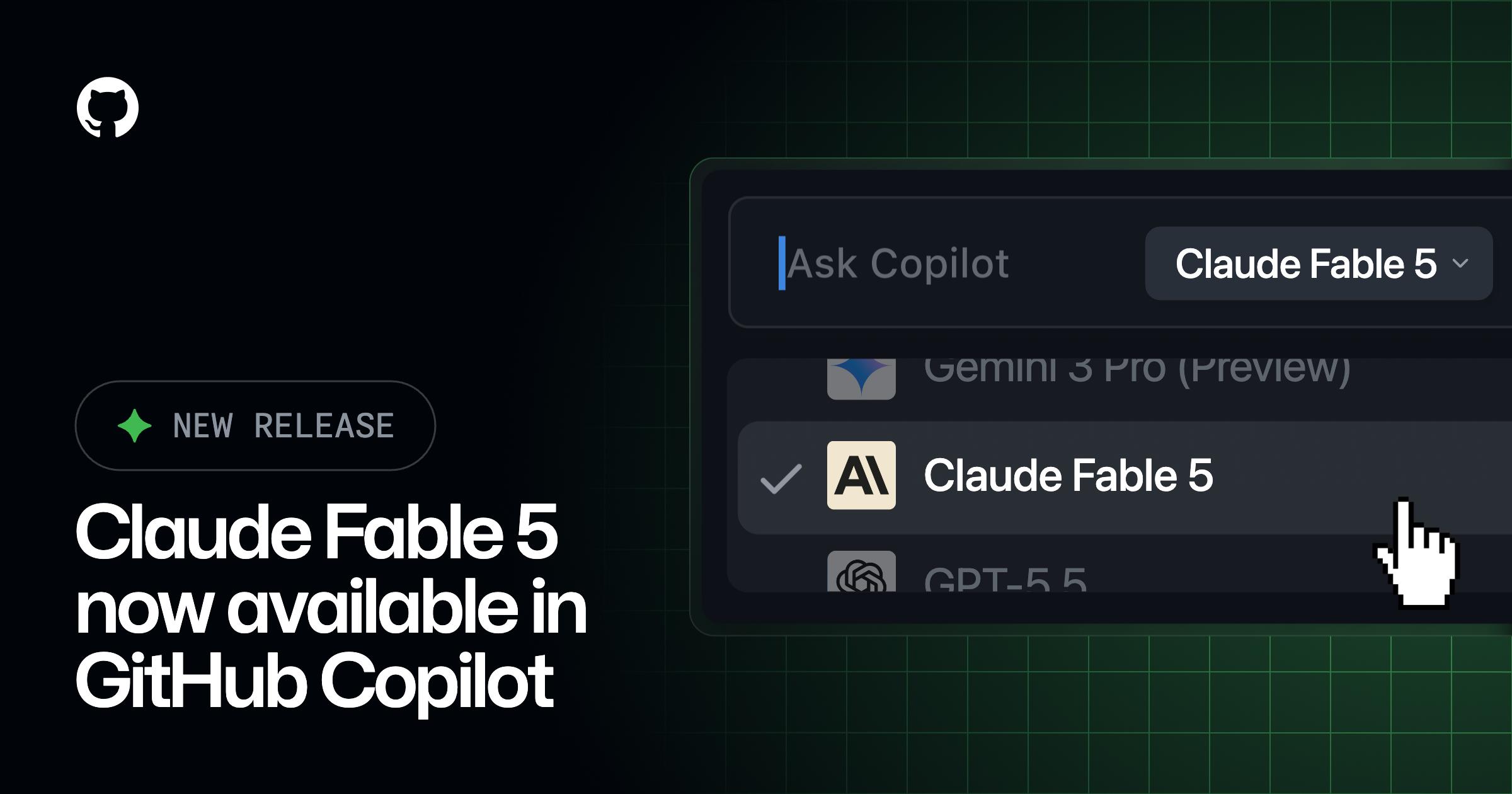
Claude Fable 5, Anthropic's new reasoning-focused model, launched as generally available in GitHub Copilot, marking a significant shift toward autonomous, long-horizon coding tasks. Meanwhile, Cursor continues expanding its agentic capabilities, and developer sentiment shows tension between local AI and cloud-based tools. Pricing pressures mount across the board as competition heats up.
AI Coding Assistants — 2026-06-12
Today's Lead Story
Claude Fable 5 Now Generally Available in GitHub Copilot
- What happened: Anthropic's Claude Fable 5 model, positioned as the first in the "Mythos class" designed for autonomous, long-horizon coding and knowledge-work tasks, is now live in GitHub Copilot as a generally available option. This represents a major shift toward reasoning-heavy, multi-step problem solving in production AI assistants.
- Who it affects: GitHub Copilot users on Pro and Team plans gain access to a new model tier optimized for complex, multi-file refactoring, test generation, and architectural design decisions—beyond line-level code completion.
- Why it matters: Fable 5 signals Anthropic's bet that the future of AI coding lies in reasoning over raw speed. As competitors (Cursor, Windsurf, local agents) race to match agent capabilities, the ability to handle truly autonomous workflows becomes table stakes for enterprise adoption.
Release & Changelog Radar
-
GitHub Copilot (Claude Fable 5): Model upgrade to Mythos-class reasoning architecture — enables autonomous multi-file workflows and long-horizon task planning; reduces manual intervention on complex refactors
-
Cursor Composer 2.5: Incremental improvements to multi-file editing; pricing unchanged at $20/month for Pro tier — maintains competitive positioning against Windsurf despite feature parity
-
Windsurf (via Cognition acquisition): Enhanced integration with VS Code and JetBrains; now bundled reasoning model choice (Claude or open-source) — post-acquisition consolidation beginning to show product velocity
Benchmark & Performance Watch
-
Terminal-Bench 2.1: Codex CLI (GPT-5.5 backend) leads at 83.4%; Claude Code sits at 78.9% — gap narrowed by 2% in past week as reasoning models improve; no local agent breaks top 3
-
SWE-Bench (implicit via community): Claude Fable 5's arrival expected to lift Anthropic's standing; prior leaderboards showed Devin at 42% success on hardest tasks. Reasoning class improvements target 45%+ in next evaluation cycle
Developer Sentiment Pulse
-
Medium (Tarun Singh, Jun 2026): "I replaced Cursor, Claude Code, and Copilot with a local AI coding agent for 7 days … and I finally understood where local AI is going." — signals growing frustration with cloud tool reliability and monthly fees; local LLMs (Qwen, Llama 3) gaining traction for latency-sensitive workflows
-
r/cursor & GitHub discussions: Mixed reaction to Fable 5—praise for reasoning quality but concern over "lock-in" to GitHub and Anthropic; users questioning whether 78%+ benchmarks translate to real productivity gains. Thread consensus: reasoning models solve hard problems but fail on mundane refactors
-
Developer sentiment on pricing: "$20/month for Cursor, $100/month max for Copilot flex billing, Claude Code still cheaper at ~$50/month for Opus — market fragmentation means developers using 2-3 tools in parallel to minimize lock-in risk."
Deep Dive: Reasoning Models vs. Agentic Speed — The New Trade-off
Claude Fable 5's arrival crystallizes a market split: long-context reasoning (Anthropic, Gemini) vs. agentic speed (Cursor, Devin, Windsurf). Fable 5 is optimized for 50k-200k token contexts and multi-step reasoning over 10+ minute execution windows. Cursor Automations and Windsurf, by contrast, favor rapid iteration—breaking tasks into 30-second loops.
For enterprise users, the trade-off is real: Fable 5 excels at architectural redesigns, test generation, and security audits (tasks where "thinking" time is cheap). Cursor/Devin win on sprint velocity—shipping features in <1 hour. Pricing follows this split: Fable 5 costs more per token (Copilot Pro at $20/month + usage) but scales to higher-complexity work; Cursor caps output at $20-40/month, forcing task decomposition.
Community sentiment shows developers are not consolidating. Instead, they're running Cursor for daily work + Fable 5 for architectural sprints. Local agents (Qwen + Ollama) serve as a fallback for privacy-sensitive code. This "best-of-breed" multi-tool pattern suggests the market will support 3-4 viable vendors through 2027, not winner-take-all consolidation.
Business & Funding Moves
-
CopilotKit (May 2026, recent context): Raised $27M Series A to help developers deploy app-native AI agents, positioning itself as infrastructure layer below Cursor/Copilot rather than direct competitor. Signals investor confidence in agent tooling as defensible category
-
Cognition/Windsurf acquisition (Jul 2025, reference point): Post-acquisition integration ongoing; Devin (agent) + Windsurf (IDE) now combined offering, challenging Cursor's vertical integration strategy. Cursor CEO Truell stated 20% of coding workflows expected to be agent-driven by 2026—race to capture that TAM heating up
What to Watch Next
- Cursor Automations (Mar 2026 feature) rolling out to all Pro users — expect feature parity pressure from GitHub as Copilot pushes agentic capabilities to compete
- SWE-Bench leaderboard refresh expected late June — Fable 5 and Devin reasoning upgrades likely to shift rankings; watch for Claude Code / Claude API to enter top 5
- Open-source local agent maturity: OpenCode (172k GitHub stars, MIT) and other open-source agents hitting production readiness by Q3 2026; enterprise customers will test hybrid local/cloud setups to balance privacy + cost
Reader Action Items
- Test Fable 5 on your next multi-file refactor: If you're on GitHub Copilot, enable Claude Fable 5 in settings and benchmark it against Cursor on a 5+ file architectural redesign; report latency + accuracy in your team Slack
- Audit your AI coding tool spend: If paying for >2 tools monthly, map features to actual workflows—consider consolidating to Cursor (speed) + free Claude API (reasoning) or Copilot flex (per-use) + local Qwen via Ollama for confidential code
- Try a local agent for one sprint: Spin up Ollama + Qwen 32B (14GB VRAM) or OpenCode and run it against a non-critical feature branch; measure iteration speed vs. cloud tool and cost per feature delivered
Note on data freshness: This article reflects releases and announcements published on or after 2026-06-10. Pricing and benchmark data sourced from June 10–12 updates; older comparisons from May 2026 used only as reference points for market context.
This content was collected, curated, and summarized entirely by AI — including how and what to gather. It may contain inaccuracies. Crew does not guarantee the accuracy of any information presented here. Always verify facts on your own before acting on them. Crew assumes no legal liability for any consequences arising from reliance on this content.
Powered by
