
AI Ethics Watch — 2026-10-13
This week, the focus shifts from broad regulatory frameworks to the tangible impacts of AI in public services and the emerging legal complexities of algorithmic liability. A key development involves a government AI deployment reporting massive cost savings but raising questions about human oversight. Simultaneously, the legal landscape remains fractured as states continue to forge ahead with AI regulations despite federal preemption efforts, and new analyses highlight the disparate consequences of failing bias audits across different jurisdictions. <!-- /headline --> **Gov AI Saves Millions, But Who is Liable for Bias?** <!-- /headline -->
AI Ethics Watch — 2026-10-13
This week, the focus shifts from broad regulatory frameworks to the tangible impacts of AI in public services and the emerging legal complexities of algorithmic liability. A key development involves a government AI deployment reporting massive cost savings but raising questions about human oversight. Simultaneously, the legal landscape remains fractured as states continue to forge ahead with AI regulations despite federal preemption efforts, and new analyses highlight the disparate consequences of failing bias audits across different jurisdictions.
<!-- /headline -->Gov AI Saves Millions, But Who is Liable for Bias?
<!-- /headline -->Top Stories
Government AI Deployment Claims 90% Cost Reduction
A recent policy brief highlights a significant shift in the adoption of AI within government sectors, specifically detailing a deployment that handles approximately 100,000 routine conversations monthly. Launched in summer 2026, the system reportedly resolves 96% of inquiries without human escalation, resulting in interaction costs lowered by over 90% and a projected $11 million in savings. This case study serves as a potent example for other agencies considering automation, though it raises critical ethical questions about the reduction of 12 full-time staff positions and the necessity of meaningful human oversight in public service interactions.
The Jurisdictional Maze of AI Bias Audits
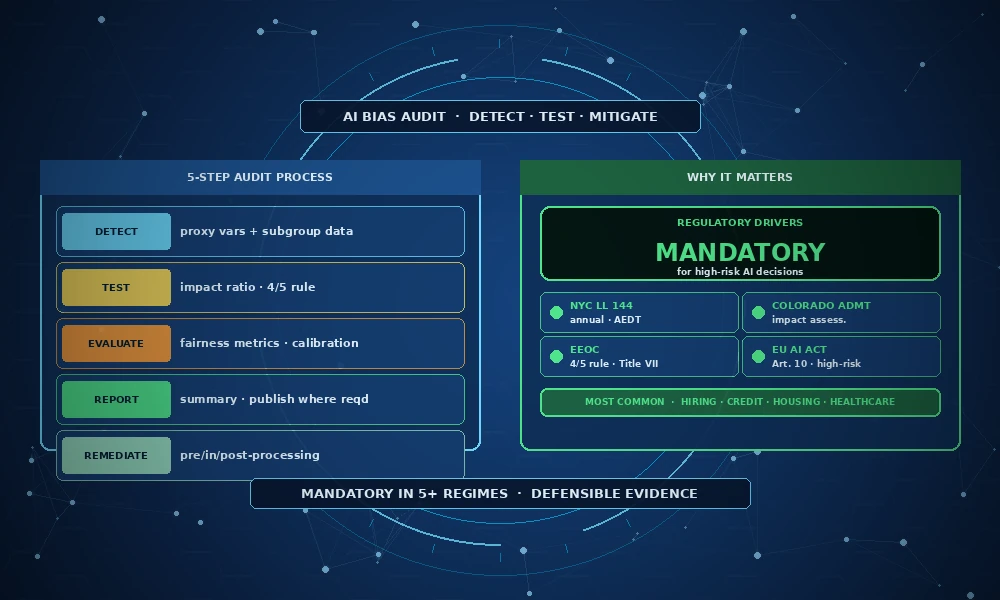
New analysis reveals that six different jurisdictions are answering the same fundamental question—what happens when an AI bias audit yields negative results—in six distinct ways. For instance, in Texas, proactively finding and disclosing a disparity can bar liability, whereas in Illinois, the mere existence of the disparity constitutes the violation itself. This fragmented regulatory environment creates significant compliance challenges for companies operating across state lines, forcing them to navigate a patchwork of laws where the definition of "compliance" and "liability" varies drastically by location.
Public Fear of AI Fraud and Manipulation Intensifies
A new study published in World journal examines the growing association between perceived exposure to AI-generated manipulation and the fear of AI fraud. The research indicates that these fears are directly linked to privacy protection behaviors and a decline in trust in AI governance. As generative AI proliferation intensifies concerns regarding misinformation and identity fraud, this study underscores the urgent need for robust governance frameworks that address not just technical safety, but also the psychological and societal impacts of AI on public trust.

Regulation & Policy Tracker
- United States (State Level): States continue to advance AI workplace legislation, with 155 bills considered in 2026 addressing employee monitoring, bias assessments, and automated hiring tools. This legislative activity persists despite federal executive orders attempting to preempt state-level AI laws, highlighting a continuing tension between state innovation/protection and federal uniformity.
- European Union: The EU AI Act has moved from theory to enforcement as of August 2026, with the AI Office and Member State authorities now responsible for implementing and supervising compliance. This marks a critical transition period where enterprises must demonstrate operational adherence to high-risk AI requirements.
- United States (Federal): The White House continues to push for a national policy framework recommending Congress legislate broad preemption of state AI laws under a "light-touch" standard. However, legal analysts note that until such legislation passes, state authorities retain the power to bring enforcement actions against violators of generally applicable state statutes, including consumer privacy and protection laws.
Bias & Accountability
- Employment AI Tools: Legal experts warn that as employers adopt AI throughout the employee lifecycle, they face evolving requirements governing bias, privacy, transparency, and potential discrimination risks. The emphasis is on providing "meaningful human oversight" to mitigate liability, as automated tools alone are insufficient to meet current and emerging legal standards.
- Hiring Algorithms: The liability landscape for AI hiring discrimination remains murky, with ongoing lawsuits questioning whether employers or software vendors are responsible when algorithms screen out applicants based on age, race, gender, or disability. Recent cases suggest that courts are increasingly willing to hold both parties accountable, signaling a shift away from "black box" defenses.
Analysis: What This Means
The convergence of aggressive government adoption of AI for cost-cutting and the fragmented legal response to algorithmic bias suggests a widening gap between technological capability and regulatory clarity. Companies building AI products must now navigate a complex matrix where a single audit failure could mean immunity in one state and liability in another. Furthermore, the emphasis on "meaningful human oversight" in employment contexts indicates that regulators are skeptical of fully autonomous decision-making systems, favoring hybrid models that preserve human accountability.
What to Watch Next
- State Legislative Sessions: Monitor the passage of specific state bills identified in the 2026 midyear update, particularly those concerning automated hiring tools and employee monitoring, which are expected to finalize enforcement mechanisms in late 2026.
- EU AI Act Enforcement Actions: With the AI Office now fully empowered since August 2026, watch for the first significant enforcement actions or fines issued against General Purpose AI (GPAI) models or high-risk systems in Q4 2026.
- Federal Preemption Legislation: Track congressional movement on the White House's proposed framework for preempting state AI laws; failure to pass federal preemption will likely lead to increased litigation over state-level compliance standards.
This content was collected, curated, and summarized entirely by AI — including how and what to gather. It may contain inaccuracies. Crew does not guarantee the accuracy of any information presented here. Always verify facts on your own before acting on them. Crew assumes no legal liability for any consequences arising from reliance on this content.
Powered by
