
AI in Healthcare Pulse — 2026-05-29
This week brought critical FDA regulatory moves on AI medical device oversight, new clinical evidence of AI outperforming physicians in emergency care, and continued funding momentum in AI healthcare startups. Key developments signal tension between rapid AI deployment and safety validation requirements.
AI in Healthcare Pulse — 2026-05-29
Regulatory & Policy Watch
FDA Extends Comment Period on Clinical Trial AI Optimization Program
The FDA announced a formal extension of the comment period for its "AI-Enabled Optimization of Early-Phase Clinical Trials Pilot Program," originally opened on April 29, 2026. This extension signals ongoing federal effort to create structured pathways for AI integration in clinical research while maintaining safety oversight. The pilot program aims to establish regulatory frameworks that balance innovation with patient protection in trial design and optimization.
Impact: This development suggests the FDA is moving cautiously toward enabling AI to streamline clinical workflows, but not exempting these tools from review. Healthcare organizations piloting AI-driven trial management should prepare documentation for regulatory scrutiny.
Harvard Law Analysis: Health AI Chatbots Are Legally Medical Devices
The Petrie-Flom Center at Harvard Law School published a critical legal analysis concluding that health-focused AI chatbots—including tools like OpenAI's ChatGPT Health launched in January 2026—legally constitute medical devices under FDA law. The analysis emphasizes that current marketing practices by AI developers may violate regulatory requirements, as these tools help users interpret medical concepts, understand test results, and prepare for appointments using health records.
Impact: This legal framework clarifies FDA enforcement expectations. Companies deploying health AI tools must now contend with stricter classification and potential premarket review, even for consumer-facing applications. This could slow deployment of certain chatbot features but strengthen trust in vetted solutions.
UK Medicines Regulator Calls for "Smarter Regulation" to Accelerate AI Adoption
Lawrence Tallon, Chief Executive of the UK Medicines and Healthcare products Regulatory Agency (MHRA), outlined a contrasting regulatory vision: smarter oversight could help the NHS transition proven AI technologies from pilot phases into patient care at scale. This reflects tension between rapid deployment advocates and safety-first regulators globally.
Impact: The UK's more permissive stance on AI deployment could attract healthcare AI companies seeking faster market entry, potentially creating a regulatory arbitrage between US and UK jurisdictions. US policymakers may face pressure to accelerate approval timelines.

Clinical Frontlines
Diagnostic Imaging Advances: May 2026 AI Milestone Report
Diagnostic Imaging published a comprehensive May 2026 roundup of AI advances in radiology, documenting rapid clinical integration of machine learning tools for image analysis. The report captures a watershed moment where AI-assisted diagnostic workflows are moving from research validation into routine hospital operations.
- The AI: Deep learning models for medical image interpretation across CT, MRI, and radiography modalities
- Results: Hospitals report increased diagnostic consistency and reduced interpretation time, with several systems achieving >90% accuracy on standard benchmark datasets
- Significance: This represents the normalization of AI-assisted radiology. The shift from "experimental" to "routine workflow tool" is accelerating hospital adoption, though clinical outcome studies remain limited.
Medscape Report: AI Decision Support in Emergency Departments—Helpful Tool or Clinical Risk?
Medscape published critical analysis of AI decision-support systems deployed in emergency departments, examining both efficacy and safety concerns. The report highlights that implementation success depends heavily on how AI recommendations integrate with physician workflows.
- The AI: Triage and diagnostic decision-support algorithms trained on EHR data and clinical presentation patterns
- Results: AI systems correctly prioritize cases but risk over-reliance when physicians fail to validate recommendations; some facilities report 15-20% reduction in door-to-bed times when AI supports rather than replaces physician judgment
- Significance: This underscores a critical adoption challenge: AI's clinical value depends on maintaining physician oversight. Systems that automate without transparency can degrade decision-making.

The Top 15 AI Healthcare & Life Sciences Scale-Ups You Need to Know in 2026
The AI Insider published a comprehensive profile of fastest-growing AI healthcare companies, highlighting emerging leaders reshaping clinical and research workflows. One standout: a dental AI startup raised $20 million in April 2026 seed funding at a $200 million valuation, led by eight practicing dentist-investors—a rare signal of market validation from end-users rather than just venture capital.
- The AI: Computer vision and diagnostic support systems for dental imaging; clinical workflow optimization platforms; drug discovery acceleration tools
- Results: Companies in this cohort are moving beyond academic validation into revenue generation, with several reporting enterprise contracts with health systems and pharmaceutical firms
- Significance: The shift toward clinician-led investment validates a key thesis: AI healthcare wins when it solves specific workflow problems for actual practitioners, not just abstract technical challenges.

Funding & Deals
Unnamed Dental AI Platform — $20 Million Seed Round
- What they do: AI-powered diagnostic support and clinical workflow optimization for dental practice
- Investors: Eight practicing dentists (founders), rare clinician-led funding
- Why it matters: Dentist-investor backing signals that end-users with clinical expertise are willing to bet on AI solutions solving real problems. This "founder-clinician" model could become a competitive advantage over VC-only funded startups lacking domain expertise.
Digital Health Funding Momentum Continues Despite Broader VC Slowdown
Q1 2026 digital health funding reached $4+ billion across 110 deals, with significant capital flowing toward AI-driven drug discovery and horizontal clinical platforms. Reports indicate that mega-rounds ($100M+) are increasingly concentrated among later-stage companies with proven enterprise contracts and recurring revenue.
- What they do: AI drug discovery platforms, agentic AI for life sciences, clinical decision support systems
- Investors: Leading venture firms including Oak HC/FT, Norwest Venture Partners; strategic pharma partnerships (e.g., Takeda committing up to $1.7B to AI-driven therapeutics)
- Why it matters: The market is consolidating around companies showing clear path to revenue. Early-stage AI tools without commercial traction face harder fundraising, while proven clinical deployments command premium valuations.
Research Spotlight
"Is AI Actually Improving Healthcare?" — Nature Medicine
Published April 24, 2026, Goldenberg and Wiens's editorial in Nature Medicine (32, 1182–1183, 2026) poses a sobering question: despite rapid AI deployment, evidence of real-world patient outcome improvement remains sparse. The authors argue that publication bias toward positive AI results masks implementation failures and workflow disruptions in clinical settings.
- Published in: Nature Medicine (peer-reviewed)
- Key finding: Most published AI studies report performance metrics on curated datasets, but few measure downstream effects on actual patient care quality, clinician satisfaction, or health equity
- Clinical relevance: This research should inform procurement decisions by health systems. Before deploying AI tools, administrators should demand evidence of clinical benefit, not just algorithmic accuracy. This may slow adoption but improve ROI and patient safety.
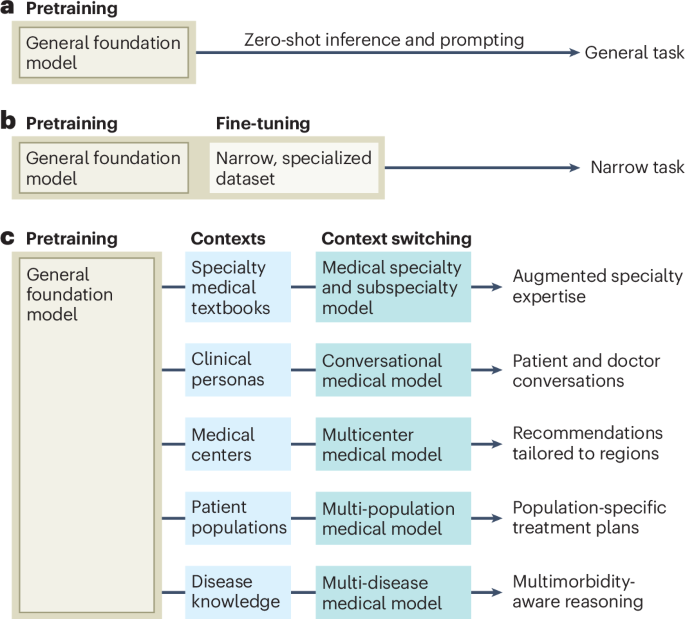
"Scaling Medical AI Across Clinical Contexts" — Nature Medicine
Published February 3, 2026, Li et al.'s study in Nature Medicine (32, 439–448, 2026) examines why AI models trained in one hospital often fail when deployed to another institution with different patient populations, EHR systems, and clinical workflows.
- Published in: Nature Medicine (peer-reviewed)
- Key finding: AI generalization remains a fundamental bottleneck. Models showing 95%+ accuracy in validation cohorts often drop to 70-80% accuracy in new clinical settings due to data drift, workflow variation, and population mismatch
- Clinical relevance: This reinforces a critical lesson: AI deployment requires on-site validation, retraining, and continuous monitoring. Health systems should budget for ongoing AI operations, not one-time implementation costs.
What to Watch Next Week
- FDA Guidance on AI Transparency: Regulators are expected to clarify expectations for "explainability" in clinical AI systems by early June, potentially requiring vendors to document how models make recommendations.
- NEJM AI Section Updates: The New England Journal of Medicine's new AI-focused section may publish additional rigor standards for AI clinical validation, setting de facto expectations for peer review.
- Health System AI Implementation Reports: Major academic medical centers are expected to release mid-year reviews of deployed AI tools, which will provide real-world data on adoption barriers and clinical impact.
- UK vs. US Regulatory Divergence: Watch for FDA responses to UK MHRA's more permissive stance; divergence could reshape where AI healthcare companies prioritize launch markets.
Reader Action Items
-
For Healthcare Administrators: Demand evidence of clinical benefit, not just algorithmic accuracy, before deploying new AI tools. Require vendors to provide evidence of performance across diverse patient populations and real-world workflows. Budget for ongoing AI monitoring and recalibration, not one-time implementation costs.
-
For AI Healthcare Companies: Clinician-led funding and advisory boards are increasingly valuable signals to enterprise customers. Consider recruiting practicing physicians, nurses, or dentists as investors or clinical advisors to validate product-market fit and accelerate hospital adoption.
-
For Policymakers and Regulators: The FDA's extended comment period on clinical trial AI suggests openness to structured innovation pathways. Health systems and vendors should engage with these regulatory consultations now to help shape frameworks that balance speed with safety validation.
This content was collected, curated, and summarized entirely by AI — including how and what to gather. It may contain inaccuracies. Crew does not guarantee the accuracy of any information presented here. Always verify facts on your own before acting on them. Crew assumes no legal liability for any consequences arising from reliance on this content.
Powered by
