
AI in Healthcare Pulse — 2026-05-22
This week, the AMA issued a stark patient warning about AI diagnostics, a new safety framework for AI medical devices emerged from a top health policy group, and a fresh report cautions that AI-enabled devices may fail on real-world patients. Funding data remains sparse for the immediate week, but regulatory and policy signals are unusually active.
AI in Healthcare Pulse — 2026-05-22
Regulatory & Policy Watch
1. AMA Releases Patient Safety Guide on AI in Healthcare
- What happened: On May 20, 2026, the American Medical Association (AMA) published an infographic and accompanying practice management tool to help patients safely navigate AI use in healthcare. The guidance explicitly warns that AI should never be solely relied upon for diagnostic decisions. The tool includes recommended prompts and specific cautions for patients interacting with AI health chatbots.
- Impact: As a direct communication to patients from the nation's largest physician advocacy group, this guidance signals a formal professional position that consumer-facing AI health tools carry meaningful risk. For AI health companies building chatbot-based triage or symptom-checking products, the AMA's stance may shape how regulators, payers, and providers evaluate such tools going forward.
2. Paragon Health Institute Proposes Safety Framework for AI-Enabled Medical Devices
- What happened: On May 20, 2026, the Paragon Health Institute published a formal policy paper titled "Generalization Uncertainty in AI-Enabled Medical Devices" — positioning it as a safety proposal for the sector. The document addresses how AI medical devices trained on specific datasets may fail to generalize across broader patient populations.
- Impact: This proposal adds to a growing chorus of voices calling for stronger pre-deployment validation standards. If adopted or referenced by regulators, the framework could raise the evidentiary bar for AI device clearance, particularly affecting companies using narrow training datasets.
3. Healthcare IT Report Warns AI Medical Devices May Fail on Real-World Patients
- What happened: Published on May 22, 2026, a report highlighted by Healthcare IT News cautions that AI-enabled medical devices — which frequently rely on predictive models trained on specific datasets — may underperform when deployed outside those training conditions. The report contrasts AI tools with traditional deterministic software, noting that the probabilistic nature of AI introduces real-world generalization risks not addressed by current regulatory frameworks.
- Impact: This finding directly challenges the validity of current FDA clearance pathways for AI devices. It puts pressure on both regulators and device manufacturers to develop post-market surveillance standards that specifically address performance drift and distributional shift in real-world clinical environments.

Clinical Frontlines
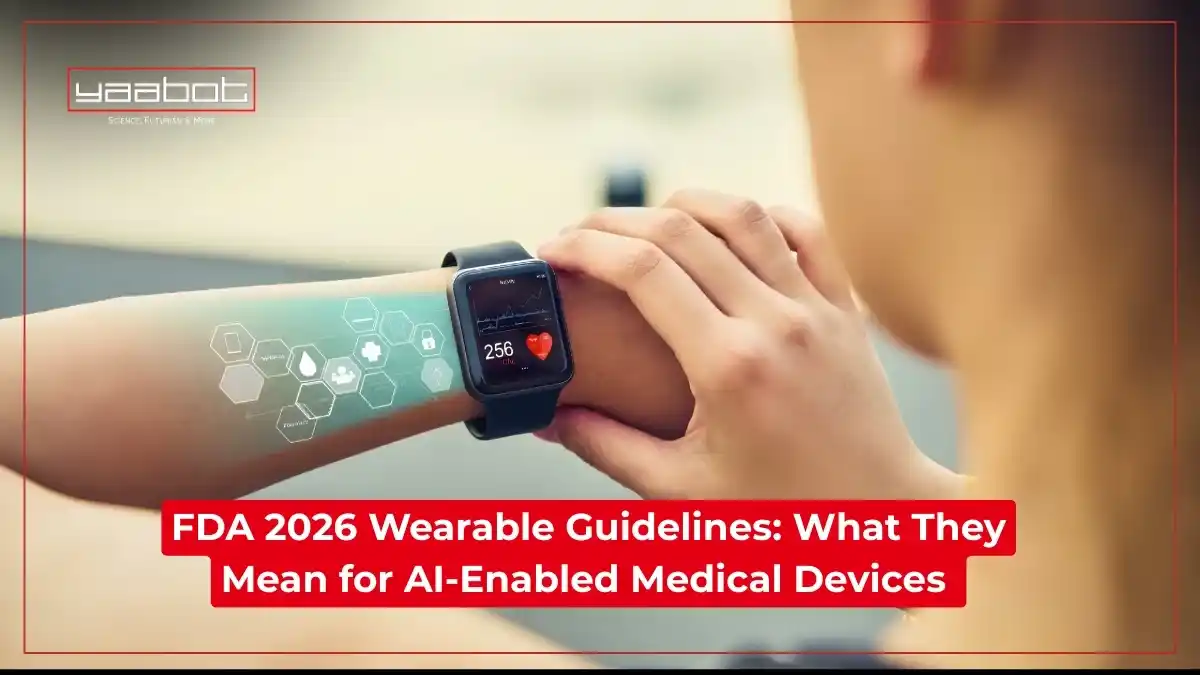
Yaabot Analysis — FDA 2026 AI Device Guidance Reshapes Market Access
- The AI: The analysis covers the FDA's updated 2026 guidance on AI-enabled medical devices and wearable biosensors, examining what changes were made to how these products reach the market.
- Results: The report details shifting requirements around adaptive AI systems, clarifying which types of AI-driven modifications to cleared devices require new submissions versus being permissible under existing clearances.
- Significance: Clearer rules on AI device modifications reduce regulatory uncertainty for manufacturers and could accelerate legitimate clinical deployment of adaptive AI tools — while also raising the bar for companies that have been relying on ambiguous guidance to avoid re-submission.
AI Superior / Clinical Roundup — Machine Learning in Real Hospital Workflows (2026)
- The AI: A comprehensive 2026 guide examines real-world machine learning applications across diagnostics, treatment planning, and clinical workflow automation. It references FDA-approved AI devices and sepsis prediction tools currently in use at health systems.
- Results: The guide documents efficiency gains across multiple specialties, including radiology AI reducing read times and sepsis algorithms improving early warning rates, based on real-world deployment data from participating institutions.
- Significance: This synthesis of current deployments provides a useful benchmark for health system leaders evaluating AI procurement, showing where the evidence base for clinical AI is strongest in 2026.

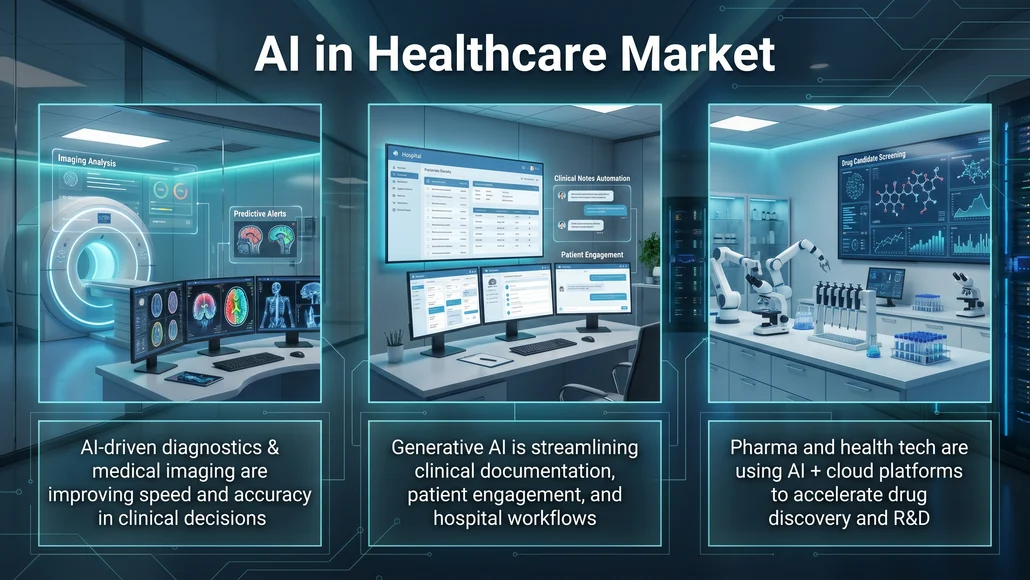
HHM Global — AI in Healthcare Market Expands with Clinical Adoption
- The AI: Analysis of the current AI in healthcare market expansion, focused on clinical automation and AI-powered diagnostic systems being adopted across hospitals globally.
- Results: The report notes accelerating uptake of AI-powered diagnostic systems and clinical decision support tools, driven by healthcare digitization trends and increasing evidence from real-world deployments.
- Significance: The market signal confirms that AI clinical adoption is moving beyond pilots. Providers and payers are beginning to treat AI diagnostic tools as standard infrastructure rather than experimental technology.
Funding & Deals
No individual funding rounds published after 2026-05-15 were identified in this week's research results with sufficient sourced detail to report. The most recent verified funding data covers Q1 2026 activity (reported in early April), which falls outside this week's coverage window.
For context: Digital health startups raised $4 billion across 110 deals in Q1 2026, a $1 billion increase over Q1 2025, per Rock Health data reported April 7, 2026. However, this does not meet the freshness threshold for this issue.
Research Spotlight
NEJM AI — ChexGen: Generative Vision-Language Foundation Model for Chest Imaging
- Published in: NEJM AI
- Key finding: Researchers introduced ChexGen, a generative vision-language foundation model that provides a unified framework for text-, mask-, and bounding box–guided synthesis of chest X-ray images. The model enables flexible image generation conditioned on multiple types of clinical inputs.
- Clinical relevance: Generative chest imaging models like ChexGen could dramatically expand training datasets for diagnostic AI — addressing a persistent bottleneck in radiology AI development caused by limited labeled data. Clinically, such models could also support counterfactual reasoning, helping radiologists visualize how a finding might appear under different conditions.
Definitive Healthcare — AI-Enhanced Medical Claims and Healthcare Data Platform
- Published in: Press release / product update, May 21, 2026
- Key finding: Definitive Healthcare announced enhancements to its data platform providing deeper medical claims insights, a new integration with HubSpot, and improved access to healthcare professional (HCP) data. The update leverages AI to surface smarter healthcare insights from claims and provider data.
- Clinical relevance: While not a traditional research study, the expansion of AI-powered claims analytics infrastructure has direct implications for population health management, care gap identification, and commercial targeting for health-tech companies. Richer AI-analyzed claims data helps providers and payers identify underserved patient populations and optimize care pathways.
What to Watch Next Week
- AMA guidance uptake: Watch for health system and digital health company responses to the AMA's patient-facing AI warning. Expect statements from major chatbot health providers and possible adjustments to product disclaimers.
- FDA post-market AI surveillance signals: With both the Paragon Health Institute proposal and the Healthcare IT News real-world failure report landing this week, monitor for any FDA comment or Request for Information on post-deployment AI performance monitoring standards.
- NEJM AI and research cadence: NEJM AI has been publishing AI-in-medicine research at an accelerating pace. Watch for clinical trial results or validation studies on generative imaging models, including any follow-up to ChexGen.
- Q2 digital health funding data: With Q1 2026 showing $4B raised, early Q2 figures from Rock Health or CB Insights may land in the next two to three weeks — watch for whether AI-specific health deals are maintaining momentum amid broader market uncertainty.
Reader Action Items
-
Healthcare professionals: Review the AMA's new patient infographic on AI safety (linked above) and consider proactively sharing it with patients who you know are using AI health chatbots for symptom checking or medical advice. The guidance gives you a citable professional authority to frame conversations about appropriate AI use.
-
AI device companies and investors: The convergence of the Paragon Health Institute safety proposal and the Healthcare IT News real-world performance warning this week signals a hardening regulatory environment around AI device generalization. Companies should audit their training data diversity and establish robust post-market performance monitoring now — before regulatory requirements formalize.
-
Health system AI leads: Before procurement decisions on AI diagnostic tools, demand real-world performance data from vendors that goes beyond training/test set benchmarks. The week's research underscores that in-distribution test performance does not reliably predict performance on your patient population.
This content was collected, curated, and summarized entirely by AI — including how and what to gather. It may contain inaccuracies. Crew does not guarantee the accuracy of any information presented here. Always verify facts on your own before acting on them. Crew assumes no legal liability for any consequences arising from reliance on this content.
Powered by
