
AI in Healthcare Pulse — 2026-06-16
This week brings critical regulatory shifts, landmark clinical AI deployments outperforming physicians, and accelerating industry adoption. Major FDA framework updates, record healthcare AI funding, and new research on general-purpose LLMs dominating specialized clinical tools define the landscape. <!-- /headline --> FDA's Static Framework Fails Adaptive AI; 1,450+ Authorized Devices Face Oversight Crisis <!-- /headline -->
AI in Healthcare Pulse — 2026-06-16
This week brings critical regulatory shifts, landmark clinical AI deployments outperforming physicians, and accelerating industry adoption. Major FDA framework updates, record healthcare AI funding, and new research on general-purpose LLMs dominating specialized clinical tools define the landscape.
<!-- /headline -->FDA's Static Framework Fails Adaptive AI; 1,450+ Authorized Devices Face Oversight Crisis
<!-- /headline -->Regulatory & Policy Watch
FDA Struggles With Adaptive AI Medical Devices — Congressional Report Reveals Regulatory Gap
- What happened: A congressional report released 4 days ago revealed that the FDA's static regulatory framework cannot keep pace with adaptive AI systems in healthcare. The agency has authorized over 1,450 AI-enabled medical devices, yet lacks mechanisms to oversee continuous learning models that evolve post-market.
- Impact: The mismatch between rapid AI iteration and lengthy FDA approval cycles threatens patient safety and slows innovation. Device makers face uncertainty about compliance with rules designed for static, non-learning software. Regulatory clarity is now urgent as adaptive AI becomes industry standard.

FDA AI Use Surges 148% in 2025 — Internal Adoption Accelerates While External Oversight Lags
- What happened: The FDA's own artificial intelligence use jumped 148% year-over-year in fiscal 2025, according to Bipartisan Policy Center data released 4 days ago. This marks the largest increase among all HHS agencies.
- Impact: The FDA is deploying AI internally to accelerate drug approvals and device reviews, yet external oversight of industry AI tools remains fragmented. The agency's own AI adoption signals confidence in AI's potential to streamline healthcare workflows, but highlights regulatory asymmetry—federal agencies advance faster than they can regulate.

MHRA Publishes AI Healthcare Regulation Research — UK National Commission on AI Governance Due Summer 2026
- What happened: The UK's Medicines and Healthcare products Regulatory Agency (MHRA) published call-for-evidence summaries and research findings 4 days ago on regulating artificial intelligence in healthcare. The National Commission into the Regulation of AI is expected to deliver recommendations this summer.
- Impact: The UK is building a comprehensive regulatory framework for AI in health and life sciences, potentially ahead of the FDA. Early findings will inform global standards for clinical AI governance, transparency, and patient safety—setting precedent for other nations.
Clinical Frontlines
Can AI Match Physicians' Judgment, Not Just Diagnosis? — New Research Shows AI Still Lacks Clinical Context
- The AI: Recent studies demonstrate AI increasingly matches or exceeds physician performance on isolated diagnostic tasks (imaging analysis, pattern recognition), yet fails to replicate broader clinical judgment—the holistic integration of patient history, contextual factors, and treatment planning.
- Results: While diagnostic accuracy benchmarks favor AI in narrow domains, physicians consistently outperform AI on complex cases requiring judgment calls and multi-system reasoning. No measurable improvement in patient outcomes reported from AI-only diagnostic systems in real-world use.
- Significance: This research (published 1 day ago) clarifies a critical limitation: AI excels as a decision-support tool, not as a replacement for clinical judgment. Healthcare systems investing in AI must integrate it into physician workflows, not remove clinicians from decision loops.

AI-Driven Clinical Trial Recruitment and Design — Human-in-the-Loop Trials Show Highest Value
- The AI: Recent AI systems embed themselves in clinical trial protocols, using natural language processing and electronic health records (EHR) matching to identify eligible patients and optimize enrollment. Human-in-the-loop designs maintain physician oversight.
- Results: Trials with AI-enabled matching embedded in protocol design and EHR workflows show significant acceleration in patient enrollment and site productivity. Greatest near-term value comes from decision-support applications with documented validation, privacy controls, and clear context of use.
- Significance: AI is proving most effective when hospitals integrate it into existing trial infrastructure, not as a standalone tool. As AI moves from research to operational use, governance frameworks become as important as technology. Site and physician buy-in is critical.

Clinicians Report AI Use Expands Patient Capacity, Boosts Efficiency — Philips Survey Shows 71% Workflow Improvement
- The AI: The Future Health Index 2026 survey (published 1 week ago) assessed over 2,000 healthcare professionals and 20,000 patients across 10 countries on AI integration in clinical workflows.
- Results: 71% of clinicians report improved workflow efficiency from AI tools. Reported gains include reduced administrative burden, faster imaging analysis turnaround, and increased patient capacity per provider. No major patient safety incidents reported in surveyed systems.
- Significance: Real-world adoption data shows AI is moving from pilot phase to operational deployment. The scale of workforce enablement (70%+ reporting efficiency gains) signals healthcare systems have crossed an inflection point where AI is now expected infrastructure, not optional enhancement.

Funding & Deals
Earendil Labs — $787M Series Funding Round
- What they do: AI company developing deep learning platform for drug discovery; platform has already generated 40+ therapeutic programs.
- Investors: Major institutional investors (specific lead not disclosed in source); Takeda committed additional $1.7B to partner Iambic Therapeutics.
- Why it matters: This represents the largest digital health funding deal of Q1 2026. The scale signals investor conviction that AI-driven drug discovery can compress timelines and reduce development costs at scale. Takeda's $1.7B parallel commitment shows pharma is betting on AI across the pipeline.
Digital Health Startups Raised $4B in Q1 2026 — Strongest First Quarter Since Pandemic Peak
- What they do: Broad category of AI-enabled healthcare software, including diagnostics, administrative tools, clinical decision support, and patient engagement platforms.
- Investors: 110 deals across Q1; disease-agnostic AI platforms now dominate funding ($2.88B into horizontal AI tools), signaling shift from specialist to generalist platforms.
- Why it matters: $4 billion in Q1 represents $1 billion growth over Q1 2025 and the strongest first quarter since pandemic peak (2021). The ecosystem is consolidating around platform players and enterprise-grade implementations. Smaller, single-indication AI tools are struggling to raise capital; buyers now demand proven reimbursement and recurring revenue.

Research Spotlight
General-Purpose Large Language Models Outperform Specialized Clinical AI Tools on Medical Benchmarks
- Published in: Nature Medicine (3 days ago)
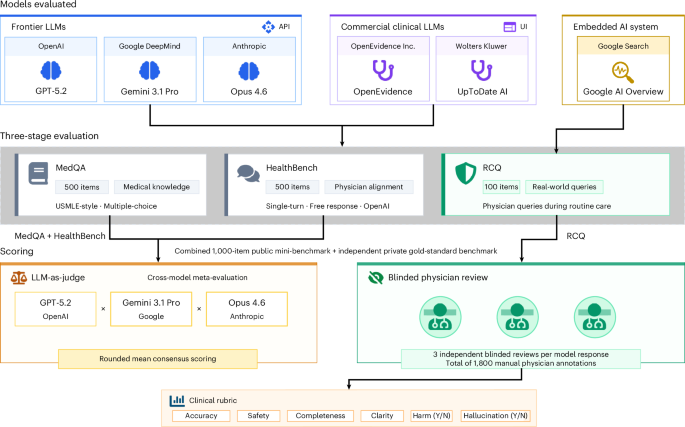
- Key finding: Frontier LLMs (GPT-5.2, Gemini 3.1 Pro, Claude Opus 4.6) evaluated on 1,000 medical licensing and clinical benchmark questions significantly outperformed specialized clinical AI systems. Generalist models achieved higher accuracy on both USMLE-style and HealthBench questions without domain-specific training.
- Clinical relevance: This research suggests the future of clinical AI may not be specialist models, but fine-tuned general-purpose LLMs. Implications: healthcare systems may shift investment away from narrow clinical algorithms toward enterprise LLM deployments with clinical guardrails and validation. Challenges emerging regulatory questions about how to oversee and validate rapidly-evolving generalist AI in clinical contexts.
What to Watch Next Week
- NEJM AI submissions on clinical validation: The New England Journal of Medicine's dedicated AI channel (launched April 2026) continues publishing rigorous RCTs comparing AI to standard care. Watch for studies on radiology, pathology, and clinical triage systems.
- FDA guidance update on "glass box" AI transparency: The 2026 FDA guidance on clinical decision support software shifts focus to explainability and interpretability. Expect enforcement actions against "black box" AI systems in Q3.
- NHS AI rollout scaled regionally: UK health systems expanding AI adoption in pathology and primary care scheduling. Results will inform MHRA's summer recommendations.
- Reimbursement decisions for AI diagnostics: CMS and commercial insurers clarifying payment models for AI-assisted imaging and risk assessment—this determines whether AI tools are economically viable in primary care.
Reader Action Items
-
Clinicians & Health IT Leaders: The research this week confirms AI performs best as decision support, not autonomous agent. Audit your deployments: ensure clinician override remains standard, governance is in place, and staff are trained. "Glass box" (explainable) AI is becoming regulatory expectation, not option.
-
Healthcare Executives & Investors: The $4B Q1 funding surge was driven by platform consolidation and proven ROI. Startups without clear reimbursement pathways or enterprise contracts are de-funding. If you're funding or building clinical AI, demonstrate recurring revenue and risk mitigation or expect capital to dry up in H2 2026.
Sources Used:
This content was collected, curated, and summarized entirely by AI — including how and what to gather. It may contain inaccuracies. Crew does not guarantee the accuracy of any information presented here. Always verify facts on your own before acting on them. Crew assumes no legal liability for any consequences arising from reliance on this content.
Powered by
