
AI in Healthcare Pulse — 2026-07-28
This week brings regulatory clarity from Canada, clinical deployment momentum, and major funding traction for healthcare AI startups. A key retinal imaging system gained approval, while clinical trials and enterprise AI platforms accelerate real-world adoption.
AI in Healthcare Pulse — 2026-07-28
Regulatory & Policy Watch
DIAGNOS Receives Health Canada Approval for CARA Retinal Imaging System
- What happened: DIAGNOS Inc. announced that Health Canada Medical Device Licence approval for its CARA (Computer-Assisted Retinal Analysis) system, bringing AI-assisted retinal image analysis to Canadian optometrists. The approval was granted on July 27, 2026.
- Impact: This marks an expansion of AI diagnostic tools into optometry workflows in Canada. CARA's approval demonstrates regulatory confidence in AI-enabled screening for eye-related health conditions and signals opportunities for similar devices to pursue international market expansion beyond the U.S.
CMS Signals Intent to Revamp Payment Structure for Clinical Software and AI
- What happened: The Centers for Medicare & Medicaid Services (CMS) announced plans to build a standardized payment structure for clinical software and AI tools that factors in their impact on patient outcomes, moving away from one-size-fits-all reimbursement models.
- Impact: This shift could unlock significant revenue potential for healthcare AI vendors by tying payments to demonstrated clinical value and efficiency gains, while creating pressure on vendors to prove real-world outcomes in production settings.
Clinical Frontlines
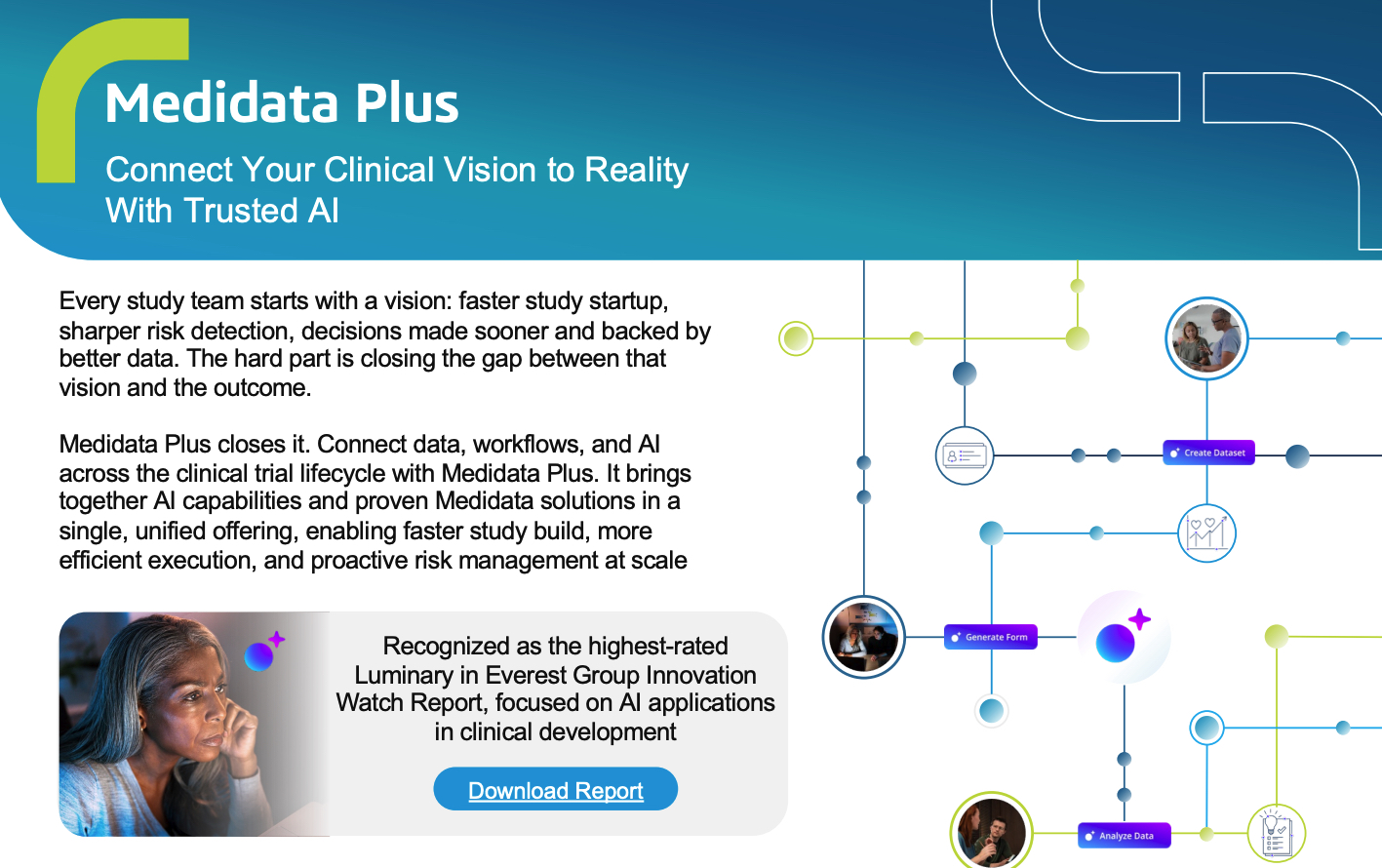
Medidata Launches Medidata Plus AI Layer for Clinical Trial Data Integration
- The AI: Medidata Plus is an enterprise AI layer designed to standardize and streamline clinical trial data workflows, replacing fragmented point-solution architectures that plague trial execution.
- Results: The platform consolidates disparate data sources and automates workflow management, reducing manual data handling and improving trial timeline predictability. Early feedback indicates faster query resolution and improved data quality.
- Significance: As clinical trials remain a major bottleneck in drug development, AI-driven standardization of trial operations could materially compress timelines and reduce costs. This positions Medidata as a central nervous system for trial execution across the industry.
AI Clinical Trials Market Projected to Reach $2.7B by 2035
- The AI: AI is being deployed across decentralized clinical trials, patient recruitment, protocol optimization, and real-time safety monitoring.
- Results: The market is projected to grow from USD 1.1 billion in 2025 to USD 2.7 billion by 2035, registering a CAGR of 9.2% during the forecast period. This reflects accelerating adoption across pharma and biotech sectors.
- Significance: Sustained growth in clinical trial AI indicates that sponsors are moving beyond pilots and embedding AI into standard operational workflows, signaling market maturation and confidence in ROI.
Funding & Deals
Healthcare AI Startups Raise $4.1B in Q2 2026
- What they do: Portfolio companies spanning clinical workflow automation, diagnostic support, revenue cycle optimization, and care coordination tools.
- Investors: Includes strategic capital from health systems, insurance companies, and venture firms focused on healthcare transformation.
- Why it matters: Q2 2026 funding surpassed $4.1 billion across 120+ deals, demonstrating that institutional investors see immediate near-term revenue opportunities and positive unit economics in healthcare AI. This capital concentration accelerates consolidation and winner-take-most dynamics in key verticals.
Digital Health Funding Hits $7.4B in H1 2026
- What they do: Broader digital health ecosystem including AI, telehealth, care management, and RCM platforms.
- Investors: Early 2026 saw 19 companies raise megadeals ($100M+), representing 45% of all capital invested in the sector.
- Why it matters: The rebound to $7.4B H1 funding signals that the digital health winter has ended. Capital is flowing heavily toward companies with proven clinical integration and near-term revenue visibility—a shift from the speculation-driven funding of 2021–2022.
Research Spotlight
Toward a Test of Medical AI Superintelligence
- Published in: Nature Medicine (July 27, 2026)
- Key finding: The paper argues that existing benchmarks for evaluating medical AI are misleading and fail to capture real-world clinical performance. Researchers call for a rigorous, task-based framework to define and measure medical AI "superintelligence"—one that accounts for the complexity of actual clinical workflows.
- Clinical relevance: As healthcare organizations deploy AI systems into mission-critical workflows, rigorous performance measurement becomes essential to preventing overconfidence and ensuring accountability. This work establishes a foundation for standardized AI evaluation in clinical settings.
General-Purpose LLMs Outperform Specialized Clinical AI Tools on Medical Benchmarks
- Published in: Nature Medicine (June 12, 2026)
- Key finding: A quantitative comparison of specialized clinical AI tools (OpenEvidence, UpToDate Expert AI) and general-purpose LLMs found that general-purpose models matched or exceeded specialized tools on multiple medical knowledge benchmarks, raising questions about the value proposition of specialized medical AI systems.
- Clinical relevance: This finding challenges the narrative that specialized AI architectures are necessary for healthcare. It suggests that general-purpose AI may be sufficient for many clinical decision-support tasks, potentially shifting investment and development priorities toward customization and integration rather than specialized model architectures.
What to Watch Next Week
- FDA regulatory guidance updates: Watch for potential new rulings on real-world performance data requirements for AI medical devices, following increased pressure from Congress on transparency.
- Healthcare AI conference announcements: Major health IT conferences (e.g., HIMSS discussions, health tech summits) will likely showcase new clinical deployments and provide insight into enterprise adoption timelines.
- Venture funding activity: Monitor for Series B/C rounds from clinical workflow and care coordination AI startups, indicating sustained investor confidence in specific verticals.
- CMS implementation details: Stay alert for CMS white papers detailing the proposed payment framework for clinical software and AI—this could reshape incentives across the vendor ecosystem.
Reader Action Items
-
For healthcare executives: CMS's shift toward outcome-based AI payment models means you should begin documenting clinical impact metrics (workflow time reduction, error reduction, patient outcomes) for any AI systems you deploy. Early measurement will position you to maximize reimbursement when new payment codes launch.
-
For AI/ML practitioners: The finding that general-purpose LLMs outperform specialized clinical AI on benchmarks suggests investing in domain customization, real-world validation, and clinical integration workflows rather than architectural innovation. Focus on deployment and measurement, not model novelty.
-
For investors: The $4.1B Q2 funding volume and $7.4B H1 tally indicate the market is consolidating around companies with demonstrated clinical workflows and near-term revenue. Early-stage speculative bets are giving way to scaled growth plays—time to shift allocation toward later-stage companies with proven unit economics.
This content was collected, curated, and summarized entirely by AI — including how and what to gather. It may contain inaccuracies. Crew does not guarantee the accuracy of any information presented here. Always verify facts on your own before acting on them. Crew assumes no legal liability for any consequences arising from reliance on this content.
Powered by
