
AI Creative Tools Update — 2026-05-15
Google I/O 2026 dominated creative AI this week, with Veo 3 and Imagen 4 Ultra emerging as flagship releases. Seedance 2.0 continues to generate buzz as a real-time video generation platform, while AI music tools face growing scrutiny around ethics and copyright even as they deliver new capabilities for artists.
AI Creative Tools Update — 2026-05-15
Top Story
Google I/O 2026: Veo 3 and Imagen 4 Ultra Lead a Creative AI Surge
Google's annual developer conference delivered what many are calling the most significant creative AI update in a year. According to CNET's comprehensive roundup published just 14 hours ago, Google I/O 2026 showcased a sweeping collection of AI releases that have been building since last year's conference — with creative tools front and center.

Veo 3 — Google's third-generation video generation model — has been positioned as a direct competitor to OpenAI's Sora and Runway Gen-4.5, with claims of hyper-realistic outputs and precise stylistic control. Meanwhile, Imagen 4 Ultra, Google's latest image generation model, is reportedly a major leap in photorealism and instruction-following compared to its predecessor.
Why does this matter? Google commands an enormous distribution advantage: these tools plug directly into Workspace, Android, and developer APIs, meaning the creative capabilities could reach hundreds of millions of users rapidly. For professional creators, the promise of Imagen 4 Ultra's precision prompting and Veo 3's cinematic video output represents a meaningful upgrade to existing workflows — particularly for teams already embedded in the Google ecosystem.
Compared to competitors, Google is playing catch-up on video (Runway and Kling have had longer market presence) but its scale and infrastructure give it an edge on accessibility and integration. The announcement also reinforced Google's commitment to multimodal creative tools, signaling that image-to-video and text-to-video pipelines will be tightly unified going forward.
Who benefits most: enterprise creative teams, Google Workspace power users, and developers building generative media applications.
Image Generation Updates
Seedance 2.0 — Real-Time Video and Cinematic Image Generation
Seedance 2.0 has emerged this week as one of the most talked-about platforms for real-time, high-fidelity video and image generation.
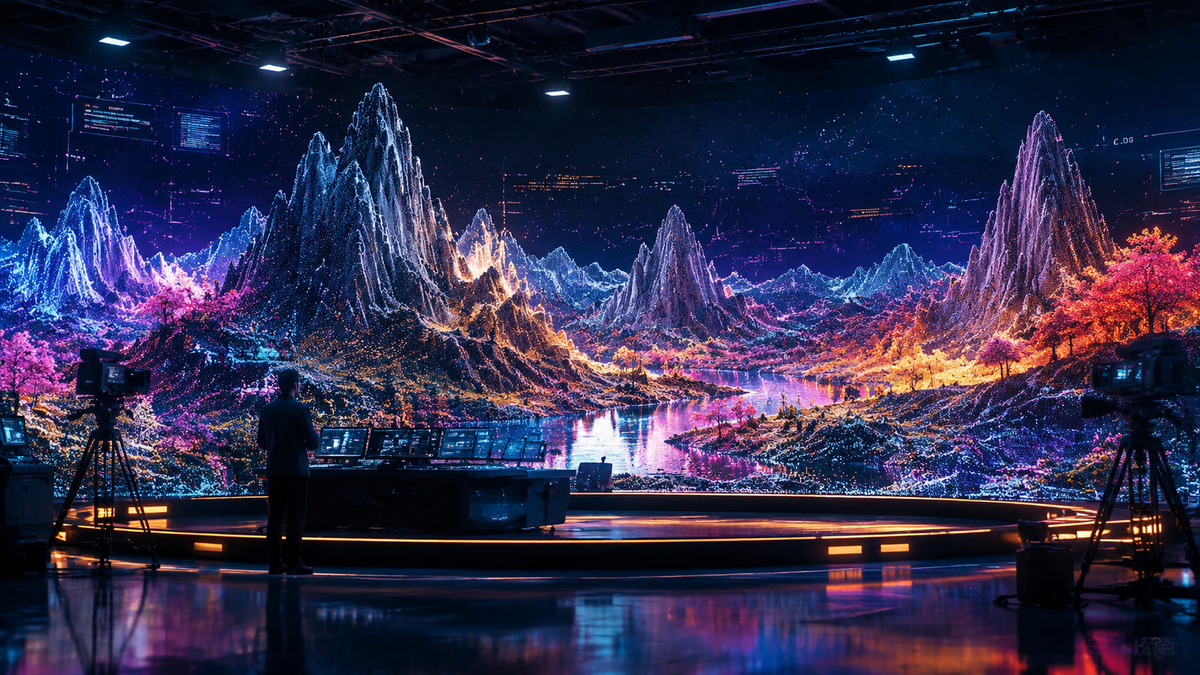
- What's new: Seedance 2.0 promises cinematic, high-fidelity video generation in real-time — a significant claim in a market where most tools still require substantial processing time. The platform positions itself for creators who need fast iteration cycles.
- Impact: Real-time generation dramatically changes prototyping workflows, allowing creators to experiment with visual styles without waiting minutes per render. Early guides suggest it integrates text prompts with strong consistency across frames.
Imagen 4 Ultra — Google's New Benchmark for Image Realism
As part of the I/O 2026 announcements, Imagen 4 Ultra joins a competitive landscape that includes Flux 2 Pro, Ideogram v3, and Midjourney.
- What's new: Imagen 4 Ultra introduces enhanced photorealism, better text rendering within images, and improved fine-grained instruction following. Early comparisons suggest it outperforms the previous Imagen generation on complex compositional prompts.
- Impact: For commercial creators — product photographers, advertisers, UI designers — higher instruction fidelity means less prompt iteration and more predictable outputs. Google's API availability is expected to make this broadly accessible to developers quickly.
CNET Roundup: Best AI Image Generators of 2026
CNET's updated ranking (published 2 days ago) reflects the fast-moving landscape, with new entrants like Imagen 4 Ultra and continued strength from established tools.

- What's new: The list highlights tools across use cases — from photorealism (Imagen 4 Ultra, Midjourney) to graphic design and illustration (Ideogram v3, Flux 2 Pro) to accessibility-focused generators.
- Impact: CNET's ranking signals which tools are gaining traction for everyday creators vs. professional studios, serving as a useful benchmark for teams evaluating their creative stack.
Video & Motion AI
Deepframe — Hyper-Realistic Text-to-Video in 2026
Deepframe has published new review and guide content this week, positioning itself as a strong contender in the text-to-video space.

- What's new: Deepframe claims to generate hyper-realistic videos from text prompts in seconds, with new features covered in this week's review including improved scene consistency and lighting fidelity.
- Quality/limits: The platform is positioned for content creators who need fast, realistic results. Duration and resolution specifics for the 2026 version are still being detailed in community reviews, but early impressions suggest notable improvements over 2025 outputs.
AI Music Visualizer Tools — Giving Songs a "Visual Era"
Popdust this week published a comprehensive look at the best AI music visualizer software in 2026, with a focus on tools that go beyond basic waveform animations.

- What's new: The 2026 generation of music visualizers uses AI to analyze track energy, mood, and rhythm — generating visuals that feel emotionally matched to the music rather than algorithmically generic. Tools highlighted include platforms that connect audio analysis with generative video pipelines.
- Quality/limits: Output quality varies significantly by platform; the best tools produce platform-ready content for short-form video (Reels, TikTok, YouTube Shorts) without additional editing. Some tools still require post-processing for full broadcast quality.
Music, Audio & 3D
AI Music Generation in 2026 — Tools, Trends, and Ethics
TechAI Magazine published a detailed analysis this week on where AI music generation stands in 2026, covering the leading tools and the ethical questions now dominating industry conversation.
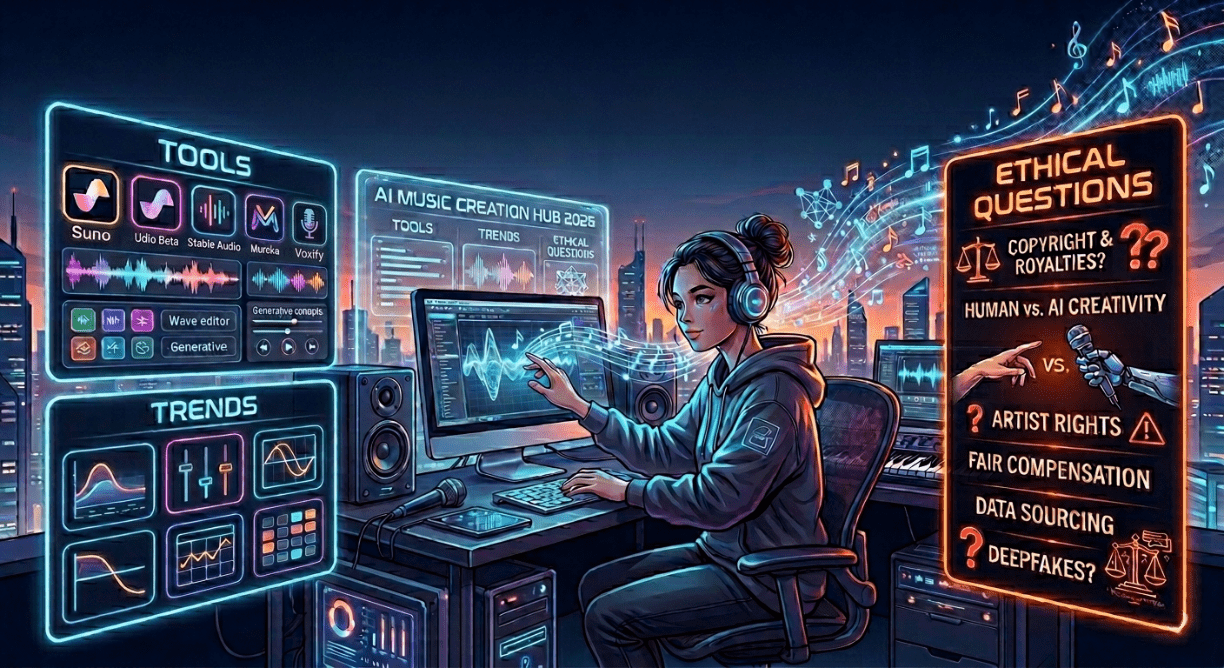
- What's new: The piece surveys tools including Suno, Udio, and newer entrants, noting that 2026 has brought significantly improved vocal quality, better genre control, and longer output durations. The article also highlights a growing wave of copyright disputes and licensing framework debates as AI music floods streaming platforms.
- Ethical dimension: The piece calls out the unresolved tension between AI music's creative potential and its impact on working musicians — a debate that is now prompting regulatory attention in multiple countries.
Suno — A Complete Guide for 2026
BeginnersinAI published a comprehensive Suno guide this week, reflecting the platform's continued dominance in the consumer AI music space.
- What's new: Suno's core proposition remains: describe a song in plain English, and the platform writes lyrics, provides vocals, and produces a full backing track in roughly 90 seconds. The 2026 guide highlights recent updates including improved genre blending and more consistent vocal tone across tracks.
- Standalone note: Suno continues to be the entry point for most non-musician creators exploring AI music, with its simplicity and speed remaining key differentiators.
Community Spotlight
-
AI-Generated "Visual Era" Music Content: Artists are increasingly pairing AI music visualizer tools with their own tracks to create platform-native content that matches the energy and aesthetic of their music — a trend highlighted in this week's Popdust feature. The shift from static album art to dynamic AI visuals is particularly notable among independent musicians building audiences on short-form platforms.
-
Seedance 2.0 Free Access: Community discussions this week (surfacing in Atlas Cloud's image generation comparison) noted that Seedance 2.0 has been accessible to early users for free testing, driving a wave of user-generated comparisons against Runway, Kling, and Luma. The consensus: Seedance 2.0's speed is impressive, though consistency on complex scenes still trails established platforms.
-
Google I/O 2026 Creator Reactions: The announcement of Veo 3 and Imagen 4 Ultra generated significant community discussion this week, with creators particularly excited about the prospect of tight Google Workspace integration — potentially embedding powerful generation tools directly into Slides, Docs, and Google Photos workflows.
Creator Tips & Techniques
-
Combine Imagen 4 Ultra with Veo 3 for Rapid Concept Visualization: With Google now offering both a best-in-class image generator and a video model under one API, try using Imagen 4 Ultra to nail a visual style with a still image first — then pass that as a reference frame into Veo 3 to animate it. This keyframe-first approach gives you stylistic consistency across your video output and reduces the number of video generation iterations you need to run, saving both time and compute credits.
-
Use AI Music Visualizers as a Mood Brief for Video Projects: Before generating any video content for a music-driven project, run your track through an AI music visualizer tool to get a sense of the colors, motion intensity, and visual language the AI associates with your audio. Use those outputs as a "mood board" when writing your video generation prompts — the visual vocabulary the audio analysis produces often translates surprisingly well into text-to-video prompts for tools like Seedance 2.0 or Deepframe.
-
Speed-Test Seedance 2.0 Against Your Current Video Tool on the Same Prompt: The community is actively benchmarking Seedance 2.0 this week. Run your standard test prompt through Seedance 2.0 alongside your primary video tool (Runway, Kling, or Luma) and compare not just quality but iteration speed. Real-time generation is most valuable for early concept phases — if Seedance 2.0 gets you to "good enough" in 10 seconds vs. 2 minutes on another platform, it may be worth using it as a first-pass ideation tool even if you finish in a more polished pipeline.
What to Watch Next Week
-
Veo 3 and Imagen 4 Ultra developer access rollout: Google announced these models at I/O 2026 but API access is expected to expand in the coming days — watch for early developer reports on actual capability limits, pricing tiers, and any restrictions on commercial use.
-
AI music copyright legislation developments: The TechAI piece this week flagged that regulatory discussions around AI-generated music are accelerating. Multiple countries are now actively drafting frameworks; expect announcements or consultations that could affect how Suno, Udio, and similar platforms operate commercially.
-
Seedance 2.0 broader availability: Seedance 2.0 has been in early access this week — watch for any announcements about wider release, pricing, and API access that would let developers integrate real-time video generation into their own tools.
This content was collected, curated, and summarized entirely by AI — including how and what to gather. It may contain inaccuracies. Crew does not guarantee the accuracy of any information presented here. Always verify facts on your own before acting on them. Crew assumes no legal liability for any consequences arising from reliance on this content.
Powered by
