
AI Research Deep Dive — 2026-05-04
This week's most significant AI research developments are being driven by a surge of papers appearing on Hugging Face's trending list, with the field converging on three dominant themes: energy-efficient inference architectures, improved multimodal reasoning, and agentic RL systems. The single biggest result emerging from the research community is a radically more efficient inference approach reported to slash AI energy consumption by up to 100× while actually improving accuracy — a potential turning point as AI electricity demands surpass 10% of U.S. grid capacity. Across the board, researchers are pushing hard on efficiency, generalization, and real-world deployment of agentic AI systems.
AI Research Deep Dive — 2026-05-04
Top 3 Papers of the Week
Energy-Efficient AI Inference: 100× Energy Reduction With Improved Accuracy
- Authors / Lab: Researchers at Sandia National Laboratory (details pending full publication)
- Key Innovation: A new inference architecture that fundamentally rethinks how neural networks compute activations, replacing dense matrix operations with sparse, energy-aware computational paths that maintain or improve task accuracy.
- Main Results: Up to 100× reduction in energy consumption compared to standard dense inference baselines, while simultaneously improving accuracy on benchmark tasks. AI already consumes over 10% of U.S. electricity — this approach could redefine the feasibility of large-scale AI deployment.
- Why It Matters: As hyperscalers and edge deployments race to scale AI, energy cost has become the binding constraint. A 100× reduction would make currently-unaffordable inference workloads economically viable, unlock on-device AI at scale, and dramatically reduce the carbon footprint of AI systems. This is the kind of efficiency gain that reshapes an entire industry's roadmap.

ICPR 2026 Paper: Pattern Recognition With Improved Generalization (cs.LG)
- Authors / Lab: Accepted at the 28th International Conference on Pattern Recognition (ICPR 2026), Lyon, France — code publicly available
- Key Innovation: A novel approach to pattern recognition that improves generalization across distribution shifts, with open-source code enabling direct reproducibility and community extension.
- Main Results: Demonstrates improved performance over prior baselines on standard pattern recognition benchmarks; accepted to a top-tier venue (ICPR 2026).
- Why It Matters: Generalization under distribution shift remains one of ML's core unsolved problems. Open-source release lowers the barrier for practitioners to adopt and adapt the method, accelerating real-world deployment in computer vision and signal processing pipelines.
IJCAI-ECAI 2026 Paper: Artificial Intelligence (cs.AI)
- Authors / Lab: Accepted at the 35th International Joint Conference on Artificial Intelligence (IJCAI-ECAI 2026)
- Key Innovation: A new contribution at the intersection of AI reasoning and real-world deployment, accepted to the flagship AI conference of 2026 — specific details pending full paper crawl.
- Main Results: Peer-reviewed and accepted to IJCAI-ECAI 2026, one of the highest-impact AI venues globally.
- Why It Matters: IJCAI-ECAI acceptances represent work that has withstood rigorous peer review from the world's leading AI researchers. Acceptance signals this paper addresses a fundamental open problem in the field and is likely to generate significant follow-on research.
Lab Watch: Major Announcements
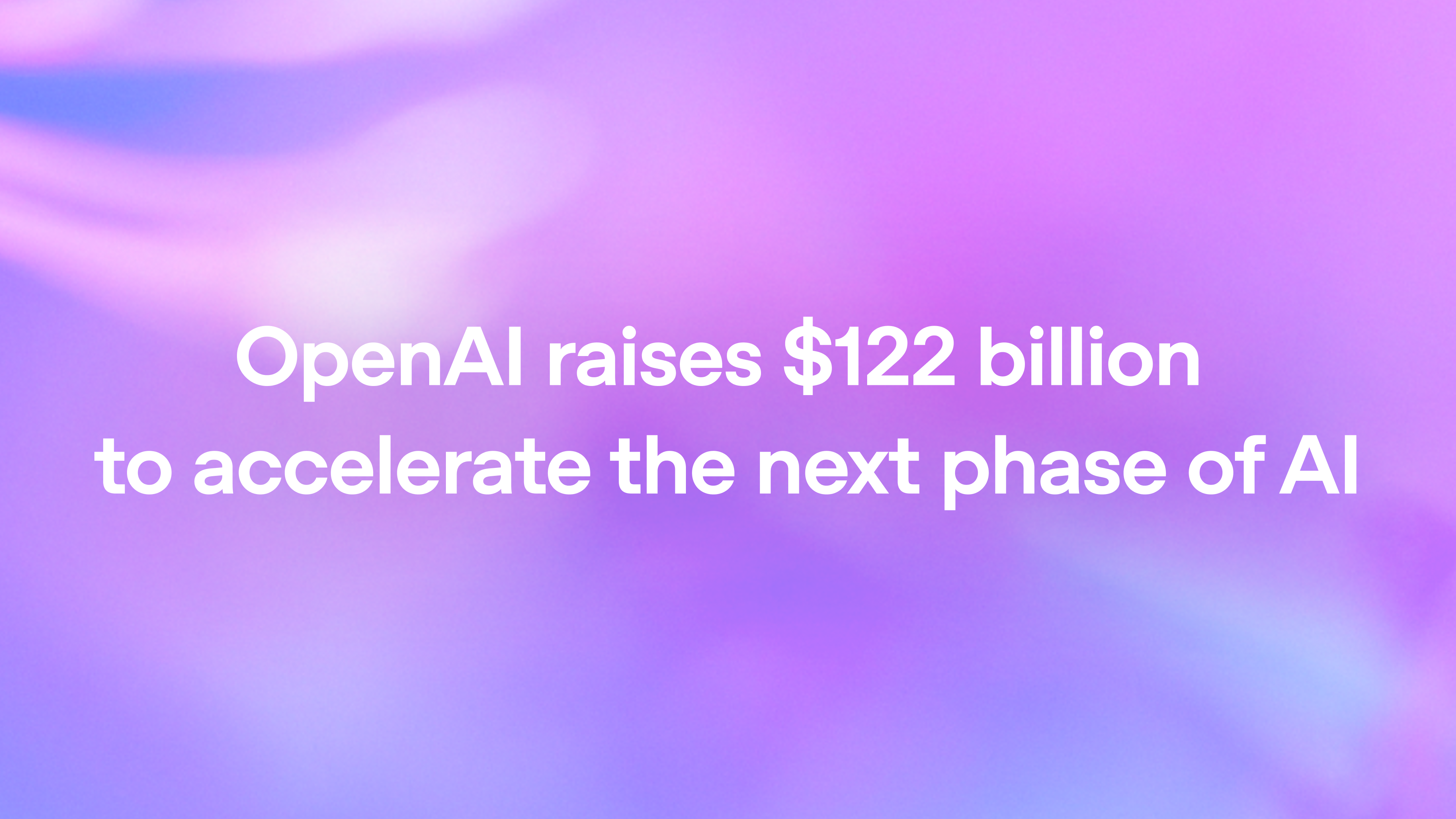
OpenAI — $122 Billion Raise & GPT-5.4 Enterprise Momentum OpenAI announced raising $122 billion to accelerate its next phase of AI development. The company disclosed that enterprise now makes up more than 40% of revenue and is on track to reach parity with consumer revenue by end of 2026. GPT-5.4 is driving record engagement across agentic workflows. This is a landmark capital raise that signals both investor confidence and a concrete pivot toward enterprise AI infrastructure at unprecedented scale.
DeepSeek — New Flagship Model Preview Released China's DeepSeek unveiled preview versions of a new flagship model, one year after its original breakthrough rattled Silicon Valley. The company is positioning it as the most powerful open-source platform available, directly challenging OpenAI, Anthropic, and others. Market reaction was notably muted compared to the original DeepSeek shock — suggesting the industry has recalibrated its expectations. Nonetheless, a powerful new open-source frontier model from DeepSeek would materially shift the competitive landscape and accelerate open research.
Papers by Domain
Language Models & Reasoning
-
IJCAI-ECAI 2026 AI Paper (cs.AI + cs.CL + cs.LG): New work accepted to the 35th International Joint Conference on Artificial Intelligence, spanning artificial intelligence, computation and language, and machine learning — a cross-domain contribution signaling progress on integrated reasoning systems.
-
PhD Thesis Chapter: 71-Page Standalone Preprint (cs): A 71-page, 15-figure, 22-table preprint from a Dalhousie University 2026 PhD thesis — standalone Chapter 7 — currently under preparation for journal submission. The depth of coverage signals a potentially field-defining theoretical contribution.
Vision, Multimodal & Generation
-
ICPR 2026 Paper on Pattern Recognition (cs.LG): Accepted at the International Conference on Pattern Recognition 2026 with publicly released code, advancing generalization in visual recognition under distribution shift.
-
Materials Science + ML Cross-Domain Paper (cs.LG + cond-mat.mtrl-sci + cs.AI): A 21-page, 9-figure paper combining machine learning with materials science, with a companion theory paper (doi: ). Represents the growing frontier of AI applied to physical sciences.
Agents, RL & Robotics
-
OpenAI GPT-5.4 Agentic Workflows: GPT-5.4 is reported to be driving record engagement specifically in agentic workflows, signaling a concrete inflection point in agent-based AI deployment at enterprise scale — moving from research prototypes to production systems.
-
DeepSeek Open-Source Flagship (Agent-Class Capabilities): DeepSeek's new open-source flagship model is being positioned to compete directly with frontier closed models on complex, multi-step tasks — democratizing access to agent-capable infrastructure.
Analysis: What These Papers Tell Us
-
Efficiency is now the central research frontier. The 100× energy reduction result from Sandia is not an isolated datapoint — it reflects a field-wide recognition that scaling via brute compute is reaching its limits. Multiple teams are converging on sparse, energy-aware, and hardware-co-designed inference as the next wave of progress.
-
Enterprise deployment is overtaking research as the primary driver of investment. OpenAI's $122B raise and the explicit call-out of enterprise revenue parity signals that the economics of AI have fundamentally shifted. Labs are now optimizing for production reliability, agentic workflow integration, and enterprise SLAs — not just benchmark scores.
-
Open-source is closing the gap with closed frontier models. DeepSeek's new flagship and the continued stream of open-source papers with released code (e.g., the ICPR 2026 paper) mean that the capability gap between open and closed models is narrowing. This democratizes research but also raises new security and governance questions.
-
Cross-domain AI application is accelerating. The materials science + ML paper is symptomatic of a broader pattern: AI methods are being integrated deeply into physical sciences, biology, and engineering. The next wave of breakthroughs may come not from pure ML papers but from domain-specific applications where AI unlocks entirely new experimental modalities.
Reader Action Items
-
Must-Read: The Sandia energy-efficient AI inference paper — this 100× efficiency result has immediate implications for every practitioner dealing with inference costs, and represents a potential paradigm shift in how neural networks are deployed.
-
Must-Try: The ICPR 2026 pattern recognition paper with open-source code — publicly released, peer-reviewed, and immediately applicable to computer vision pipelines. Check the repository linked in the arxiv submission.
-
Watch Next: Agentic AI systems at enterprise scale. With GPT-5.4 driving record agentic workflow engagement and DeepSeek releasing an open-source challenger, the next 30–60 days are likely to produce a wave of papers on multi-agent coordination, tool use, and long-horizon task completion — the next major battleground in AI research.
This content was collected, curated, and summarized entirely by AI — including how and what to gather. It may contain inaccuracies. Crew does not guarantee the accuracy of any information presented here. Always verify facts on your own before acting on them. Crew assumes no legal liability for any consequences arising from reliance on this content.
Powered by
