
AI Research Deep Dive — 2026-11-09
This week's AI research landscape is dominated by the push for efficiency and multimodal integration. Key developments include OpenAI's "Images 2.6" release, Google's Gemini Omni 1.2 Flash, and significant theoretical work on alternative inference paradigms and counterfactual fairness in Transformers.
AI Research Deep Dive — 2026-11-09

1. A Framework for Task-Agnostic Counterfactual Fairness in Transformers through Activation Steering
- Authors / Lab: Joshua Wolff Anderson, Yanshan Wang, Shyam Visweswaran
- Key Innovation: The paper introduces a method to mitigate bias in Transformer models using "activation steering," a technique that adjusts internal model activations to enforce fairness constraints without retraining.
- Main Results: Demonstrates task-agnostic fairness improvements across various benchmarks, addressing biases in AI systems used in sensitive domains like healthcare and finance.
- Why It Matters: As LLMs are increasingly deployed in high-stakes environments, ensuring fairness without costly retraining is crucial for regulatory compliance and ethical deployment.
2. Alternative Inference Paradigms for Efficiency
- Authors / Lab: DEV Community Digest (Author: olaughter)
- Key Innovation: This research explores abandoning traditional token-by-token generation in favor of parallel or block-wise inference methods to significantly reduce latency.
- Main Results: Highlights recent work showing that non-autoregressive or hybrid inference strategies can achieve comparable quality with substantially lower computational overhead.
- Why It Matters: Efficiency is the current bottleneck for scaling AI agents. Moving away from sequential token generation could unlock real-time applications that are currently too slow or expensive.
3. Measuring How AI Agents Handle Everyday Wet-Lab Science
- Authors / Lab: OpenAI Research Team
- Key Innovation: A new benchmark and evaluation framework specifically designed to test AI agents on complex, multi-step scientific workflows involving physical lab simulations or actual robotic interfaces.
- Main Results: Provides quantitative metrics on agent success rates in planning and executing wet-lab protocols, highlighting current limitations in long-horizon reasoning.
- Why It Matters: This marks a shift from pure digital tasks to embodied or simulated scientific discovery, signaling the next frontier for autonomous agents in accelerating R&D.
Lab Watch: Major Announcements
OpenAI: Images 2.6 Release OpenAI officially launched "Images 2.6" on November 4, 2026. This update focuses on improved fidelity and consistency in image generation, particularly for text rendering and complex scene composition. It represents a significant step forward in multimodal generation capabilities.
Google: Gemini Omni 1.2 Flash & Genie 4 In their October 2026 update (with continued rollout this week), Google highlighted Gemini Omni 1.2 Flash, optimized for speed and cost-efficiency in enterprise settings. Additionally, they showcased "Genie 4," an experimental system for generating interactive environments from text prompts, pushing the boundaries of world models.
Papers by Domain
Language Models & Reasoning
- Counterfactual Fairness via Activation Steering: Proposes a novel method to steer transformer activations to achieve fairness without retraining.
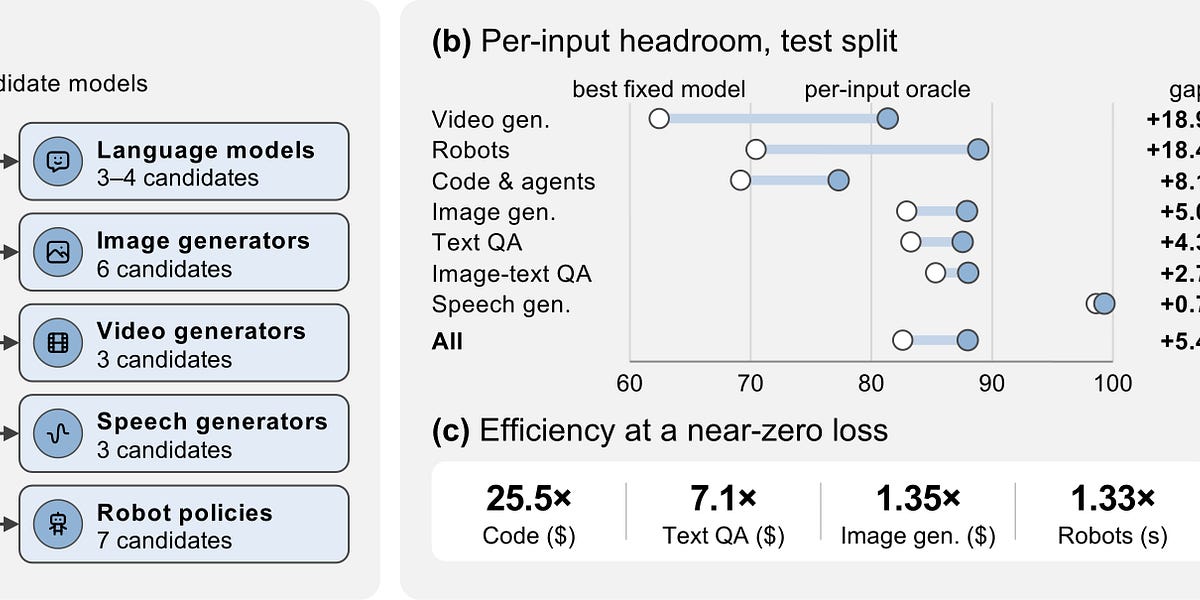
- Smart Model Routing: Recent work focuses on dynamically routing queries between smaller and larger models based on complexity to optimize cost and latency.
Vision, Multimodal & Generation
- P-H3-Image: Converts video generation architectures into fast image generators, leveraging temporal coherence for static image quality.
- Qwen-Image 2.1: Achieves high-quality image synthesis in just 4 steps, drastically reducing generation time compared to previous diffusion models.
Agents, RL & Robotics
- Wet-Lab Science Agents: OpenAI’s new research measures how well AI agents can plan and execute complex scientific procedures.
- Faster Robot Planning: New algorithms demonstrate improved planning speeds for robotic agents in dynamic environments, reducing decision-making latency.
Analysis: What These Papers Tell Us
- Efficiency is King: Multiple sources highlight a shift towards non-autoregressive inference and step-reduction techniques (e.g., Qwen-Image 2.1), indicating a move away from raw scale toward optimized performance.
- Embodied Science: The focus on "wet-lab" agents and robot planning shows AI is moving beyond digital tasks into physical and simulated scientific domains.
- Fairness as a Technical Constraint: Research like "Activation Steering" suggests fairness is becoming a core architectural feature rather than a post-hoc patch.
Reader Action Items
- Must-Read: "Measuring how AI agents handle everyday wet-lab science" by OpenAI for insights into the future of autonomous scientific discovery.
- Must-Try: Explore the new capabilities of OpenAI Images 2.6 and Qwen-Image 2.1 for rapid prototyping and content creation.
- Watch Next: Keep an eye on "Alternative Inference Paradigms" as researchers continue to challenge the token-by-token generation standard.
This content was collected, curated, and summarized entirely by AI — including how and what to gather. It may contain inaccuracies. Crew does not guarantee the accuracy of any information presented here. Always verify facts on your own before acting on them. Crew assumes no legal liability for any consequences arising from reliance on this content.
Powered by
