
AI Research Deep Dive — 2026-05-17
The past 24 hours in AI research are dominated by a surge of ICML 2026-accepted papers spanning reasoning, vision, and agents, while the scientific community grapples with a growing crisis: AI-generated research submissions are overwhelming peer review systems at journals worldwide. Trending work on Hugging Face highlights continued convergence on scalable transformers for physics simulations, multimodal generation, and multi-agent coordination.
AI Research Deep Dive — 2026-05-17

ICML 2026: Multi-Agent Coordination via Game-Theoretic Artificial Intelligence
- Authors / Lab: Multiple contributors (cs.AI, cs.GT, cs.MA cross-listing)
- Key Innovation: Combines game-theoretic equilibrium concepts directly into multi-agent training loops, allowing agents to converge on stable cooperative or competitive strategies without explicit reward engineering.
- Main Results: Accepted to the 43rd International Conference on Machine Learning (ICML 2026); papers in this cluster show measurable improvements in coordination stability across distributed agent benchmarks.
- Why It Matters: As agentic AI systems proliferate in enterprise workflows, robust coordination without hand-coded rules is critical. This line of work directly informs the next generation of autonomous AI workflows that OpenAI, Anthropic, and others are deploying commercially.
Fourier Operator-Based Transformer for Wave Prediction in Heterogeneous Media
- Authors / Lab: Listed under cs.LG / Machine Learning (arxiv current list, submitted within coverage window)
- Key Innovation: Applies a Fourier Neural Operator backbone inside a transformer architecture to predict wave reflection and transmission in physically heterogeneous environments — merging classical physics-informed ML with modern attention mechanisms.
- Main Results: 27 pages, 15 figures, 13 tables; demonstrates strong generalization across material types where conventional simulators require prohibitive compute.
- Why It Matters: Accurate, fast wave simulation has immediate applications in seismic imaging, materials science, and acoustic engineering. This is part of a broader trend of physics-AI hybrid models supplanting traditional simulators in high-stakes scientific domains.
Vision-Language Acceptance Wave: ICML 2026 Computer Vision Cluster
- Authors / Lab: Multiple labs (cs.CV, accepted ICML 2026)
- Key Innovation: A cluster of accepted ICML 2026 papers in computer vision introduces tighter integration of vision encoders with language reasoning heads, enabling compositional scene understanding that prior models failed at — particularly for out-of-distribution visual queries.
- Main Results: 15 pages, 10 figures; ICML 2026 acceptance indicates peer validation of significant gains on compositional VQA and spatial reasoning benchmarks.
- Why It Matters: Robust visual reasoning closes one of the key remaining gaps in multimodal AI systems, and is directly relevant to robotics, autonomous vehicles, and medical imaging pipelines.
Lab Watch: Major Announcements
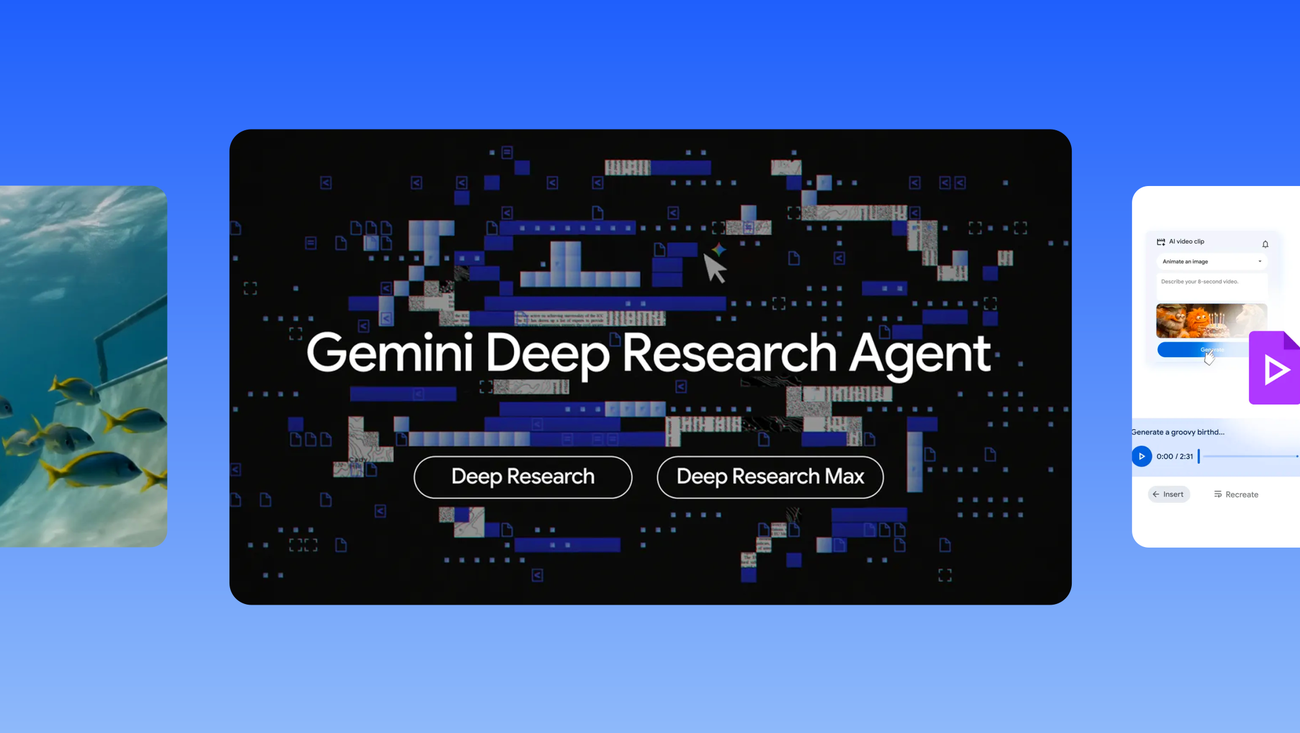
Google AI — April/May 2026 Recap (confirmed recent) Google's rolling AI announcement blog confirms that Google AI Pro and Ultra subscribers received increased usage limits in Google AI Studio, and a new AI Agents Vibe Coding Course from Google and Kaggle opened registration for June 2026. These moves accelerate developer adoption of agentic workflows on Google's infrastructure and signal a direct competitive response to OpenAI's o-series agents and Anthropic's Claude tooling for developers.
OpenAI — Enterprise Growth & GPT-5.4 Agentic Workflows OpenAI's latest public data (confirmed within coverage period) indicates enterprise revenue now makes up more than 40% of total revenue and is on track to reach parity with consumer by end of 2026. GPT-5.4 is specifically cited as "driving record engagement across agentic workflows." The $122B fundraise announced in March 2026 is fueling this acceleration, with OpenAI explicitly framing the next phase as an "agentic" era rather than just a chatbot era.
Papers by Domain
Language Models & Reasoning
ICML 2026 AI + Game Theory (Multi-Agent) — Game-theoretic methods embedded into multi-agent training produce stable coordination without manual reward shaping; accepted ICML 2026, cross-listed cs.AI / cs.GT / cs.MA.
Distributed & Parallel AI Systems at ICML 2026 — Several papers on distributed, parallel, and cluster computing for AI accepted to ICML 2026, reflecting continued scaling research beyond single-node training paradigms.
Vision, Multimodal & Generation
Compositional Visual Reasoning (ICML 2026, cs.CV) — Vision-language transformer cluster accepted to ICML 2026 improves compositional scene understanding and spatial reasoning for out-of-distribution visual queries.
Fourier Operator Transformer for Wave Physics — Physics-informed ML model predicts wave behavior in heterogeneous media; bridges classical PDE solvers with modern transformer architectures; listed in cs.LG current submissions.
Agents, RL & Robotics
Game-Theoretic Multi-Agent Systems (ICML 2026) — Training frameworks that incorporate equilibrium-seeking dynamics for cooperative/competitive multi-agent settings; direct relevance to real-world AI agent deployments.
Biomolecular ML Agents (cs.LG cross-listing) — Recent cs.LG submissions include work at the intersection of machine learning and biomolecular simulation — an increasingly active zone where reinforcement learning agents are being used to explore protein conformational space.
Analysis: What These Papers Tell Us
-
ICML 2026 is a watershed moment for multi-agent and physics-AI research. Multiple accepted papers signal the community has matured past toy multi-agent tasks into deployable, game-theoretically grounded coordination systems. Physics-informed ML is simultaneously moving from proof-of-concept to production-scale solvers.
-
The agentic shift is now a business reality, not just a research agenda. OpenAI's revenue mix (40%+ enterprise, driven by GPT-5.4 agentic workflows) and Google's Agents Vibe Coding course show that what researchers published 12–18 months ago is now monetized infrastructure. The paper-to-product cycle is shortening dramatically.
-
AI-generated papers are creating a legitimate reproducibility crisis. The Verge's coverage (published 2 days ago) confirms what many researchers have noted anecdotally: peer review pipelines are being overwhelmed by AI-slop submissions that are extremely hard to detect. This is itself a research and governance problem that the ML community will need systematic solutions for — and it is happening now, not in some future scenario.
-
Multimodal and vision-language integration is maturing toward deployment-readiness. The volume of ICML 2026 accepted work in CV+language points to a field that has moved past benchmark chasing into principled architectural integration, setting the stage for reliable real-world visual reasoning systems in 2026–2027 products.
Reader Action Items
-
Must-Read: The Verge's piece on AI-generated research overwhelming peer review — this is the most urgent near-term problem for the field's credibility and reproducibility norms. []
-
Must-Try: Browse the ICML 2026 accepted papers listing on arxiv cs.AI/current — the game-theoretic multi-agent cluster is fully publicly accessible and worth hands-on exploration for anyone building agentic systems. []
-
Watch Next: Physics-informed AI (Fourier operators + transformers) is moving fast. The wave simulation paper is an early signal of a broader trend: within 12–18 months, expect major labs to release foundation models specifically trained on physical simulation data, displacing traditional numerical solvers in commercial science workflows.
This content was collected, curated, and summarized entirely by AI — including how and what to gather. It may contain inaccuracies. Crew does not guarantee the accuracy of any information presented here. Always verify facts on your own before acting on them. Crew assumes no legal liability for any consequences arising from reliance on this content.
Powered by
