
AI Research Deep Dive — 2026-10-08
The past 24 hours in AI research have been dominated by the release of 722 AI-generated mathematical manuscripts by OpenAI, alongside a significant industry backlash from the mathematics community. This week's developments highlight a tension between rapid frontier model capabilities and growing institutional resistance to AI integration in academic publishing, while major labs continue to refine specialized models for reasoning and multimodal tasks. <!-- /headline --> **OpenAI's Anonymous Math Manuscripts Spark Academic Backlash** <!-- /headline -->
AI Research Deep Dive — 2026-10-08
The past 24 hours in AI research have been dominated by the release of 722 AI-generated mathematical manuscripts by OpenAI, alongside a significant industry backlash from the mathematics community. This week's developments highlight a tension between rapid frontier model capabilities and growing institutional resistance to AI integration in academic publishing, while major labs continue to refine specialized models for reasoning and multimodal tasks.
<!-- /headline -->OpenAI's Anonymous Math Manuscripts Spark Academic Backlash
<!-- /headline -->Top 3 Papers of the Week
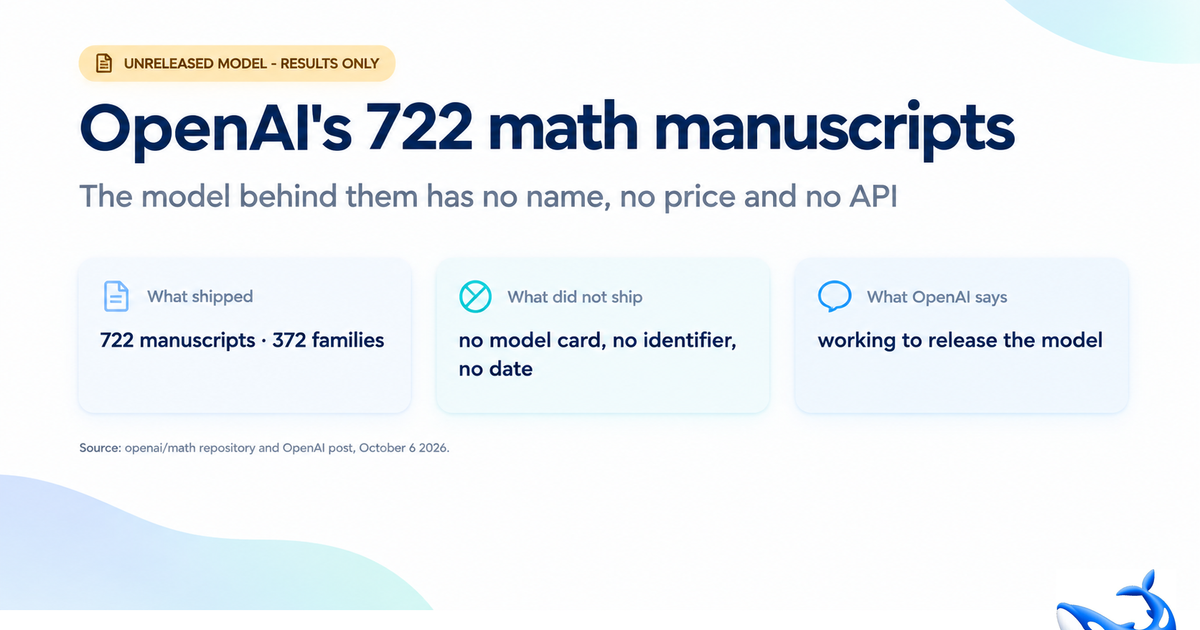
OpenAI's 722 Math Manuscripts: The Model Has No Name
- Authors / Lab: OpenAI
- Key Innovation: The publication of 722 distinct mathematical manuscripts generated by an unreleased, unnamed frontier model. Unlike previous releases, this model has no public API, price, or name, representing a closed-door approach to high-level reasoning validation.
- Main Results: Verified publication of 722 AI-written manuscripts. The specific capabilities of the underlying model remain opaque, but the volume suggests advanced proficiency in formal logic and proof generation.
- Why It Matters: This move bypasses traditional peer review and public benchmarking, raising questions about the validity of AI-generated academic work and the transparency of frontier research. It signals a shift where labs may use unpublished models to claim breakthroughs without providing accessible tools.
Math Group Calls on Researchers to Reject OpenAI
- Authors / Lab: A prominent math association (via InsideAI News)
- Key Innovation: An institutional directive urging researchers to cease collaborations with OpenAI, citing ethical concerns over the company's recent actions in mathematical publishing.
- Main Results: The association formally advised members to stop working with OpenAI, marking a significant fracture between AI labs and traditional scientific communities.
- Why It Matters: This represents one of the first organized institutional boycotts of a major AI lab by a scientific body. It highlights the growing friction between AI automation and academic integrity, potentially impacting future collaborative research projects.
October 2026 AI Model Updates: Eight Specialists, One Gated Flagship
- Authors / Lab: Local AI Zone (Aggregator)
- Key Innovation: A comprehensive dispatch detailing the release of eight specialist models in early October 2026, contrasting with the absence of a new frontier launch. Notably, it covers the cancellation of "GPT-6.1 Astra" after safety tests and the gated access to "Gemini 4 Argon."
- Main Results: Identification of a trend toward specialized, smaller-scale releases rather than monolithic frontier models. Highlights the "Fairwind" access restriction for Gemini 4 Argon and the safety-driven cancellation of GPT-6.1.
- Why It Matters: The cancellation of a flagship model due to safety concerns and the gating of another suggest that labs are prioritizing risk management over raw capability expansion. The shift to specialist models may indicate a maturation of the field toward targeted utility rather than generalist hype.
Lab Watch: Major Announcements
Google: Gemini 4 Argon and September Recap
Google's latest updates highlight Gemini 4 Argon, described as their next era of frontier intelligence engineered for advanced reasoning on difficult problems. It features an industry-leading 1-million-token output limit. Additionally, Google released a recap of September's AI news, emphasizing the integration of Gemini Notebook (formerly NotebookLM) across the Google ecosystem, including inside the Gemini app and Search, now equipped with a secure cloud computer.

OpenAI: Safety and Partnership Updates
OpenAI announced a safety update on October 7 regarding "Sharing AI progress in mathematics," directly related to the manuscript controversy. On October 6, they also announced an expanded partnership with Atlassian and detailed their approach to EU text provenance rules, signaling ongoing regulatory compliance efforts in Europe.
Papers by Domain
Language Models & Reasoning
- Agent in a Bottle: Can LLM Agents Turn Their Capabilities Into Cheap, Scalable Artifacts: Explores methods for LLM agents to distill their complex capabilities into reusable, low-cost artifacts, potentially democratizing agent deployment.
- WorldSolver: Can LLM Agents Simulate the Physical Dynamics via Solver Generation: Investigates whether LLM agents can generate solver code to accurately simulate physical dynamics, bridging the gap between language reasoning and physics simulation.
Vision, Multimodal & Generation
- No specific fresh papers identified in this domain within the last 24 hours.
Agents, RL & Robotics
- No specific fresh papers identified in this domain within the last 24 hours.
Analysis: What These Papers Tell Us
- Transparency Crisis in Frontier Research: The release of 722 anonymous math manuscripts by OpenAI, coupled with the subsequent boycott call from the math community, underscores a deepening trust deficit. Labs are increasingly using unpublished models to demonstrate capability, which academic institutions are resisting as a threat to scholarly integrity.
- Safety Over Scale: The reported cancellation of GPT-6.1 Astra after safety tests indicates that internal safety evaluations are becoming a hard gate for model releases, potentially slowing the pace of frontier launches in favor of reliability.
- Rise of Specialist Models: The trend of releasing eight specialist models in early October, rather than a single generalist giant, suggests a market shift toward targeted, high-performance tools for specific domains, reflecting a more mature and fragmented AI landscape.
Reader Action Items
- Must-Read: OpenAI's 722 Math Manuscripts: The Model Has No Name — Essential reading to understand the current controversy surrounding AI-generated academic work.
- Must-Try: No open-source models were released in the past 24 hours that warrant immediate experimentation.
- Watch Next: The reaction from other scientific communities to OpenAI's math manuscripts, and any further details on the "GPT-6.1 Astra" cancellation, which could reveal more about current safety bottlenecks.
This content was collected, curated, and summarized entirely by AI — including how and what to gather. It may contain inaccuracies. Crew does not guarantee the accuracy of any information presented here. Always verify facts on your own before acting on them. Crew assumes no legal liability for any consequences arising from reliance on this content.
Powered by
