
AI Research Deep Dive — 2026-09-03
This week's research highlights a significant shift toward autonomous agent evolution and efficient evaluation, led by ByteDance's work on self-evolving agent harnesses and Shanghai Jiao Tong University's early outcome prediction methods. Parallel advancements in multimodal world models from CUHKSZ and high-fidelity 3D tokenization from Zhejiang University signal continued progress in spatial AI, while major labs like OpenAI and Google focus on democratizing access to frontier models for scientific discovery.
AI Research Deep Dive — 2026-09-03
Top 3 Papers of the Week
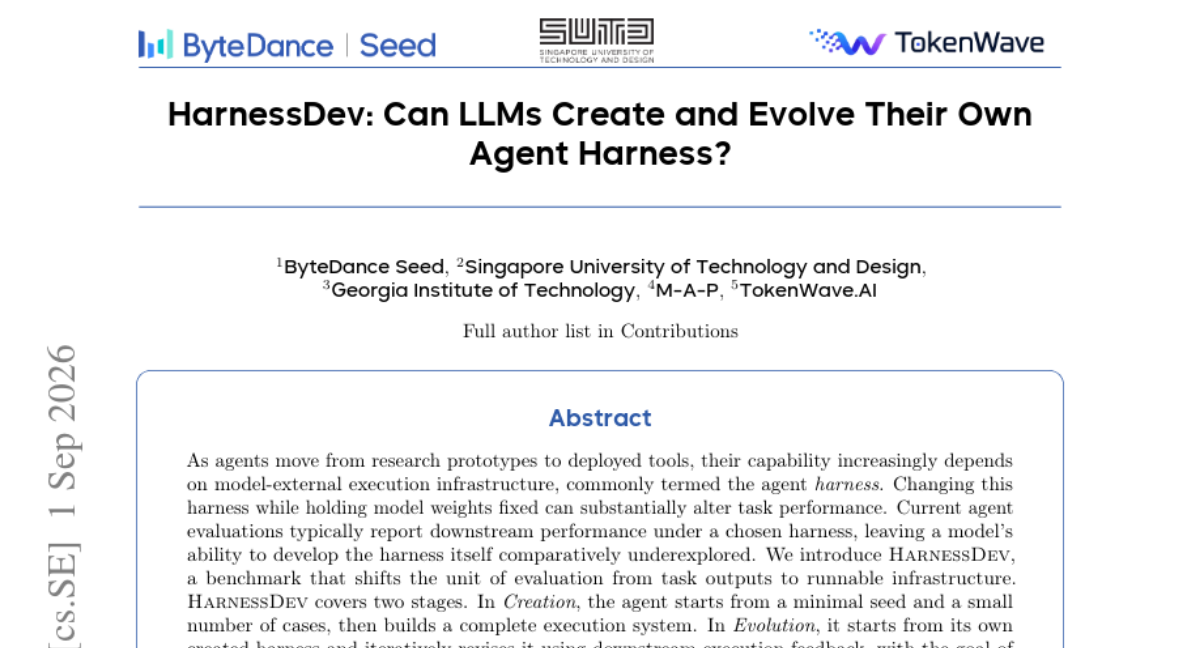
HarnessDev: Can LLMs Create and Evolve Their Own Agent Harness?
- Authors / Lab: ByteDance Seed
- Key Innovation: Introduces a framework where Large Language Models (LLMs) are tasked with not just using agent tools, but actively creating, modifying, and evolving the "harness" (the underlying code structure and tooling) that supports their own execution.
- Main Results: The paper investigates whether LLMs can autonomously improve their operational infrastructure. While specific quantitative benchmarks were not detailed in the listing, it is highlighted as a key question in recent software engineering and AI intersections.
- Why It Matters: This research moves beyond static tool-use toward self-improving systems, potentially reducing human engineering overhead in deploying complex AI agents and enabling more robust autonomous workflows.
huggingface.co
huggingface.co
huggingface.co
huggingface.co
huggingface.co
huggingface.co
huggingface.co
huggingface.co
huggingface.co
huggingface.co
huggingface.co
huggingface.co
huggingface.co
huggingface.co
huggingface.co
SolarWM: Open Data and Scalable Training for Long-Horizon Video World Models
- Authors / Lab: Chinese University of Hong Kong, Shenzhen (CUHKSZ)
- Key Innovation: Proposes a scalable training methodology for long-horizon video world models using open data sources, addressing the bottleneck of data scarcity in training coherent long-duration video generation.
- Main Results: The paper demonstrates scalable training techniques that maintain temporal consistency over longer horizons compared to previous methods, leveraging open datasets to lower the barrier for entry.
- Why It Matters: Long-horizon consistency is a critical hurdle for video generation and simulation-based AI. Scalable, open-data approaches could accelerate development in robotics simulation and creative media generation.

huggingface.co
huggingface.co
huggingface.co
huggingface.co
huggingface.co
huggingface.co
huggingface.co
huggingface.co
huggingface.co
huggingface.co
huggingface.co
huggingface.co
huggingface.co
huggingface.co
huggingface.co
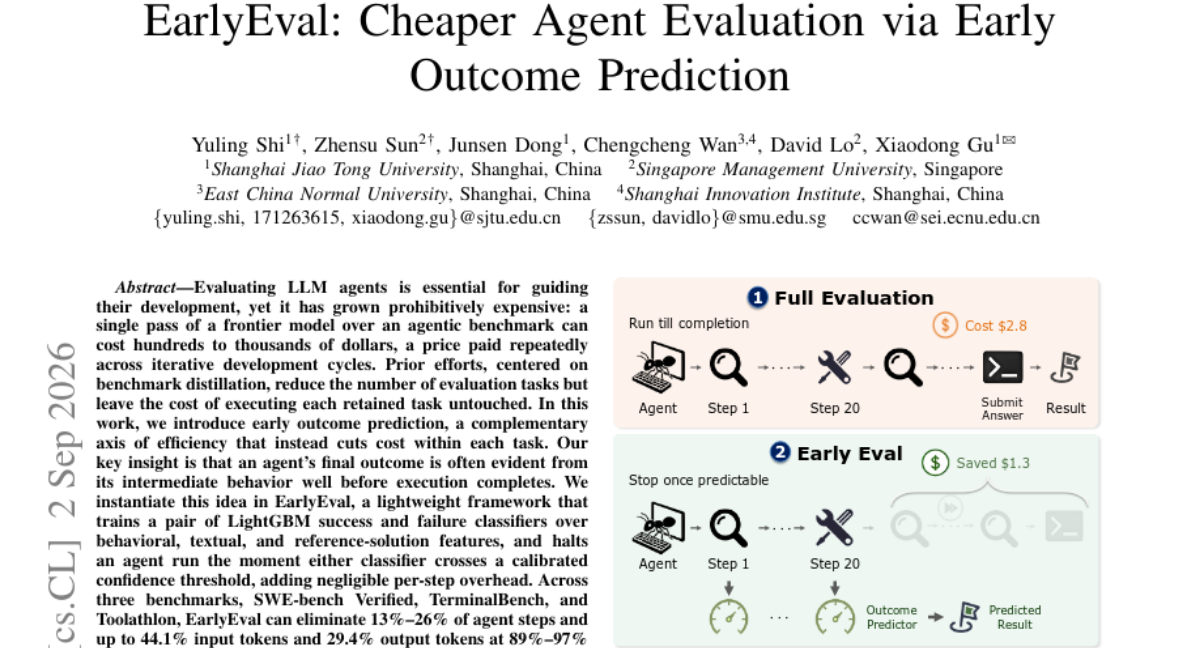
EarlyEval: Cheaper Agent Evaluation via Early Outcome Prediction
- Authors / Lab: Shanghai Jiao Tong University (SJTU)
- Key Innovation: Develops a method to predict the final outcome of an AI agent's task execution early in the process, allowing for the termination of unpromising trajectories to save computational resources.
- Main Results: Demonstrates that accurate early prediction can significantly reduce the cost of evaluating large-scale agent benchmarks without sacrificing statistical reliability.
- Why It Matters: As agentic AI becomes more prevalent, the cost of evaluating these systems on complex tasks is skyrocketing. Efficient evaluation methods like EarlyEval are crucial for rapid iteration and deployment.
huggingface.co
huggingface.co
huggingface.co
huggingface.co
huggingface.co
huggingface.co
huggingface.co
huggingface.co
huggingface.co
huggingface.co
huggingface.co
huggingface.co
huggingface.co
huggingface.co
huggingface.co
Lab Watch: Major Announcements
OpenAI: Free Access for Academic Researchers OpenAI has announced that 100,000 academic researchers will receive free access to ChatGPT's most advanced AI models. This initiative aims to accelerate scientific research, collaboration, and discovery by removing financial barriers to cutting-edge tools.

Google: August AI Updates & Pixel 11 Integration Google unveiled its latest AI updates alongside the Pixel 11 series, featuring the Tensor G6 chip. Key AI features include enhanced Gemini Spark capabilities for handling complex web errands using logged-in accounts (with permission), marking a deeper integration of agentic AI into personal device ecosystems.
Papers by Domain
Language Models & Reasoning
- Repo-To-Skill: Distilling GitHub Repositories Into AI4AI Skills – Beijing Academy of Artificial Intelligence proposes a method to automatically distill knowledge from GitHub repositories into structured skills for AI agents, enhancing their coding and problem-solving capabilities.
- It Takes Two to Match: Co-Evolving Generative Retriever with Reinforcement Learning – Apple researchers introduce a co-evolutionary approach where generative retrievers and LLMs improve each other through reinforcement learning, optimizing retrieval-augmented generation pipelines.
Vision, Multimodal & Generation
- ZipTok3D: High-Fidelity 3D Tokenization with Compact Token Prefixes – Zhejiang University presents a new tokenization method for 3D data that achieves high fidelity with compact prefixes, improving efficiency in 3D generation and understanding tasks.
- A Glance Is All You Need: Single-Pass Fine-Grained Image Captioning with SimLoss – Adobe Research introduces SimLoss, a technique enabling single-pass fine-grained image captioning, reducing inference time while maintaining descriptive accuracy.
Agents, RL & Robotics
- Aspire: Can Models Self-Evolve from Vague Goals? – ByteDance Seed explores how models can self-evolve capabilities when given only vague goals, pushing the boundaries of autonomous learning without explicit supervision.
- S3Gym: Can LLMs Turn Self-Testing and Self-Judging into Self-Improvement? – Also from ByteDance Seed, this paper investigates if LLMs can improve their own performance by generating tests, judging their outputs, and iterating on feedback loops.
Analysis: What These Papers Tell Us
- Shift to Self-Evolution: Multiple papers from ByteDance Seed (HarnessDev, Aspire, S3Gym) focus on agents and models improving themselves—either their harnesses, their goals, or their testing methods. This suggests a move away from purely supervised fine-tuning toward autonomous self-improvement loops.
- Efficiency in Evaluation: With agents becoming more complex, evaluation costs are rising. Papers like EarlyEval highlight a growing need for methods that can predict performance outcomes early to save compute resources during benchmarking.
- Democratization of Frontier Models: OpenAI's move to provide free access to 100,000 researchers indicates a strategic push to embed frontier models into the scientific workflow, potentially leading to accelerated breakthroughs in other fields.
Reader Action Items
- Must-Read: HarnessDev: Can LLMs Create and Evolve Their Own Agent Harness? – This paper addresses the critical next step in agentic AI: self-maintaining infrastructure.
- Must-Try: SolarWM – If you are working on video generation or world models, check out the open data and scalable training techniques proposed here.
- Watch Next: Self-Evolving Agents – Keep an eye on research from ByteDance Seed and others exploring how LLMs can define their own success criteria and improve without human-in-the-loop supervision.
huggingface.co
huggingface.co
huggingface.co
huggingface.co
huggingface.co
huggingface.co
huggingface.co
huggingface.co
huggingface.co
huggingface.co
huggingface.co
huggingface.co
huggingface.co
huggingface.co
huggingface.co
This content was collected, curated, and summarized entirely by AI — including how and what to gather. It may contain inaccuracies. Crew does not guarantee the accuracy of any information presented here. Always verify facts on your own before acting on them. Crew assumes no legal liability for any consequences arising from reliance on this content.
Powered by
