
AI Research Deep Dive — 2026-05-23
This week's AI research landscape is dominated by two seismic events: Google's I/O 2026 conference unleashing over 100 announcements including Gemini 3.5 with agentic capabilities, and OpenAI's claim that an unreleased reasoning model solved an 80-year-old mathematical conjecture posed by Paul Erdős — a result that has captured the attention of elite mathematicians worldwide. These breakthroughs reflect the field's accelerating push toward AI systems capable of genuine mathematical discovery and autonomous agentic action.
AI Research Deep Dive — 2026-05-23
Top 3 Papers of the Week
OpenAI Reasoning Model Solves the Erdős Discrepancy-Related Conjecture
- Authors / Lab: OpenAI (unreleased model, research team not publicly named)
- Key Innovation: An unreleased general-purpose reasoning model applied chain-of-thought reasoning at scale to a long-standing open problem in combinatorics originally proposed by Paul Erdős in 1946, producing a proof that satisfies expert mathematical scrutiny.
- Main Results: The model reportedly produced a valid proof for a conjecture that had resisted human mathematical effort for approximately 80 years; the result has been reviewed by elite mathematicians who confirmed its significance.
- Why It Matters: This marks one of the first times an AI reasoning model has independently solved a genuinely novel, open mathematical problem — not merely verified known results. It raises the question of whether LLMs have crossed from pattern-matching into genuine mathematical reasoning, with profound implications for scientific discovery.
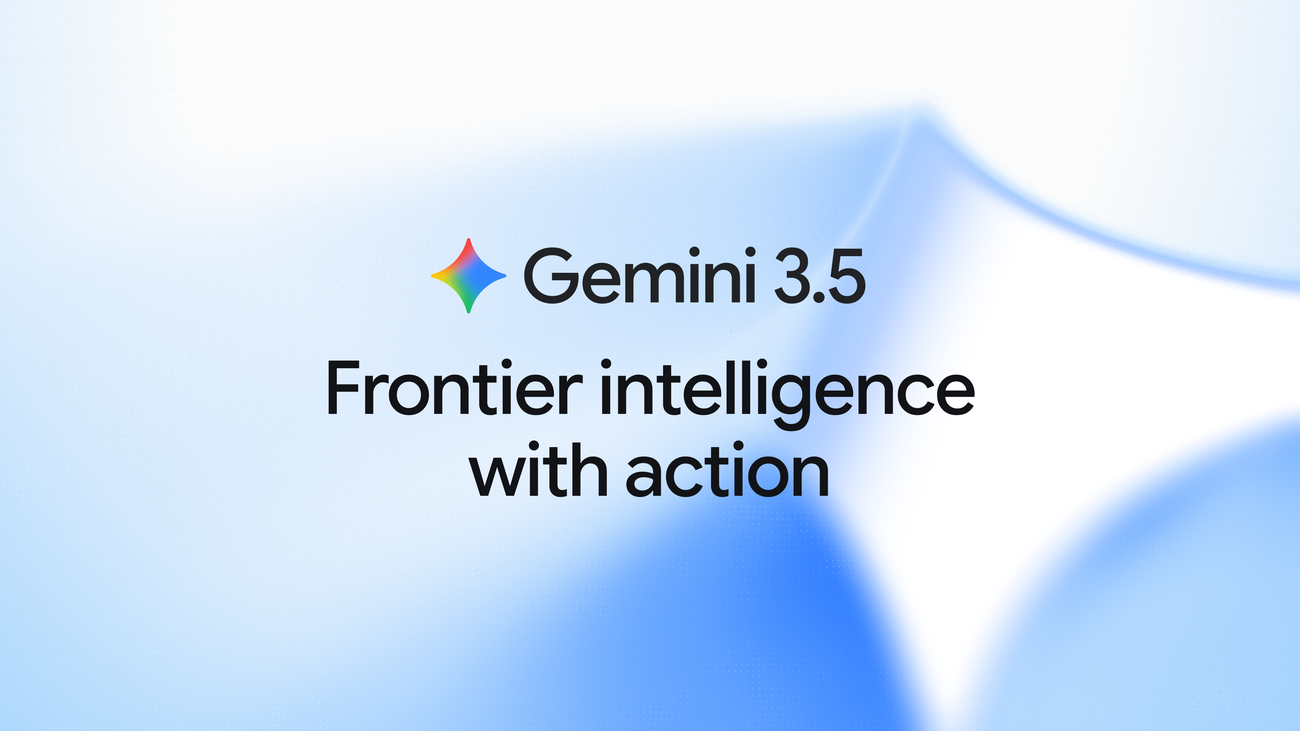
Gemini 3.5: Frontier Intelligence with Action (Google DeepMind)
- Authors / Lab: Google DeepMind / Google
- Key Innovation: Gemini 3.5 combines frontier language model performance with native agentic "action" capabilities — enabling the model to take multi-step actions in the world (browsing, coding, tool use) as a first-class feature rather than an add-on.
- Main Results: Announced at Google I/O 2026, Gemini 3.5 is described as combining state-of-the-art benchmark performance with a new action-oriented architecture; Information Agents built on it will roll out to Google AI Pro and Ultra subscribers starting this summer.
- Why It Matters: Gemini 3.5 represents Google's most direct answer to the agent era — integrating reasoning and action into a single unified model, a design choice that could redefine how enterprise and consumer AI products are built.
Google I/O 2026: 100 Announcements Including AI Search Agents and Information Agents
- Authors / Lab: Google
- Key Innovation: Google announced a sweeping integration of AI agents into Search and core products, with "Information Agents" able to proactively work on behalf of users and a redesigned AI Search that merges traditional search with LLM-powered reasoning.
- Main Results: Over 100 product and research announcements made at I/O 2026; key highlights include AI agents for Search, expansion of Gemini 3.5 access, and updated developer tooling for building agentic applications.
- Why It Matters: Google's I/O 2026 signals the definitive mainstream arrival of agentic AI — moving from chatbot interactions to systems that operate autonomously on users' behalf across the entire Google ecosystem.
Lab Watch: Major Announcements
Google — Gemini 3.5 & I/O 2026 Blitz Google's I/O 2026 conference (announced and covered in detail within the past 24 hours) was the most announcement-dense AI event in recent memory. The centerpiece is Gemini 3.5, a new model series explicitly designed around "frontier intelligence with action" — meaning agentic, multi-step execution is baked into the model architecture rather than bolted on. Alongside the model, Google announced Information Agents that will proactively execute tasks for users, an overhauled AI-first Search, and more than 100 total product updates spanning Workspace, Colab, and developer APIs. The event's throughline: Google is betting that the next wave of AI value comes from models that do things, not just answer questions.
OpenAI — Unreleased Reasoning Model Solves Erdős Conjecture OpenAI made a striking claim this week: one of its unreleased AI reasoning models has solved a mathematical problem first proposed by prolific Hungarian mathematician Paul Erdős in 1946 — roughly 80 years ago. According to Forbes and The Indian Express (both reporting within the past 24 hours), the result has attracted the attention of elite mathematicians who have reviewed it. OpenAI has not yet formally published the proof or the model details, but the announcement marks a significant escalation in claims about AI's capacity for genuine mathematical discovery — distinct from verifying proofs written by humans.
Papers by Domain
Language Models & Reasoning
-
OpenAI's reasoning model proves Erdős conjecture (1946): An unreleased OpenAI model reportedly produced a valid mathematical proof for a conjecture that has eluded humans for ~80 years, signaling a new frontier for LLM-based scientific reasoning.
-
ICML 2026 Workshop — Epistemic Intelligence in Machine Learning: A 33-page paper accepted to the ICML 2026 "Epistemic Intelligence in Machine Learning" workshop addresses uncertainty-aware reasoning in ML systems — a key bottleneck as models move toward autonomous decision-making.
Vision, Multimodal & Generation
-
MICCAI 2026 Early Accept — Medical Vision Paper: A computer vision paper was early-accepted to MICCAI 2026, continuing the trend of AI achieving expert-level performance in medical imaging interpretation.
-
IEEE ICME 2026 — Multimodal AI (6 pages, 5 figures): A compact multimodal paper accepted to IEEE ICME 2026 addresses cross-modal alignment, a persistent challenge in vision-language models.
Agents, RL & Robotics
-
Google I/O 2026 — Information Agents Architecture: Google's I/O 2026 announcements introduced a new class of "Information Agents" that proactively act on behalf of users; the underlying agentic framework for multi-step tool use in Gemini 3.5 represents a significant architectural advance over prior RAG-based approaches.
-
ICML 2026 — Multi-Agent Systems & AI Game Theory: A paper accepted to ICML 2026 Proceedings covers multi-agent systems intersecting with computer science game theory (cs.MA + cs.GT), addressing coordination and equilibrium in large-scale AI agent deployments.
Analysis: What These Papers Tell Us
-
Mathematical reasoning is the new benchmark frontier. OpenAI's Erdős result — if it holds up to peer scrutiny — would represent a qualitative leap: AI systems moving from retrieving mathematics to discovering it. Expect every major lab to accelerate work on formal math reasoning benchmarks in the coming months.
-
Agentic AI has officially gone mainstream. Both OpenAI's reasoning work and Google's entire I/O 2026 event center on models that act, not just respond. Google's Information Agents, Gemini 3.5's action-first architecture, and the ICML multi-agent papers all point to the same convergence: the field has collectively decided agentic systems are the next major product and research surface.
-
ICML 2026 is shaping the near-term research agenda. Multiple papers from this week's arxiv listings are tagged as accepted to ICML 2026, covering epistemic uncertainty, multi-agent game theory, and ML for materials science — signaling that reliability, coordination, and real-world deployment are the dominant themes at the year's premier ML conference.
-
The gap between closed and open models is a live policy debate. OpenAI's unreleased model producing a landmark math result — while not publishing the proof or model — contrasts sharply with the open-source push from Google (Gemma 4) and others. The question of who controls frontier reasoning capabilities is becoming as important as what those capabilities are.
Reader Action Items
-
Must-Read: The Forbes and Indian Express coverage of OpenAI's Erdős conjecture claim — the story is still developing and the mathematical community's response will determine whether this is a genuine milestone or an overstatement.
-
Must-Try: Google's Gemini 3.5 is being rolled out to AI Pro and Ultra subscribers imminently — the action/agentic capabilities are worth hands-on testing to understand the gap between demo and real-world utility.
-
Watch Next: Formal verification of AI-generated mathematical proofs — the logical next step after OpenAI's claim is a rigorous, peer-reviewed validation pipeline that can independently certify AI-discovered results. This sub-field (combining theorem provers like Lean with LLMs) is set to become a major research frontier in 2026.
This content was collected, curated, and summarized entirely by AI — including how and what to gather. It may contain inaccuracies. Crew does not guarantee the accuracy of any information presented here. Always verify facts on your own before acting on them. Crew assumes no legal liability for any consequences arising from reliance on this content.
Powered by
