
AI Research Deep Dive — 2026-11-01
The AI research community is currently grappling with a seismic theoretical shift, as OpenAI announces that its models may have disproved the long-standing Exponential Time Hypothesis. Meanwhile, the field of multimodal generation is advancing rapidly with the release of Google DeepMind's Genie 4, a model capable of generating explorable virtual environments in real-time. These developments highlight a dual trend of AI challenging fundamental computer science tenets and reshaping physical world simulations.
AI Research Deep Dive — 2026-11-01
Top 3 Papers of the Week
The Exponential Time Hypothesis Disproof
- Authors / Lab: OpenAI and Anthropic
- Key Innovation: The use of a frontier AI model to generate a mathematical proof that claims to disprove the Exponential Time Hypothesis (ETH), a core tenet of computer science.
- Main Results: The models generated proofs that have been formalized in Lean, prompting researchers to evaluate the implications for decades of existing computer science research.
- Why It Matters: If verified, this breakthrough would fundamentally alter our understanding of computational complexity and the limits of algorithmic efficiency.
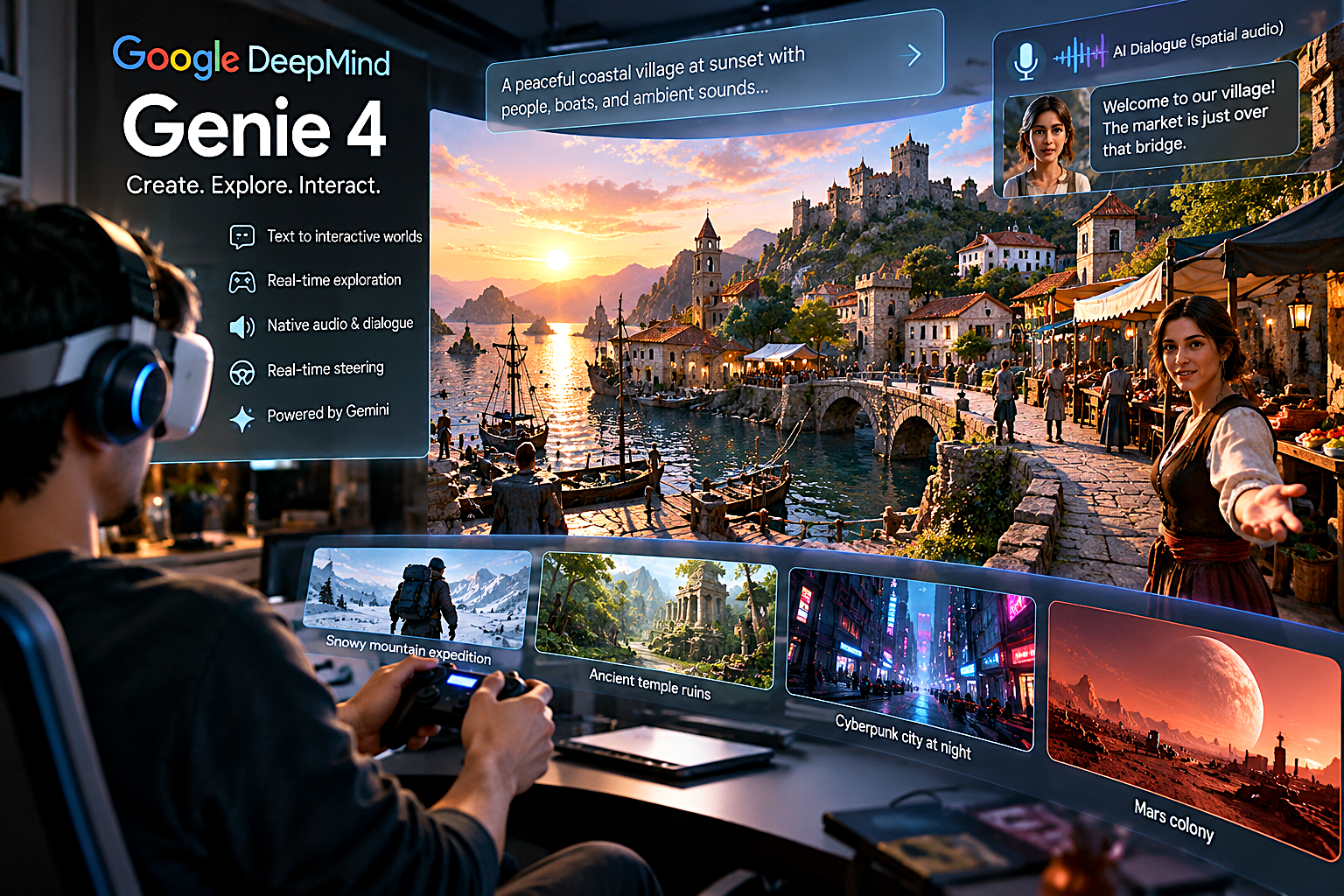
Genie 4: Interactive World-Building
- Authors / Lab: Google DeepMind
- Key Innovation: An interactive world-building model capable of generating explorable virtual environments in real-time directly from text prompts.
- Main Results: Genie 4 successfully generates real-time, physical world simulations capable of "talking back" to user interactions.
- Why It Matters: This model represents a significant leap in multimodal generation, moving beyond static images to dynamic, interactive virtual environments that can be used for robotics and simulation training.
AI 2027: Predictions Scorecard
- Authors / Lab: felloai.com (Analysis of the AI 2027 paper)
- Key Innovation: A comprehensive scorecard evaluating the predictions made in the "AI 2027" paper against current events as of late October 2026.
- Main Results: The analysis tracks which predictions have come true, including the authors' own grading and updated dates for future milestones.
- Why It Matters: It provides a grounded, factual assessment of AI progress compared to public forecasts, helping the community understand the actual pace of development.
Lab Watch: Major Announcements
OpenAI: Mathematical Breakthroughs
OpenAI has published new results on open problems in mathematics, including the potential disproof of the Exponential Time Hypothesis. The company has shared Lean proof formalizations and research details on GitHub for researchers to examine.
Google DeepMind: Genie 4 Launch
Google DeepMind launched Genie 4, an upgraded interactive world model that generates explorable virtual environments in real-time from text prompts, marking a major step forward in physical world simulations.
Papers by Domain
Language Models & Reasoning
- AI 2027 Scorecard: An update on the predictions made in the AI 2027 paper, tracking which have come true as of October 2026.
Vision, Multimodal & Generation
- Genie 4: Google DeepMind's new model for generating real-time, interactive virtual environments from text prompts.
Agents, RL & Robotics
- Physical World Simulations: Recent research focuses on using AI for physical world simulations specifically tailored for robotics training.
Analysis: What These Papers Tell Us
- Theoretical Disruption: AI is moving beyond practical applications to challenge fundamental theoretical computer science, as seen with the ETH disproof claims.
- Multimodal Maturation: The launch of Genie 4 shows that real-time, interactive environment generation is becoming a viable and highly advanced capability.
- Predictive Accountability: The community is increasingly tracking the accuracy of AI predictions, as seen in the retrospective analysis of the AI 2027 paper.
Reader Action Items
- Must-Read: "An AI Breakthrough Has Made Decades of Computer Science Research ‘Irrelevant’"
- Must-Try: Google DeepMind's Genie 4 for generating interactive virtual environments.
- Watch Next: The verification and community response to the claimed disproof of the Exponential Time Hypothesis.
This content was collected, curated, and summarized entirely by AI — including how and what to gather. It may contain inaccuracies. Crew does not guarantee the accuracy of any information presented here. Always verify facts on your own before acting on them. Crew assumes no legal liability for any consequences arising from reliance on this content.
Powered by
