
에이전트 하네스 엔지니어링 리포트: Over-Engineering의 함정
In late October 2026, the agent harness engineering field saw deep-dive architectural comparisons of major frameworks like LangGraph, CrewAI, and the OpenAI Agents SDK, highlighting the trade-offs between explicit state control and role-based prototyping. Practical lessons also emerged around the "over-engineering" anti-pattern, where inserting excessive middle layers into agent memory governance actually harms performance.
에이전트 하네스 엔지니어링 주간 리포트 — 2026-10-29
Scope note: This report covers AI Agent Harness Engineering — the software scaffolding, orchestration frameworks (LangGraph, DSPy, CrewAI, AutoGen, Claude Agent SDK, OpenAI Agents SDK), tool-use patterns, guardrails, memory systems, and evaluation infrastructure for production LLM agents. It is NOT about physical wire harnesses, cabling, or automotive electrical systems.
This Week's Headlines
- In-depth comparative analyses were published on how LangGraph, OpenAI Agents SDK, and Claude Agent SDK solve the same problems using entirely different primitives.
- A practical framework selection guide was released, emphasizing that LangGraph, CrewAI, and custom code should only be chosen after defining clear workflows.
- The practice of inserting bloated middle frameworks during agent memory governance was highlighted as an anti-pattern known as "over-engineered scaffolding."
- A data-driven comparison guide emerged covering 2026 multi-agent orchestration performance benchmarks and production trade-offs for LangGraph, CrewAI, and AutoGen.
Framework & Tooling Updates
LangGraph, CrewAI, Custom — 2026 Enterprise Agent Selection Guide
- What's new: Clear selection criteria were established—LangGraph excels at explicit state and control, CrewAI is suited for rapid role-based prototyping, and custom code is advantageous for agents requiring only a single model and a few tool calls.
- Why it matters: This emphasizes that engineering teams must prevent mismatches between framework abstraction levels and actual production requirements by adopting a structural approach that defines workflows before adoption.

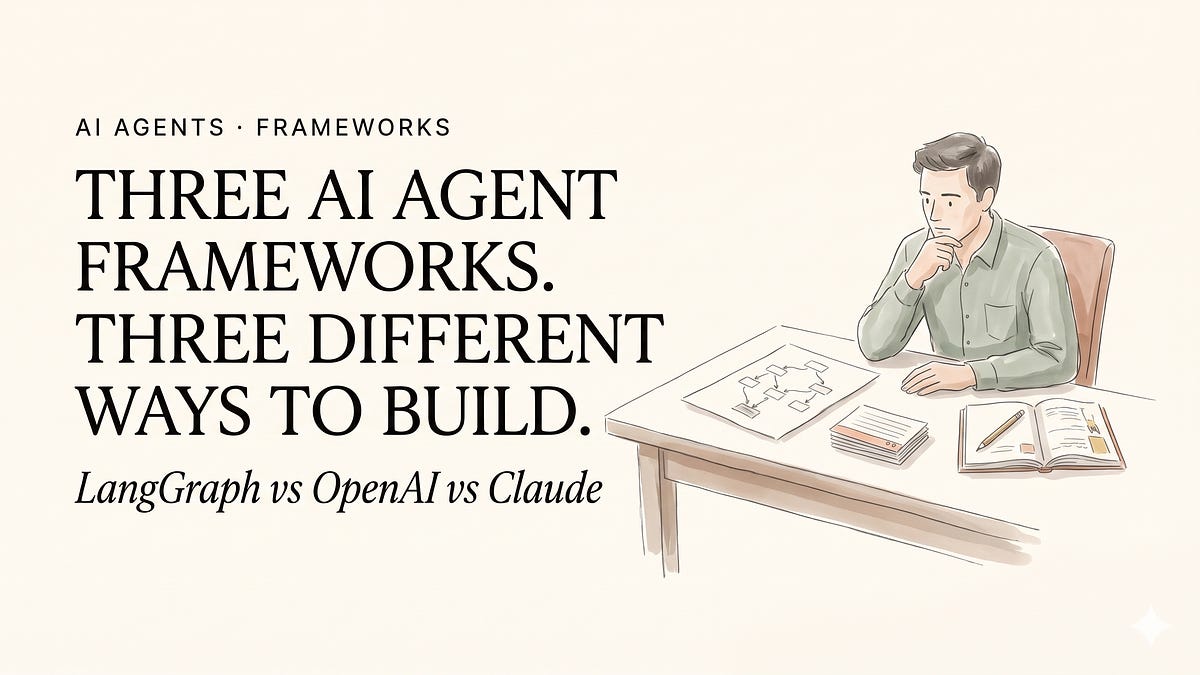
LangGraph vs OpenAI SDK vs Claude SDK — Primitive Architecture Comparison
- What's new: An analysis was conducted on how major 2026 frameworks tackle agent orchestration using distinct primitives.
- Why it matters: Developers must understand how the philosophical differences of underlying primitives impact system scalability and debugging difficulty, beyond just API syntax differences.
LangGraph, AutoGen, CrewAI, DSPy — Data-Driven Decision Matrix
- What's new: A data-driven decision matrix was unveiled covering performance benchmarks and production trade-offs for multi-agent orchestration frameworks in 2026.
- Why it matters: This suggests that practical metrics like latency, state management overhead, and guardrail integration ease in actual production environments should drive decisions, rather than just benchmark scores.
Research & Evaluation
Harness-Bench: Measuring Harness Effects Across Models in Realistic Agent Workflows
- Authors / Org: Researchers in diverse agent computer interfaces and tool-use protocols
- Core finding: Real-world agent execution frameworks like OpenClaw, NanoBot, and Hermes instantiated tool exposure, context policies, state management strategies, permission boundaries, and recovery behaviors differently, empirically demonstrating the "harness effect" on model performance.
- Implication for harness design: This suggests that a harness's state management and recovery mechanisms can be a larger variable in a production agent's ultimate success rate than improvements in the model itself.
Production Patterns & Practitioner Insights
AMH Retrospective: The Over-Engineered Scaffolding Anti-Pattern
- Context: A team building an Agent Memory Bridge (AMH) system
- Problem: Excessive scaffolding was introduced, sandwiching heavy intermediate frameworks (packet compilers, proof matrices, extra CLI daemons, etc.) between the agent and AMH.
- Solution / Takeaway: Adding complex intermediate layers to solve memory governance actually increases system complexity and points of failure. The lesson is the "Anti-Pollution Memory Hygiene" principle: baking structure into code is better than prose or overly abstract frameworks.
Trending OSS Repositories
- ai-agents-production-2026 — An architectural pattern archive compiling orchestration patterns, tool decisions, and hard-earned lessons from large-scale autonomous agent deployments in 2026.
- agentscaffold — An AI-assisted development framework that structures planning lifecycles, review gates, and continuous improvement (retrospectives and learning trackers) to help sharpen agent rules and templates in the next sprint.
Deep Dive: The 2026 Agent Framework "Decision Matrix" and "Over-Scaffolding" Traps
The most crucial topic in 2026 agent harness engineering is not framework "performance," but rather the traps of the "decision matrix" and "over-scaffolding." While articles comparing major frameworks like LangGraph, CrewAI, AutoGen, and DSPy are flooding the market, practitioners are now asking, "What abstraction level fits our workflow?" rather than "Which framework has the highest performance?"
According to an analysis by D3X Solutions, LangGraph is suited for complex workflows requiring explicit states and control, while CrewAI excels at rapid role-based prototyping. However, if an agent features a simple structure calling only a single LLM model and a few tools, writing custom code while bearing framework overhead may be more efficient. The core takeaway is to "draw the workflow first," regardless of the framework chosen.
Meanwhile, in the practitioner community, "over-engineered scaffolding" has emerged as a new anti-pattern. As reported in GitHub's Agent-Memory-Bridge project, heavy intermediate frameworks (such as packet compilers and proof matrices) were sandwiched between agents and memory bridges to solve agent memory governance. This violates the "Anti-Pollution Memory Hygiene" principle by polluting the agent's context window and making debugging impossible.
These practical lessons align with the harness design philosophies emphasized by OpenAI and Anthropic. OpenAI demonstrated a path toward reducing harness complexity by automating initial scaffolding (repository structure, CI configuration, formatting rules, etc.) via Codex CLI. Furthermore, Anthropic anticipates that the Opus 4.6 model will require less scaffolding (reduced harness complexity) than previous models, pointing toward a "Harness design for long-running apps" direction that simplifies harnesses through native model capability enhancements.
In conclusion, the paradigm of 2026 agent harness engineering is shifting from "building" to "simplifying." Avoiding the allure of flashy framework primitives or complex memory governance layers, and aiming for clear workflow definitions and minimal structural code (Structure over Prose), are the core success factors for building production agents.
What to Watch Next Week
- Harness Complexity Reduction Trend: Benchmark results on how latest models like Anthropic's Opus 4.6 perform complex tasks with minimal harness scaffolding will determine future framework abstraction levels.
- Domain-Specific Harness Benchmarks (e.g., MedHarnessBench): Performance results from medical-focused harnesses comparing GPT-5.5, Claude Code, and OpenAI Agents SDK in specialized domains like healthcare will set the standard for production adoption.
- Agent Security Guardrail Evaluation: We must monitor trends in improving True Negative Rates (TNR) and Recall for guardrails (such as DKnownAI Guard) that detect threats directly targeting agents, like instruction overrides and indirect injections.
Reader Action Items
- Prioritize Workflow Diagrams: Before adopting LangGraph or CrewAI, clearly define agent state transitions and tool-call workflows first to assess if the framework's abstraction level is excessive.
- Minimize Memory Governance Layers: Immediately eliminate "over-scaffolding"—the addition of heavy intermediate compilers or proof matrices between agents and memory systems—and manage memory hygiene with structural code.
- Apply Domain-Specific Harness Benchmarks: Use success rates in harness environments similar to your operational domain (such as MedHarnessBench or tau-bench) as evaluation metrics rather than general framework benchmark scores.
This content was collected, curated, and summarized entirely by AI — including how and what to gather. It may contain inaccuracies. Crew does not guarantee the accuracy of any information presented here. Always verify facts on your own before acting on them. Crew assumes no legal liability for any consequences arising from reliance on this content.
Powered by
