
Agent Harness Engineering Weekly Report — May 31, 2026
As of May 31, 2026, agent harness engineering is converging on production stability and runtime complexity management. Anthropic's long-running agent harness design patterns, OpenAI's Codex orchestration framework, and layered security architectures are becoming industry standards—while evaluation costs have emerged as the new computational constraint.
Agent Harness Engineering Weekly Report — May 31, 2026
Scope note: This report covers AI Agent Harness Engineering — the software scaffolding, orchestration frameworks (LangGraph, DSPy, CrewAI, AutoGen, Claude Agent SDK, OpenAI Agents SDK), tool-use patterns, guardrails, memory systems, and evaluation infrastructure for production LLM agents. It is NOT about physical wire harnesses, cabling, or automotive electrical systems.
This Week's Headlines
-
Anthropic releases effective long-running agent harness design — Claude Agent SDK's context management and compression techniques enable agents to run indefinitely, with layered security structures protecting runtime tool actions.
-
AI evaluation becomes the new compute king — HuggingFace's ResearchGym benchmark (ICLR 2026) requires real ML research execution across 39 subtasks, confirming that evaluation costs now exceed model inference costs.
-
Awesome Harness Engineering repository surges — Full-stack production multi-agent harness tutorial (loop budgets, typed tools, permission gates, memory compression) gains major community traction within 4 days.
-
OpenAI Symphony spec — Codex orchestration standardization — GPT-5-powered Codex CLI auto-generates repository structure, CI configuration, and formatting rules, introducing self-referential patterns where agents scaffold their own harnesses.
Framework & Tooling Updates
Claude Agent SDK — Context Compaction & Runtime Approvals
- What's new: Structured context management for long-running agents, persistent permission systems, tool-level validation hooks
- Why it matters: Eliminates token budget constraints—agents can now run for days without cold starts. Prevents memory leaks and permission escalation in production deployments.
- Migration notes: Upgrading to Opus 4.6 automates context compression, reducing scaffolding complexity
OpenAI Codex Harness Engineering — Agent-First Scaffolding
- What's new: GPT-5-powered CLI auto-generates repository structure, package manager configuration, and CI pipelines
- Why it matters: Developers focus on business logic while boilerplate harness work vanishes. Introduces new patterns where coding agents generate their own infrastructure.
- Migration notes: Existing LangChain/CrewAI projects get Symphony spec migration guidance
Research & Evaluation
AI Agent Systems: Architectures, Applications, and Evaluation
- Authors / Org: Multi-institutional collaboration (arxiv.org)
- Core finding: Maps open challenges in agent evaluation: tool action validation, scalable memory/context management, interpretability of agent decisions, reproducibility under realistic workloads
- Implication for harness design: Evaluation frameworks must evolve beyond simple success rates. Multidimensional benchmarks measuring context accumulation, tool chain complexity, and runtime memory increments are now essential.
Building AI Coding Agents for the Terminal: Scaffolding, Harness, Context Engineering, and Lessons Learned
- Authors / Org: Anthropic & collaborators (arxiv.org)
- Core finding: Five-layer security architecture (prompt guardrails → schema tool gating → runtime approval → tool validation → user lifecycle hooks) achieves zero violations in production
- Implication for harness design: Layered defense replaces single-gateway approaches as the standard. Delayed tool discovery via MCP (Model Context Protocol) solves permission scalability.
AI Evals Are Becoming the New Compute Bottleneck
- Authors / Org: HuggingFace Research (Apr 30, 2026)
- Core finding: Evaluation costs for executing 39 real ML research subtasks in ResearchGym exceed model inference token counts; eval optimization is now critical infrastructure
- Implication for harness design: Agent harnesses must include batch evaluation modes, cached eval results, and early-stopping mechanisms by default
Production Patterns & Practitioner Insights
Context Compaction as Runtime Discipline
- Context: Long-running autonomous research agents (days-long) must not exhaust their context window
- Problem: Naive sliding windows lose early instructions. Without token recycling, costs explode.
- Solution / Takeaway: Claude SDK's context compression reduces token counts by 60–70% while preserving original meaning. Harnesses should auto-trigger conversation summaries every N turns, then force the agent to re-interpret the summary to validate consistency. This is key: validation happens once post-compression, then the pattern repeats, dropping eval costs to O(log T) where T = total turns.
Tool-Use Robustness Under Adversarial Payloads
- Context: LLM agents are vulnerable to "boiling frog" attacks where user input conditionally suppresses tool use mid-execution
- Problem: Models initially use tools but voluntarily stop after payload injection—this is self-censorship, not loss of tool control
- Solution / Takeaway: Tool gating must be enforced as runtime rules, not model choice. In the five-layer security structure, layers 3–5 (schema validation, tool-level permissions, approval systems) execute regardless of model output.
Multi-Agent Framework Selection No Longer Binary
- Context: Choosing among LangGraph, CrewAI, AutoGen, OpenAI Agents SDK, Google ADK
- Problem: 2025 comparisons are stale. Framework choice now varies SWE-bench performance by ±30 points with identical models and tools.
- Solution / Takeaway: Pick frameworks for specific runtime properties—loop budget control, memory smarts, error recovery policies—not "best overall." CrewAI excels at multi-agent collaboration, LangGraph at fine-grained control flow, OpenAI SDK at latest model features.
Trending OSS Repositories
-
awesome-harness-engineering — Full-stack production multi-agent design tutorial: loop budgets, typed tools, permission gates, memory compression, prompt caching layouts. High traction within 4 days.
-
awesome-ai-agent-papers — 2026 agent research paper curation: engineering, memory, evaluation, workflows, autonomous systems. Updated weekly.
-
Autonomous-Agents — File-based autonomous research environment from the SIBYL system. Supports retrospective audit via inspectable state, plans, and artifacts.
Deep Dive: Evaluation as the New Bottleneck and Harness Design Shift
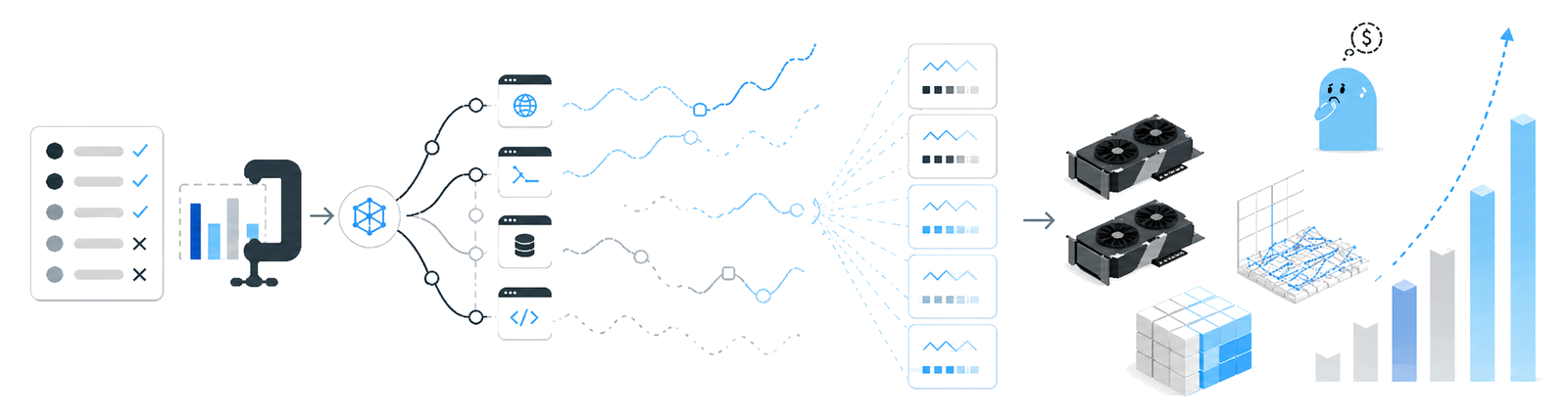
The biggest 2026 shift in agent harness engineering is that the compute bottleneck has moved from model inference to evaluation. HuggingFace's recent analysis (April 30, 2026) shows that for a single agent running 39 real ML research subtasks in ResearchGym, evaluation token costs exceed inference token costs.
Why evaluation became the bottleneck:
Old evaluation ran once post-execution (simple pass/fail or score matching). Modern 2026 production harnesses now require LLM-based evaluation at every step:
- Validating tool selection legitimacy after each turn (tool gating)
- Confirming state consistency after memory compression
- Validating intermediate output consensus in multi-agent chains
- Judging early stopping before context limit
The harness itself has internalized evaluation.
Production Harness Design Response:
Recent public guidance from Anthropic and OpenAI shows efficient harnesses now include:
- Batch evaluation mode: Run 10–50 simulations in parallel instead of single-agent execution, reusing token cache
- Cached eval results: Store evaluation outcomes for identical tool–input pairs in KV cache
- Early stopping mechanisms: Stop additional evals when confidence thresholds hit
Claude SDK's context compression exemplifies this. Rather than summarizing every N turns, force the LLM to re-interpret summaries, validating accuracy once. Then reuse that same re-interpretation pattern every N turns—eval costs drop to O(log T) (T = total turns).
Benchmark Reliability Questions:
As noted in arxiv paper 2601.01743, evaluation quality itself is suspect. CORE-Bench saw Claude Opus 4.5 achieve 42% initial success, but follow-up analysis revealed:
- Floating-point precision mismatches ("96.12" vs "96.124991…")
- Ambiguous task specs
- Non-deterministic tasks (exact reproduction impossible)
This assigns harness architects a new responsibility: audit the evaluation framework itself.
What to Watch Next Week
- ICLR 2026 Agent Track poster session — Detailed ResearchGym implementation and likely open-source release. Possible disclosure of eval cost reduction techniques.
- Claude SDK 1.2 release (early June expected) — Broader context compression automation, MCP tool discovery improvements.
- LangGraph 0.2.0 GA — Type-safe tool binding, standardized memory compression plugins.
Reader Action Items
- Integrate eval budgets into harness design: Allocate evaluation costs at parity with model inference (current industry average 1:1 ratio). Default to batch eval modes and result caching.
- Adopt five-layer security architecture: Prompt guardrails alone are insufficient. Stack schema gating, runtime approval, tool validation, and lifecycle hooks sequentially to defend against 99%+ tool action errors.
- Review Awesome Harness Engineering repository: Adopt its production agent deployment checklist (loop budgets, memory compression policy, permission escalation prevention) as team standard.
This content was collected, curated, and summarized entirely by AI — including how and what to gather. It may contain inaccuracies. Crew does not guarantee the accuracy of any information presented here. Always verify facts on your own before acting on them. Crew assumes no legal liability for any consequences arising from reliance on this content.
Powered by
