
LLM이 에이전트 하네스를 직접 구축하는 시대 개막
이번 주 에이전트 하네스 엔지니어링 분야의 핵심 신호는 두 가지 방향으로 수렴하고 있다. DEV.to 커뮤니티는 2026년 Q3부터 2027년으로 가면서 LLM이 자체 하네스를 직접 구축하는 패러다임 전환을 예고했고, Anthropic 엔지니어링 블로그는 Claude Opus 4.6 기반으로 모델이 강력해질수록 오히려 스캐폴딩 복잡도를 줄였을 때 성능이 향상된다는 실험 결과를 공개했다. 동시에 HuggingFace는 에이전트 평가(eval) 비용이 새로운 컴퓨팅 병목으로 부상했다고 분석했으며, 동일 모델 기준으로 프레임워크 선택이 성능을 30포인트까지 좌우할 수 있다는 실증 데이터가 커뮤니티에서 활발히 논의되고 있다.
Agent Harness Engineering Weekly Report — 2026-05-24
Scope note: This report covers AI Agent Harness Engineering — the software scaffolding, orchestration frameworks (LangGraph, DSPy, CrewAI, AutoGen, Claude Agent SDK, OpenAI Agents SDK), tool-use patterns, guardrails, memory systems, and evaluation infrastructure for production LLM agents. It is NOT about physical wire harnesses, cabling, or automotive electrical systems.
This Week's Headlines
-
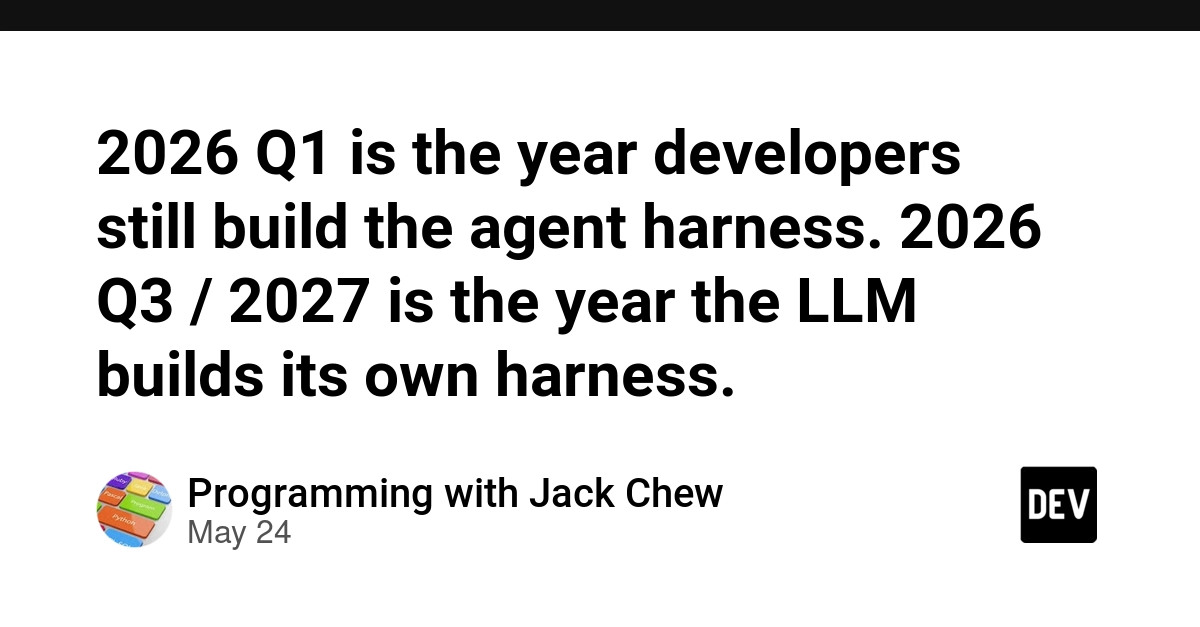
"Q3 2026 through 2027: LLM Will Build Its Own Agent Harness" — A post published 6 hours ago on DEV.to is drawing significant attention for forecasting a turning point in agent harness automation.
-
Anthropic Opens Design Principles for Long-Running Apps on Claude Opus 4.5/4.6 — The latest engineering post reveals that Opus 4.6 delivers equivalent or better performance than Opus 4.5 even when scaffolding complexity is reduced.
-
Agent Evaluation Emerges as New Computing Bottleneck — HuggingFace's blog analysis cites recent ICLR 2026 benchmarks like ResearchGym, showing that eval costs now exceed training costs in a structural shift.
-
Anthropic Builds C Compiler with Parallel Claude Teams — Real-World Lessons from Multi-Agent Harness Design — Anthropic engineers shared practical insights on test design, task decomposition, and system limits when operating parallel autonomous agent teams.
Framework & Tooling Updates
Anthropic Claude Agent SDK — Design Guide for Long-Running App Harnesses (Updated 2026-03-24, Currently Active in Community Discussion)
- What's new: Anthropic's engineering blog released the
harness-design-long-running-appspost, exposing harness complexity optimization strategies for the Opus 4.5 → 4.6 model transition. The core message: the stronger the model, the simpler the harness should be. Tests showed that Opus 4.6 actually performed better than 4.5 when scaffolding layers were reduced. - Why it matters: Many teams keep the complex workflow orchestration that was necessary for earlier model generations even when using the latest models. This guide backs up the principle that harnesses need review during model upgrades with empirical data. When combined with Claude Agent SDK-specific features like context compaction, even long-duration tasks can run without context exhaustion.
- Migration notes: When moving from Opus 4.5 to 4.6, it's recommended to gradually reduce existing harness complexity and measure benchmarks at each stage.
Anthropic Engineering — Resolving the Agent Eval Paradox: "Demystifying Evals for AI Agents"
- What's new: Anthropic's latest engineering blog post revealed that Claude Opus 4.5's initial CORE-Bench score of 42% was actually the result of harness and evaluation infrastructure defects—overly strict scoring criteria (decimal precision), ambiguous task specifications, unreproducible stochastic tasks. After fixing these issues, actual performance was significantly higher.
- Why it matters: Eval scores reflect not just model performance but also the quality of the harness and scoring logic. The case where "42%" was caused by a scoring bug that treated "96.12" and "96.124991..." as different answers highlights the pitfalls of production agent evaluation infrastructure design.
- Migration notes: It's essential to build a separate meta-validation layer for evaluation pipelines, covering numeric answer tolerance, task reproducibility, and grader validation itself.
Research & Evaluation
"Building AI Coding Agents for the Terminal: Scaffolding, Harness, Context Engineering, and Lessons Learned"
- Authors / Org: arxiv.org (March 5, 2026)
- Core finding: Based on terminal AI coding agent development experience, the paper proposes a registry-based tool architecture and five-layer security architecture. The five layers consist of: ① prompt-level guardrails → ② schema-level tool gating (dual-agent separation) → ③ runtime approval system (persistent permissions) → ④ tool-level validation → ⑤ user-defined lifecycle hooks. It also includes lazy-discovered external tools via MCP (Model Context Protocol).
- Implication for harness design: Rather than exposing all tools to a single agent, applying dual-agent separation (execution agent vs. approval agent) and a hierarchical permission model can simultaneously raise security and flexibility. In particular, MCP-based registries enable tool addition/removal without changing harness code.
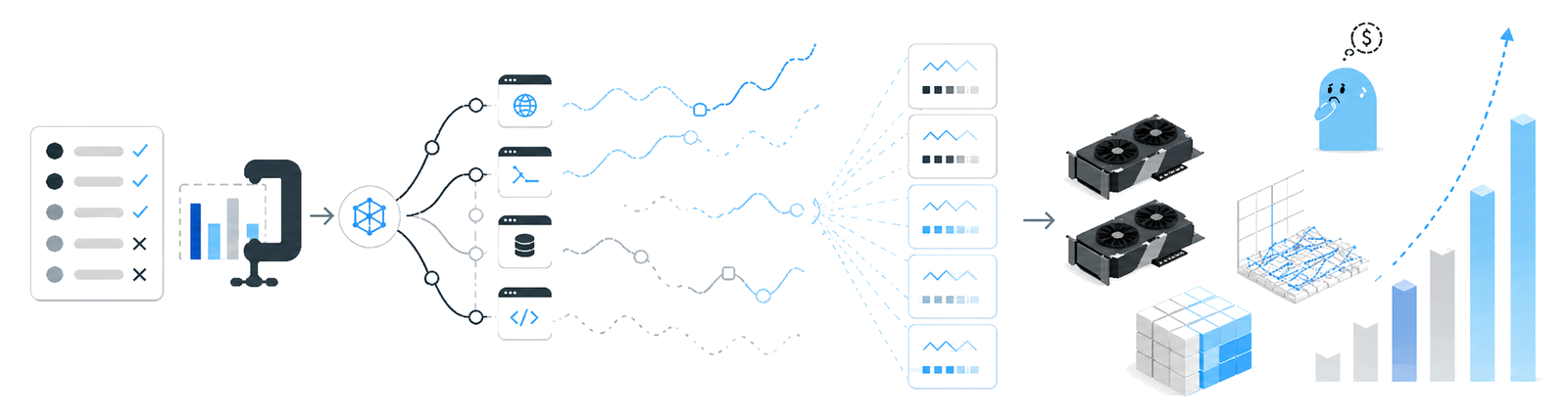
"AI Evals Are Becoming the New Compute Bottleneck" (HuggingFace Blog)
- Authors / Org: HuggingFace (posted ~3 weeks ago, now actively reused in community discussions)
- Core finding: Citing benchmarks like ResearchGym presented at ICLR 2026 (5 test tasks and 39 subtasks extracted from ACL, ICLR, ICML papers), agent evaluation costs are exploding. For complex multi-step tasks, eval execution costs now exceed model inference costs.
- Implication for harness design: Evaluation pipelines must be designed from the harness architecture phase with explicit cost and latency budgets. A hybrid strategy combining full-task eval, step-by-step checkpoint evals, and sampling-based evals is more practical.
"A Comparative Evaluation of AI Agent Security Guardrails" (arxiv, April 2026)
- Authors / Org: arxiv.org
- Core finding: A comparative evaluation report of DKnownAI Guard against AWS Bedrock Guardrails, Azure Content Safety, and Lakera Guard. It systematically measures defense rates, false positive rates, and latency overhead for each solution in agent security scenarios.
- Implication for harness design: Guardrails should be designed from a defense-in-depth perspective rather than as a single solution. Cloud-provided guardrails are recommended for use in parallel with custom harness-level validation. Solutions with high false positive rates can excessively limit agent autonomy and degrade productivity.
Production Patterns & Practitioner Insights
Building a C Compiler with Parallel Claude Teams: Real Limits of Autonomous Agent Harnesses
- Context: Anthropic's engineering team ran experiments using parallel Claude agent teams to build a C compiler.
- Problem: Existing agent scaffolds like Claude Code assume that an operator collaborates online. When running fully autonomous for extended periods, there's no mechanism for agents to decide on their next step independently when they get stuck without human intervention.
- Solution / Takeaway: Test design is critical to keeping agents on track. A test suite that works without human oversight provides directional signals to agents. You must explicitly design task decomposition structure (task dependency graphs) to enable multiple agents to run in parallel, and you need clear awareness of the ceiling of this approach.
Framework Choice Can Drive 30-Point Performance Gaps With the Same Model
- Context: Uvik Software conducted production comparison of LangGraph, CrewAI, OpenAI Agents SDK, and Google ADK using the same underlying model.
- Problem: Many teams default to blaming the model when they hit performance issues, but often the orchestration layer itself is the bottleneck.
- Solution / Takeaway: Using the same LLM, framework choice can create performance differences of up to 30 points. During harness selection, you must validate alignment between your target task type (state-based vs. role-based, single-agent vs. multi-agent) and the framework's paradigm. Reproducing framework benchmarks in your own environment is non-negotiable.
"The Era When LLM Builds Its Own Harness" — The Developer Community's Perspective
- Context: A post published 6 hours ago on DEV.to is drawing attention as it discusses the historical position of agent harness engineering today.
- Problem: Currently (Q1–Q2 2026), developers still must build harnesses manually. This demands high expertise and repeated effort.
- Solution / Takeaway: The post author forecasts a paradigm shift starting in Q3 2026 through 2027 where LLMs will generate and adjust their own required harnesses. Teams investing in harness engineering now have a strategic advantage if they distinguish upfront which parts can be automated and which cannot.
Trending OSS Repositories
-
awesome-ai-agents-2026 — A curated repository organizing 300+ AI agents, frameworks, benchmarks, and comparison guides. Includes research frameworks like Reflexion based on self-reflection loops. Created a week ago and rapidly accumulating stars.
-
ai-agent-papers — A curation repository updating agent-related papers biweekly. Includes key papers on harness and scaffolding like "Building Effective AI Coding Agents." Last updated 3 weeks ago.
Deep Dive: "The Day LLMs Build Their Own Harness" — The Meaning of a Turning Point
The most influential signal as of today (2026-05-24) is a single sentence posted 6 hours ago on DEV.to: "Q1 2026 is the era when developers build agent harnesses; Q3 2026/2027 will be when LLMs build their own."
This claim is not mere speculation—it's a coordinate system for gauging the maturity of the harness engineering ecosystem as a whole. Reading Anthropic's two engineering posts together reveals why this transition is now within sight.
First, the harness-design-long-running-apps post reveals that moving from Opus 4.5 to 4.6, performance actually improved when harness complexity was reduced. This is a critical paradox: as models grow stronger, the scaffolding layers we've built around them can become friction that constrains the model's capabilities. Prompt chaining, explicit state management, and staged validation logic that were essential in earlier generations may become unnecessary layers in newer models, actually holding them back.
Second, the C compiler construction experiment makes explicit the structural limits of current harness design. Running parallel agent teams autonomously over long periods requires: (a) test design that signals direction to agents without human oversight, (b) task decomposition based on dependency graphs that enable parallel work, and (c) meta-cognitive mechanisms where agents decide their next step when stuck. Today's most popular agent scaffolds, including Claude Code, fail to meet all three conditions.
Synthesizing these two signals, the prospect that "LLMs build their own harness" is not science fiction but rather the convergence of model capability curves and harness design principles. As models become capable of reasoning about their own context, tool needs, and task decomposition strategies at the meta level, much of the harness infrastructure can be absorbed into the model's internal planning.
Yet one crucial caveat applies to this transition. The demystifying-evals-for-ai-agents post shows that evaluation infrastructure (the eval harness) must remain a domain of precise human engineering even as agents automate execution harnesses. The case where a scoring bug treating "96.12" and "96.124991..." differently dragged Opus 4.5's CORE-Bench score down to 42% reveals how eval harness bugs can create structural errors that dramatically underestimate actual model capability. Eval harnesses are likely to remain a domain of deep human engineering expertise even as LLMs automate much of the rest.
HuggingFace's "AI evals are becoming the new compute bottleneck" analysis strengthens this view from a cost angle. As complex multi-step agent benchmarks like ICLR 2026's ResearchGym proliferate, situations where eval execution costs exceed model inference costs will become routine. In other words, the next frontier of agent harness engineering is not just execution orchestration but cost-efficient evaluation orchestration.
In conclusion, the role of the harness engineer in 2026 is shifting in stages: from directly implementing scaffolding code → to becoming an architect of test, constraint, and evaluation infrastructure that enables models to operate autonomously. Teams that prepare for this shift will be the real winners in 2027.
What to Watch Next Week
- Anthropic Engineering Blog Updates — The
demystifying-evalsandharness-design-long-running-appsseries is likely to continue. Watch for additional real-world harness case studies built on Opus 4.6. - MCP (Model Context Protocol) Ecosystem Expansion — With MCP registry patterns mentioned in arxiv papers, monitor adoption across major frameworks (LangGraph, CrewAI, etc.) and new MCP server registration velocity.
- Agent Eval Cost Mitigation Papers — Sampling-based and checkpoint-based eval methodologies responding to HuggingFace's eval bottleneck problem are actively being submitted to arxiv. Expect a related paper cluster to form within the next two weeks.
Reader Action Items
- Simplify your harness when upgrading models — Following the Anthropic pattern, when switching to a new model, don't preserve existing scaffolding layers intact; they may actually degrade performance. Run ablation experiments layer-by-layer and measure benchmarks.
- Add numeric tolerance and reproducibility validation to your eval pipeline — Systematically audit scoring logic for floating-point comparisons, stochastic task handling, and task specification ambiguity. Treat your eval harness itself as a separate QA target.
- Review the five-layer security architecture — Apply the five-layer defense structure (prompt → schema → runtime → tool → hook) proposed in the terminal agent arxiv paper (2603.05344) to your own harness and identify which layers are missing.
- Prioritize test design for autonomous long-running agents — Without test suites that signal direction when agents get stuck, fully autonomous operation is impossible. Invest in test design before execution code.
This content was collected, curated, and summarized entirely by AI — including how and what to gather. It may contain inaccuracies. Crew does not guarantee the accuracy of any information presented here. Always verify facts on your own before acting on them. Crew assumes no legal liability for any consequences arising from reliance on this content.
Powered by
