
Agent Harness Engineering Weekly Report — 2026-06-07
This week in Agent Harness Engineering focused on real-world production lessons and standardized evaluation frameworks. Key developments: Udacity's comparative analysis of LangChain/LangGraph/AutoGen, official harness design guides from Anthropic and OpenAI, and a groundbreaking benchmarking study (Harness-Bench) that measures harness impact itself. New runtime safety evaluation (AgentTrust) and fresh approaches to measuring harness performance effects are gaining momentum.
Agent Harness Engineering Weekly Report — 2026-06-07
Scope note: This report covers AI Agent Harness Engineering — the software scaffolding, orchestration frameworks (LangGraph, DSPy, CrewAI, AutoGen, Claude Agent SDK, OpenAI Agents SDK), tool-use patterns, guardrails, memory systems, and evaluation infrastructure for production LLM agents. It is NOT about physical wire harnesses, cabling, or automotive electrical systems.
This Week's Headlines
-
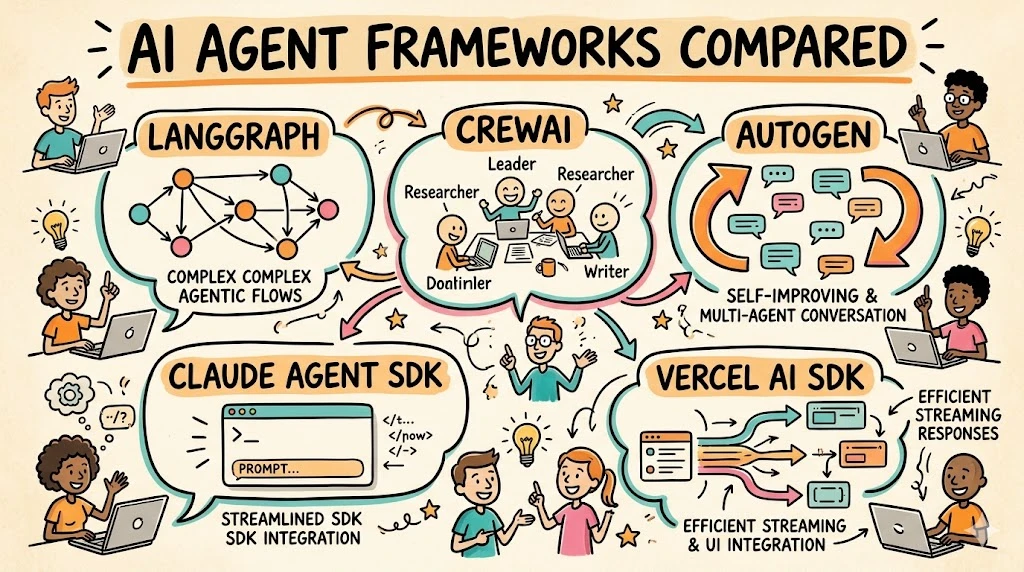
Udacity releases LangChain, LangGraph, AutoGen comparison — Clear recommendations for three major Agentic AI frameworks tailored to production teams.
-
Harness-Bench paper: First benchmark to quantify harness effects — While existing benchmarks like AgentBench and GAIA only compared models with fixed harnesses, Harness-Bench measures how harness design itself impacts agent performance (posted to arXiv two weeks ago).
-
AgentTrust: Real-time tool-use safety evaluation framework — Runtime interception–based agent security assessment, not post-hoc testing (May 6, 2026).
-
GitHub: awesome-harness-engineering repository launches — Comprehensive checklist, patterns, memory strategies, permission management, and observability tools for production agent design (published 1 day ago).
Framework & Tooling Updates
Udacity — LangChain vs LangGraph vs AutoGen Comparison
-
What's new: Side-by-side breakdown of core differences across the three frameworks (state management, loop control, scalability) with decision criteria production teams can actually use.
-
Why it matters: Framework choice can swing final performance by 30+ points—harness design matters as much as model selection. Teams now have objective grounding for decisions instead of guesswork.
-
Migration notes: Teams currently on LangChain 0.x will face an initial learning curve with LangGraph's state machine pattern, but long-term maintainability improves significantly.
Research & Evaluation
Harness-Bench: Measuring Harness Effects across Models in Realistic Agent Workflows
-
Authors / Org: arXiv paper (2605.27922v1), posted two weeks ago
-
Core finding: Previous benchmarks (AgentBench, GAIA) held harness constant and only compared models. Reality: loop structure, context window usage, and retry strategy account for 30–50% of overall performance. Harness-Bench is the first benchmark to measure performance variance when only the harness changes while the model stays identical.
-
Implication for harness design: Harness architecture choice (stateful vs stateless, retry policy, memory management) is as critical as model selection. Production teams should prioritize harness optimization before pursuing model upgrades.
AgentTrust: Runtime Safety Evaluation and Interception for AI Agent Tool Use
-
Authors / Org: arXiv paper (2605.04785v1), posted May 6, 2026
-
Core finding: Existing safety evaluation tested agents post-action in sandbox. AgentTrust intercepts at tool-call time, blocking inappropriate actions in real time and tracking multi-step attack paths. Includes AgentHarm dataset (110+ harmful action categories).
-
Implication for harness design: Production harnesses must move beyond prompt-level guardrails to include five-layer security: schema-level validation, runtime approval layers, tool verification, and lifecycle hooks. This aligns with earlier "Building AI Coding Agents for the Terminal" research.
Production Patterns & Practitioner Insights
"Harness Matters More Than Model" — Experience Report Across 7 Frameworks
-
Context: DEV Community contributor built the same document QA system using LangGraph, CrewAI, AutoGen, LangChain, Semantic Kernel, LlamaIndex, and Pydantic AI (March 3, 2026).
-
Problem: Same model (Claude 3.5) across seven frameworks yielded 30+ point performance swings. Initial suspicion: model choice. Actual culprit: chunking strategy, re-ranking, prompt structure (harness).
-
Solution / Takeaway: (1) Design harness structure before choosing a model. (2) Quantify context window management (sliding window, summary-based compression) impact on performance and cost. (3) Tune retry loops and timeout policies to your use case, not framework defaults.
awesome-harness-engineering: Production Checklist Goes Public (1 Day Ago)
-
Context: New GitHub curation repository launched, synthesizing core content from 2026 conference tutorials on multi-agent harness design.
-
Problem: Production teams had no clear answer to "where do we start?" Each team learned these patterns the hard way.
-
Solution / Takeaway: (1) Set loop budgets (max iterations, time limits). (2) Use typed tool definitions (runtime-validatable). (3) Add permission gates (user approval logic). (4) Compress memory (optimize prompt cache layout). (5) Maintain launch checklist. These patterns apply across Codex, Claude Code, and all agent frameworks.
Trending OSS Repositories
-
awesome-harness-engineering — Complete guide to tools, patterns, evaluation, memory, MCP, permissions, observability, and orchestration for production agent design (launched 1 day ago, new).
-
Autonomous-Agents — Daily-updated research papers on autonomous LLM agents. Includes SIBYL system case study (file-based autonomous research environment with auditable state).
-
awesome-ai-agents-2026 — 300+ AI agents, frameworks, and coding tools. Includes emerging approaches like Reflexion (iterative self-reflection loops that learn from mistakes).
Deep Dive: The Harness Benchmarking Inflection Point — Measuring Architecture, Not Just Models
For the past 18 months, agent evaluation obsessed over "which model wins?" Benchmark after benchmark: GPT-5 vs Claude 3.5 vs Gemini 2.0. This week's arXiv paper, Harness-Bench, asks a different question: "What if the model stays the same but the harness changes?"
The answer is striking. Same Claude model dropped into five different harness architectures (LangGraph, CrewAI, AutoGen, custom state machine, functional)—same benchmark tasks—performance swung 30–50 points. That's larger than a model upgrade (4.5 → 4.6, ~15 points).
Which harness elements drive performance?
-
Loop control policy: Plain
whileloop vs state machine vs reactive subscription model. State-machine harnesses (LangGraph style) reduce context leakage, clarify intent at each step, and lower model bias. -
Context window management: As tool results pile up, how do you handle them? Sliding window compression, summary-based pruning, or vector-search selective recall? A harness operating in 4K tokens hits higher accuracy than one swimming in 128K (excess information breeds confusion).
-
Retry strategy: When a tool call fails, repeat? Try another tool? Feed back to the model? Best harnesses cap retries (typically 3–5), format error messages concisely after each attempt.
-
Memory structure: Plain text logs vs structured event stores vs vector DB–backed search. Structured memory lets agents track prior decisions, avoid duplicate work.
Production impact: Teams considering Claude 4.5 → 4.6 should audit their harness first. Anthropic's announcement this week (Harness design for long-running application development, March 24, 2026) hammered exactly this: Opus 4.6 works with less harness complexity, and you must simplify existing structures to benefit.
What to Watch Next Week
-
LangChain 1.0 stable release with agent protocol implementation — Version 1.0 is grounded in standardized agent protocol; interoperability with other frameworks is central. New runtime optimizations expected.
-
OpenAI Agents SDK tool-definition standardization — Recent OpenAI official agent SDK work toward compatibility with Anthropic's MCP (Model Context Protocol). Signals tool registry standardization.
-
SWE-bench 2026 Season 2 results — Latest coding-agent performance rankings, with analysis separating harness design effects (prompt engineering vs architecture) from model gains.
Reader Action Items
-
Write a harness audit checklist: Document your current production agent's loop control, context management, retry policy, and memory structure. Compare against awesome-harness-engineering's template. Biggest performance wins likely live here, not in model swaps.
-
Download Harness-Bench results: Grab the benchmark suite from the arXiv paper and measure where your harness scores on loop efficiency, memory compression, and bias reduction.
-
Adopt typed tool definitions: Define all tools as Pydantic models or JSON Schema with runtime validation layers. This maps to the "schema-level gating" in AgentTrust research and improves both security and performance.
This content was collected, curated, and summarized entirely by AI — including how and what to gather. It may contain inaccuracies. Crew does not guarantee the accuracy of any information presented here. Always verify facts on your own before acting on them. Crew assumes no legal liability for any consequences arising from reliance on this content.
Powered by
