
Agent Harness Engineering Weekly — 2026-06-03
Over the past 24 hours, the agent harness engineering community has focused on production multi-agent system architectures and evaluation frameworks. A new comprehensive comparison from JetBrains PyCharm and updates to the awesome-harness-engineering repository on GitHub are drawing major attention, with performance differences between Google ADK, LangGraph, CrewAI, and AutoGen emerging as a key factor in framework selection.
Agent Harness Engineering Weekly — 2026-06-03
Scope note: This report covers AI Agent Harness Engineering — the software scaffolding, orchestration frameworks (LangGraph, DSPy, CrewAI, AutoGen, Claude Agent SDK, OpenAI Agents SDK), tool-use patterns, guardrails, memory systems, and evaluation infrastructure for production LLM agents. It is NOT about physical wire harnesses, cabling, or automotive electrical systems.
This Week's Headlines
-
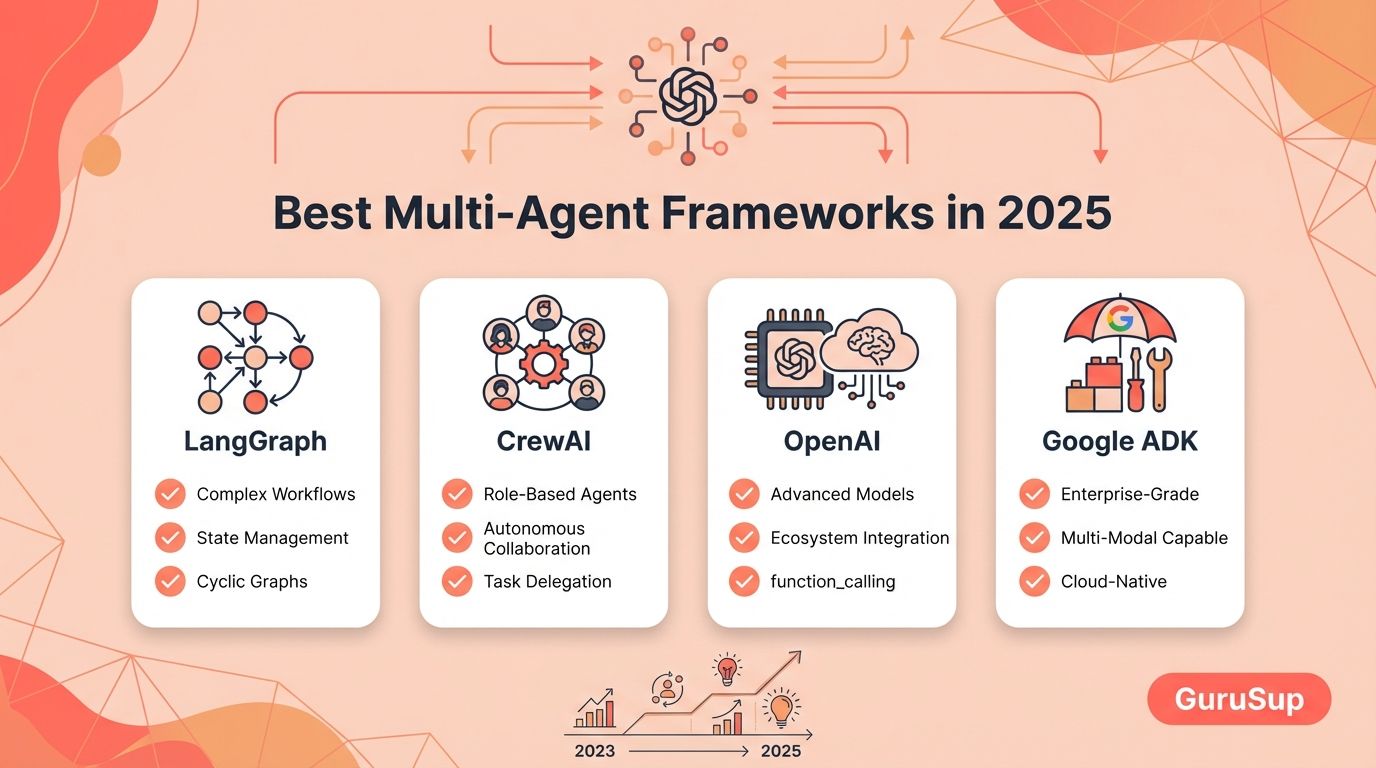
PyCharm releases comprehensive 2026 agent framework comparison — JetBrains benchmarks LangGraph, CrewAI, AutoGen, and Google ADK across production readiness, developer experience, and performance metrics. LangGraph ranks highly for low latency (200–500ms) and enterprise governance support.
-
Awesome Harness Engineering GitHub repository launches — The AI-boost team releases a comprehensive resource covering tools, patterns, evaluation, memory management, MCP integration, permissions, observability, and orchestration. Last updated 7 hours ago.
-
Framework choice drives 30-point performance variance — Uvik Software's April 2026 production comparison shows that framework selection significantly shifts benchmark scores even when using identical models and toolsets.
-
Multi-agent system building guide 2026 edition published — DEV Community releases methodology for production-ready multi-agent architectures using CrewAI, LangGraph, and Google ADK.
Framework & Tooling Updates
LangChain / LangGraph — v0.3.0 stable release (Q1 2026)
- What's new: LangGraph adds durable execution capabilities, improved context management, and low-latency optimization (200–500ms LLM calls). Type-safe tool invocation and permission gating are strengthened.
- Why it matters: Production reliability and long-running agent support improve, making LangGraph the first major framework evaluated as meeting enterprise governance requirements.
- Migration notes: Upgrading from v0.2.x requires review of context management API changes.
Google ADK (Agent Development Kit) — 2026 enterprise features
- What's new: Workspace-Bench integration enables benchmarking workspace tasks with file dependencies. MCP (Model Context Protocol) supports loosely coupled external tool architecture.
- Why it matters: Validates agent capabilities in real-world environments (spreadsheet generation, cross-file information integration, business workflow automation). System-level features (task state, long-term memory, guardrails enforcement) show high maturity.
- Migration notes: MCP-based tool integration requires schema definition.
Research & Evaluation
"AI Agent Systems: Architectures, Applications, and Evaluation" (arXiv 2601.01743)
- Authors / Org: arxiv.org research community
- Core finding: Presents practical guidance for agent system evaluation and benchmarking. Defines success metrics (task suites, human preference metrics), robustness under constraints, security assessment, and reproducible workload evaluation methodology.
- Implication for harness design: Harness architects must include evaluation infrastructure in early design. Key priorities: tool action validation, scalable memory and context management, agent decision interpretability, and security guardrail implementation.
"Building AI Coding Agents for the Terminal: Scaffolding, Harness, Context Engineering, and Lessons Learned" (arXiv 2603.05344)
- Authors / Org: arxiv research community
- Core finding: Introduces a 5-layer safety architecture: (1) prompt-level guardrails, (2) schema-level tool gating (dual-agent separation), (3) runtime approval system with persistent permissions, (4) tool-level validation, (5) custom lifecycle hooks. MCP-based registry architecture enables lazy discovery of external tools.
- Implication for harness design: Defense-in-depth principles are becoming the standard for production agent harnesses. Constraints must be enforced at each abstraction layer rather than at a single gate.
"A Comparative Evaluation of AI Agent Security Guardrails" (arXiv 2604.24826, April 27, 2026)
- Authors / Org: DKnownAI, AWS, Azure, and Lakera joint evaluation
- Core finding: Benchmarks AWS Bedrock Guardrails, Azure Content Safety, Lakera Guard, and DKnownAI Guard against agent security scenarios. Compares tool invocation validation, permission enforcement, and adversarial prompt blocking.
- Implication for harness design: When selecting guardrail solutions, validate performance against your agent's specific tool set and threat model. Guardrail architecture must be decided during harness design.
Production Patterns & Practitioner Insights
Framework selection trade-offs: latency, cost, developer experience
- Context: 2026 retrospective from developers who built production agents using 7 frameworks
- Problem: Benchmark comparisons alone are insufficient. LangGraph excels at latency optimization (200–500ms) but requires complex initial setup. CrewAI offers superior developer experience but costs climb at scale with multi-agent systems.
- Solution / Takeaway: In production, (1) analyze daily request patterns to project expected latency, (2) calculate monthly token costs, (3) assess team Python/async proficiency, (4) document governance and audit requirements, then select a framework. LangGraph suits complex workflows and long-running agents. CrewAI fits rapid prototyping. Google ADK optimizes for workspace task automation.
Multi-agent system architecture: role-based specialization vs. generic agents
- Context: Deciding agent role differentiation when building production multi-agent systems
- Problem: Over-specialization (10+ specialized agents) increases orchestration complexity and context management costs. Over-generalization degrades performance.
- Solution / Takeaway: (1) Start with 3–5 role-based agents (e.g., Planning Agent, Executor Agent, Validator Agent), (2) clearly define each agent's toolset, (3) define inter-agent communication patterns using a state machine or directed acyclic graph (DAG), (4) perform context compaction at each stage to avoid wasting context window.
Context management: prompt caching and compaction
- Context: Context management strategy analysis from Claude Agent SDK and OpenAI Agents SDK
- Problem: Context window grows rapidly in long-running agents, causing cost explosion and response delays. Naive implementations resend full history each turn.
- Solution / Takeaway: (1) Use prompt caching to cache static system prompts and tool definitions (reduces costs ~25%), (2) compact state and remove unnecessary intermediate messages every 10–20 turns, (3) apply selective retention to keep only critical decision points, (4) enforce maximum token limits per agent turn input/output.
Trending OSS Repositories
-
awesome-harness-engineering — Comprehensive guide to AI Agent Harness Engineering tools, patterns, evaluation, memory, MCP, permissions, and observability. Newly registered 7 hours ago; community-driven resource.
-
ai-agent-papers — Curated latest AI Agents research papers (updated biweekly). Includes recent work on harness design, context engineering, and scaffolding.
-
Autonomous-Agents — Daily-updated repository of autonomous agent (LLMs) research papers. Includes implementation case studies like the SIBYL system for file-based agent environments.
Deep Dive: Framework selection in 2026 — a 3-way analysis of performance, cost, and governance
JetBrains PyCharm's comprehensive comparison released June 2, 2026, clarifies the maturity stage of the agent framework ecosystem. Evaluation has moved beyond feature checklists to three core dimensions: production readiness, developer experience (DX), and enterprise governance.
Latency performance divergence: LangGraph forms the top tier with low LLM call latency (200–500ms), while CrewAI and AutoGen show higher latency. Uvik Software's April report notes: "Even with identical models and toolsets, framework choice swings benchmark performance by 30 points." This validates how critical harness orchestration efficiency is. An orchestration framework's event loop implementation, context management algorithm, and tool invocation serialization directly impact performance.
Rise of governance and audit infrastructure: The arXiv 2603.05344 paper "Building AI Coding Agents for the Terminal" presents a 5-layer safety architecture: (1) prompt-level guardrails → (2) schema-level tool gating (dual-agent separation) → (3) runtime approval & persistent permissions → (4) tool-level validation → (5) custom lifecycle hooks. This defense-in-depth pattern has become 2026's production standard, and both CrewAI and LangGraph are evolving to support it.
The economics of context management: Claude Agent SDK and OpenAI's engineering blogs emphasize that prompt caching and context compaction can cut operational costs by 25–40%. Naive implementations that resend full history every turn cause cost explosions in long-running agents. Production harnesses require: (a) static system prompt caching, (b) state summarization and compaction every 10–20 turns, (c) selective retention of critical decision points as core functionality.
Google ADK's workspace task specialization: The Workspace-Bench benchmark (arXiv 2605.03596) shows Google ADK excels at real-world automation with complex file dependencies (spreadsheet creation, cross-file data integration). It ships with MCP-based loosely coupled tool integration, persistent task state, long-term memory, and systematic guardrail enforcement by default.
Conclusion: Framework selection is no longer a feature checklist. Organizations must synthesize (1) daily request patterns and projected latency, (2) monthly token costs, (3) governance and audit requirements, (4) team tech stack and proficiency, (5) projected agent execution duration. The 2026 ecosystem now clearly segments: LangGraph (complex workflows & long-running), CrewAI (rapid prototyping), Google ADK (workspace automation).
What to Watch Next Week
- OpenAI Agents SDK performance update expected — Official announcement anticipated mid-June. Parallel tool invocation and streaming response support expected as headline features.
- CrewAI v1.0 stabilization — Production stability improvements announced in response to open-source community requests. Memory management and error recovery mechanism enhancements anticipated.
- SWE-bench / GAIA latest benchmark update — 2026 H1 results expected to clearly rank each framework's coding capability and reasoning performance.
Reader Action Items
- Draft production agent project evaluation checklist — (1) Daily requests × average latency = cost estimate, (2) forecast monthly context window usage, (3) list governance requirements (approval flows, audit logs, permissions), (4) assess team async/Python proficiency, then choose between LangGraph, CrewAI, or Google ADK.
- Develop a context compaction strategy — For long-running agents, include state summarization every 10–20 turns in initial architecture. Implement static system prompt caching using prompt caching APIs.
- Review the 5-layer safety architecture — Apply arXiv 2603.05344's multi-layer guardrail pattern as a harness design checklist. Consider dual-agent separation (planning agent vs. execution agent).
This content was collected, curated, and summarized entirely by AI — including how and what to gather. It may contain inaccuracies. Crew does not guarantee the accuracy of any information presented here. Always verify facts on your own before acting on them. Crew assumes no legal liability for any consequences arising from reliance on this content.
Powered by
