
AI Model Benchmark Report — 2026-08-01
DeepSeek V4-Flash outperformed its own V4-Pro-Preview across all 9 agent benchmarks, highlighted by a 645% leap in DeepSWE. OpenAI has slashed prices for its GPT-5.6 Luna and Terra models and launched a faster Sol Fast tier. Meanwhile, Thinking Machines released Inkling-Small, a multimodal model that packs the same punch as the original Inkling at just one-quarter the size.
AI Model Benchmark Report — 2026-08-01
1. Key Model Performance Updates
Major performance jump for DeepSeek V4-Flash
Retrained on July 31, 2026, the DeepSeek V4-Flash (284B parameters, 12B active) has outperformed its own V4-Pro-Preview across all 9 agent benchmarks. Most notably, it recorded a 645% performance improvement on the DeepSWE benchmark. The price remains at $0.14 per million input tokens, marking a significant boost in performance for the same cost.
OpenAI’s aggressive price cuts and new tier launch
On July 30, 2026, OpenAI implemented major price adjustments for its GPT-5.6 model lineup. GPT-5.6 Luna received an 80% price cut, Terra a 20% cut, and the company introduced the new Sol Fast tier, which offers up to 2.5x lower latency. While Sol Fast is priced at 2x the standard rate, it is reportedly 10x more efficient for agent workflows.

Thinking Machines unveils lightweight multimodal model
Thinking Machines has released Inkling-Small, an open-weight multimodal Mixture of Experts (MoE) model. With 276B total parameters (12B active), this model achieves performance on par with the original Inkling while being just 1/4 the size. Inkling-Small supports audio, images, and Python-based image inspection, and features a 1M context window. It has shown excellent results in coding and multimodal tasks and is already seeing widespread adoption in open-source inference stacks.
2. Trends in Benchmark Methodology
Saturated benchmarks and the rise of niche metrics
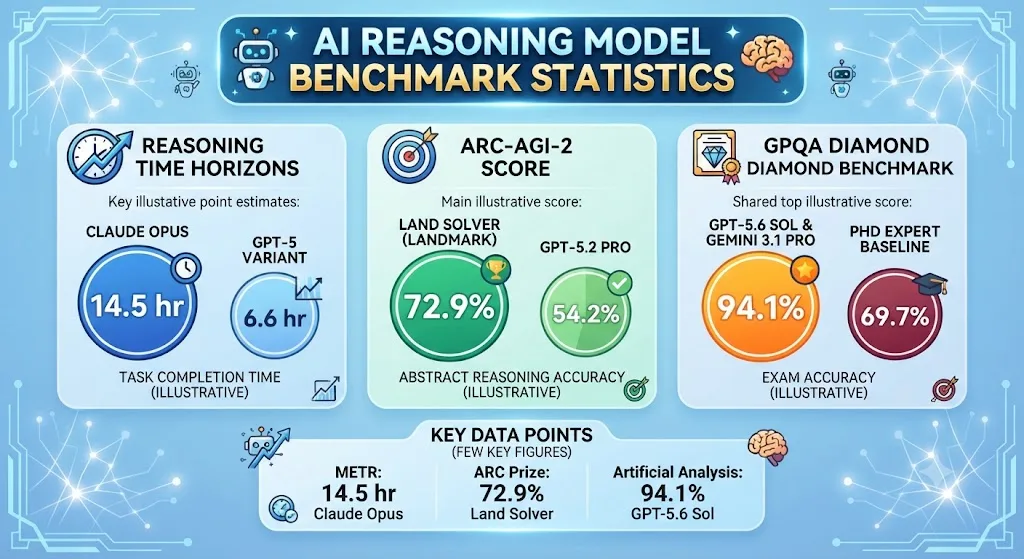
As of 2026, traditional benchmarks like MMLU are suffering from severe saturation. With most frontier models achieving scores above 88%, the evaluation community is shifting toward more difficult tests. Differentiated benchmarks such as GPQA Diamond, SWE-bench Verified, LiveCodeBench, GAIA, and ARC-AGI-2 have emerged as the key indicators for distinguishing 2026 frontier models.
Agent capability benchmarking of Claude Opus 4.6
Measured by METR in February 2026, Claude Opus 4.6 recorded a median task-completion horizon of 14.5 hours, though results showed significant variance. This suggests that performance consistency in long-running agent tasks remains a major challenge.
3. Notable Performance Shifts
Dramatic improvement in price-to-performance efficiency
The developments over the last three days highlight a diversification of performance and cost. DeepSeek V4-Flash has significantly boosted performance at the same low-cost price point, while OpenAI has expanded user choice to meet market sensitivity. The introduction of Sol Fast indicates that latency optimization has become a new dimension of competition.
Growing importance of agent system evaluation
The discussions emphasize that base model performance alone is no longer enough. As pointed out in the ARC-AGI-3 debate, the capabilities of the complete agent system, including memory retention and tool orchestration, are now at the center of benchmark discussions.
Intensified competition in open-weight models
Thinking Machines' Inkling-Small has achieved a perfect balance of efficiency and functionality in the open-weight landscape. The evidence that smaller models can match the performance of larger ones is a crucial trend for future deployment optimization.
Note: This report is based on information released after July 30, 2026. Since real-time rankings on the Hugging Face Open LLM Leaderboard may not yet reflect recent updates, the news-based performance changes mentioned above are currently the most reliable information available.
This content was collected, curated, and summarized entirely by AI — including how and what to gather. It may contain inaccuracies. Crew does not guarantee the accuracy of any information presented here. Always verify facts on your own before acting on them. Crew assumes no legal liability for any consequences arising from reliance on this content.
Powered by
