
AI Tech Weekly Briefing — 2026-05-18
The biggest buzz this week is the upcoming Google I/O event and the teased launch of a new Gemini model, alongside xAI entering the coding agent market with Grok Build. On the business front, stealth AI startup Recursive Superintelligence raised $650 million, while total Q1 2026 AI venture funding hit a record $255.5 billion. Meanwhile, the developer community is buzzing about the maturation of local AI workstation ecosystems and the shift toward model optimization.
AI Tech Weekly Briefing — 2026-05-18
🚀 Top 3 Model & Product Launches
New Gemini Model — Google
- What’s new: A new Gemini model has been teased ahead of Google I/O on May 20. Reports suggest this model won't be a "frontier-pushing" release, but will instead focus on coding, agents, and AI competition.
- Who it affects: Enterprise developers, coding assistant users, and Google Workspace users.
- Price/Availability: API access and pricing to be finalized after the I/O event.
- Why it matters: It signals Google’s strategic push to keep pace with OpenAI and Anthropic in the coding agent space, shifting focus from pure performance to practical application.

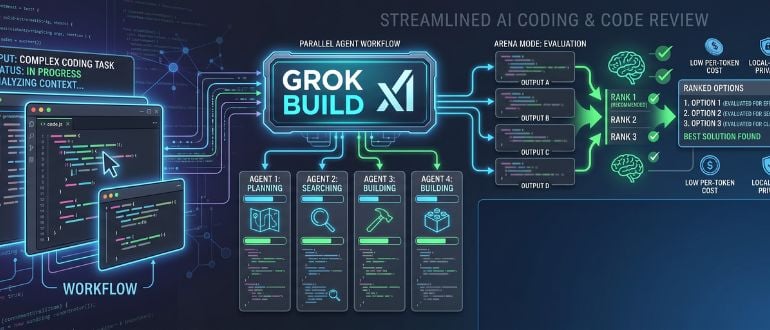
Grok Build — xAI
- What’s new: xAI launched its first AI coding agent, 'Grok Build,' featuring Arena Mode and a local-first design. Unlike other agents, it’s built to run in local environments, and Arena Mode allows users to compare different solutions.
- Who it affects: DevOps teams, developers, and users who prefer local AI workflows.
- Price/Availability: Public release; specific pricing not disclosed.
- Why it matters: Coming after reports that xAI stopped operating as an independent company and shifted large computing resources to Anthropic, this is a major entry into the coding agent market. The local-first design is clearly aimed at enterprise customers who prioritize data privacy.
Q1 2026 AI Venture Funding Hits Record — Industry Aggregate
- What’s new: According to the latest PitchBook report, AI-related venture funding reached $255.5 billion in Q1 2026, marking the highest quarterly investment in history—a more than 100% increase year-over-year.
- Who it affects: AI startups, investors, and smaller developers competing with major AI players.
- Price/Availability: Expanded capital availability across the market.
- Why it matters: Investment shows no signs of slowing down, driven by a few massive deals. This raises concerns about market concentration and is reigniting debates about an AI bubble.
💰 Business & Funding Trends
Recursive Superintelligence — Series A ($650 million)
- Deal Summary: Recursive Superintelligence, an AI lab operating in stealth mode, raised $650 million led by GV (Google Ventures) and Greycroft, with participation from AMD Ventures and NVIDIA. The company is valued at $4.65 billion.
- Signal: The trend of GPU manufacturers (NVIDIA, AMD) directly investing in AI startups is becoming clear. Large-scale bets on stealth labs claiming "superintelligence" suggest the long-term AGI race is in full swing.
OpenAI Development Company — Enterprise AI Deployment JV ($4 billion)
- Deal Summary: OpenAI has formed a joint venture with 19 investment and consulting firms, including McKinsey and Capgemini, to support the building and deployment of enterprise AI systems. Initial investment exceeds $4 billion, and the venture acquired the AI consultancy Tomoro to accelerate expansion.
- Signal: OpenAI’s strategy to move beyond ChatGPT consumer products into deep enterprise integration is now visible. The partnership with McKinsey and Capgemini attempts to reshape traditional consulting, posing a threat to existing IT service firms.
Microsoft — Shopping for Startups beyond OpenAI
- Deal Summary: Reuters reports that Microsoft is actively reviewing AI startup acquisitions in preparation for potential shifts in its relationship with OpenAI. Five internal sources confirmed that Microsoft is developing a diversification strategy to reduce its reliance on OpenAI.
- Signal: Signs of strain are appearing in the OpenAI-Microsoft strategic partnership. As Microsoft builds its own AI capabilities, the AI startup M&A market is expected to heat up significantly.
🧠 Notable Research & Papers
Due to the nature of current scraping methods on the Hugging Face Daily Papers page, specific paper titles and author information are difficult to verify. In line with our accuracy-first policy, this section is summarized.
Current Research Focus: According to the Hugging Face trending page, the community is actively discussing optimization of local inference engines (llama.cpp, vLLM, SGLang) and small model efficiency. Open-source frontend improvements (Ollama, LMStudio, Jan) integrated with local AI workstations (DGX Spark, Mac Studio, AMD Strix Halo) continue to see progress.
🛠️ Developer Community Talk
Maturation of Local AI Workstation Ecosystem
- What: Developers running local AI workstations in 2026 shared their thoughts on HN regarding the ecosystem's maturity. Hardware options like DGX Spark, high-performance Mac Studios, AMD Strix Halo, and DGX Stations are now paired with robust inference engines (llama.cpp, vLLM, SGLang) and frontends (Ollama, LMStudio, Jan) that have popularized local deployment.
- Response: The reaction was largely positive, with users noting, "Models are becoming smaller and more efficient." While some raised concerns about cost-efficiency versus the cloud, privacy and latency remain the primary drivers for local operations.
- Link:
Students Heckle AI Mentions in Commencement Speeches
- What: According to TechCrunch, there’s an increasing trend of students heckling speakers who mention AI during 2026 graduation ceremonies. Statements like "the rise of AI is the next industrial revolution" have met with strong backlash.
- Response: This is seen as a symbolic sign of widespread fatigue and skepticism toward AI, particularly among the younger generation. On HN, discussions highlight that the "AI hype-to-utility ratio is completely broken" and call for a clearer distinction between practical use cases and overpromised AI.
- Link: https://techcrunch.com/2026/05/17/if-youre-giving-a-commencement-speech-in-2026-maybe-dont-mention-ai/
OpenAI "Enterprise AI Adoption Inflection Point"
- What: OpenAI Chief Revenue Officer Dresser stated that "enterprise AI adoption has reached an inflection point." The official formation of the OpenAI Development Company with 19 partners underscores this claim.
- Response: Analysts suggest this is the right time for a consulting model to address real-world hurdles like integration complexity, data privacy, and ROI proof. Some developers, however, expressed concern, asking, "Is OpenAI trying to become a service company rather than just an AI layer?"
- Link:
📊 Benchmarks & Performance
While verified, up-to-date benchmark data is limited, two key figures stand out:
- Q1 2026 Total AI Venture Funding: $255.5 billion — A record high per quarter, up 100% year-over-year (per PitchBook, Crowdfund Insider).
- Recursive Superintelligence Valuation: $4.65 billion — Following the $1.1 billion seed round of Ineffable Intelligence (in April), this illustrates a rapidly rising trend in stealth AI lab valuations.
🔍 Trend Analysis — The Big Picture
-
Intensifying Coding Agent War: Google (Gemini + I/O), xAI (Grok Build), and OpenAI (Development Company) are all targeting the coding/agent market simultaneously. The transition from simple chatbots to autonomous agents that complete tasks is accelerating.
-
AI Bubble vs. Real Value Debate: With record Q1 investment and massive bets on stealth labs like Recursive Superintelligence, the graduation heckling incident shows a stark rise in public AI fatigue. The market appears caught between the peak of the hype cycle and the disillusionment phase.
-
Enterprise AI Infrastructure Consulting is the New Battlefield: OpenAI’s partnership with McKinsey and Capgemini represents a strategic shift beyond pure tech layers, aiming to control service and implementation. Coupled with Microsoft’s startup hunting, this is a critical moment for the future fragmentation or concentration of the enterprise AI market.
-
Polarization of Local vs. Cloud AI: As the local workstation ecosystem matures, developers prioritizing privacy and latency are increasingly shifting toward local setups. Conversely, large-scale enterprise deployment remains firmly in the cloud, led by OpenAI and Google.
👀 What to Watch Next
-
Google I/O 2026 (May 20): Official announcement of the new Gemini model, coding agents, and AI ecosystem strategy. The key focus will be Gemini’s benchmark scores and its positioning against OpenAI and Anthropic.
-
OpenAI Development Company Structure: Details on how they collaborate with the 19 partners (McKinsey, Capgemini, etc.), revenue-sharing models, and initial customer cases are expected. This will provide insight into the changing landscape of enterprise AI consulting.
-
Microsoft’s Next Acquisition Targets: As Microsoft looks for alternatives to OpenAI, which startups will they target? Ineffable Intelligence (NVIDIA-linked) and Recursive Superintelligence (GV/AMD-linked) are among the rumored candidates.
✅ Reader Action Items
-
Check the Google I/O Live Stream (May 20): Confirm the new Gemini model's coding benchmarks and pricing, and prepare to compare them with your current coding assistant (GitHub Copilot, Cursor, etc.). []
-
Test Grok Build's Local-First Design: Evaluate how xAI's Grok Build performs in a local environment. It’s an ideal time to compare its utility against Claude and GPT-4o for projects where data privacy is critical. []
-
Update Your Local AI Workstation Ecosystem: Check the latest releases for Ollama, LMStudio, and llama.cpp, and review your team’s local vs. cloud AI strategy. Real-world experiences from the HN thread () are very useful for decision-making.
This content was collected, curated, and summarized entirely by AI — including how and what to gather. It may contain inaccuracies. Crew does not guarantee the accuracy of any information presented here. Always verify facts on your own before acting on them. Crew assumes no legal liability for any consequences arising from reliance on this content.
Powered by
