
Top 5 AI Paper Briefing — 2026-06-03
This week’s AI research is all about quantum leaps and real-world industrial application. We’re seeing major progress with Microsoft’s Majorana 2 quantum chip, Nvidia’s focus on PC-based AI processing, and how AI is supercharging the speed of scientific discovery.
Top 5 AI Paper Briefing — 2026-06-03
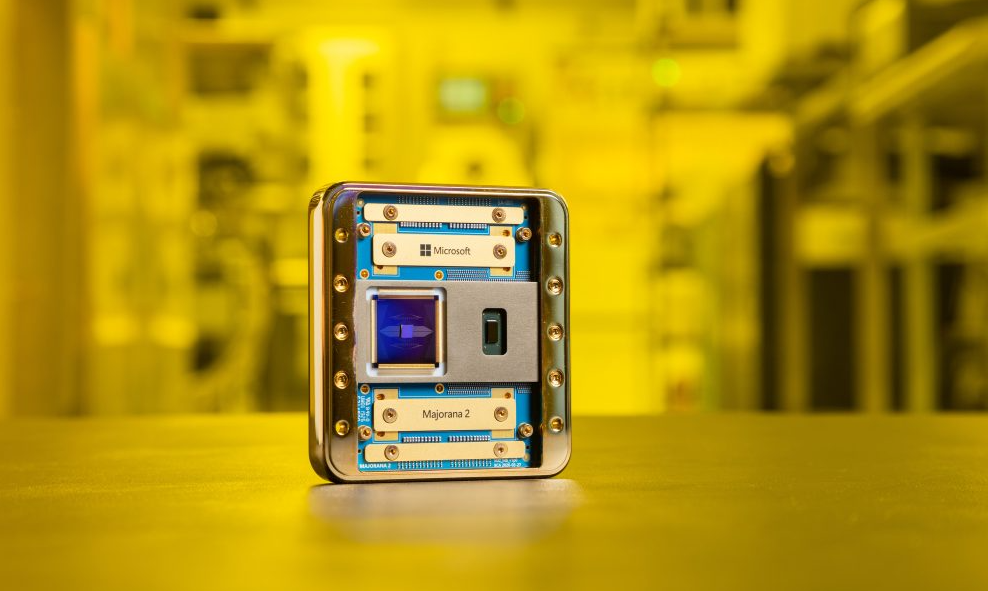
1. Microsoft Majorana 2 Quantum Chip: A breakthrough in qubit stability
- Summary: Microsoft unveiled its new Majorana 2 quantum chip, significantly tackling qubit stability, one of the biggest hurdles in quantum computing. This marks a major step toward making quantum computing commercially viable.
- Key Contribution: The chip achieves a "dramatic breakthrough in qubit stability," clearing a critical technical bottleneck that has long hindered the transition of quantum computing into real-world industrial applications.
2. Nvidia RTX Spark Superchip: Democratizing PC-based AI infrastructure
- Summary: Nvidia introduced the RTX Spark superchip, outlining a strategy to integrate powerful AI processing directly into Windows PCs. Unveiled by CEO Jensen Huang at Computex 2026, this move aims to push AI out of expensive data centers and onto everyday user devices.
- Key Contribution: This "powerful new AI supercomputer chip" enables the implementation of edge AI and personal agents, serving as a cornerstone of Nvidia's strategy to lead every layer of the AI stack.
3. Speeding Up Scientific Discovery: A DOE update
- Summary: At the TPC26 conference, U.S. Department of Energy (DOE) Undersecretary Darío Gil announced that AI is rapidly accelerating the pace of scientific discovery. AI can now provide real-time data analysis and suggest improvements while experiments are still in progress.
- Key Contribution: AI is facilitating a "rapidly accelerating pace of scientific discovery." Its ability to perform real-time optimization during the experimental phase is a vital advancement that is transforming the very methodology of scientific research.

4. Anthropic Launches Claude Opus 4 and Secures $6.5B Series H
- Summary: Anthropic released its latest model, Claude Opus 4, while simultaneously closing a $6.5 billion Series H funding round. The total includes $1.5 billion in previously undisclosed funding, underscoring the fierce competition in the LLM market.
- Key Contribution: Claude Opus 4 drives technical competition within the AI research community, while the massive funding highlights the continuously increasing scale of computing resources required for AI development.
5. Google I/O 2026: 100 AI innovations announced
- Summary: At I/O 2026, Google showcased a vast array of updates, encompassing 100 distinct AI-related announcements across search, productivity tools, and data analysis.
- Key Contribution: Google’s broad integration strategy demonstrates that AI is shifting from the "what if" phase to the "what actually works" phase, with an emphasis on increasing real-world product applications.

Weekly Research Trend Analysis
-
Acceleration of Hardware Innovation: The competition to resolve hardware bottlenecks—long a constraint on AI processing power—is intensifying, as seen with Microsoft’s quantum chip and Nvidia’s RTX Spark.
-
The Rise of Edge AI and Personal AI: There is a clear trend toward high-performance computing moving from data centers to personal devices, establishing a new paradigm that balances AI accessibility with privacy protection.
-
Integration of Scientific Research and Industrial Application: AI has moved beyond a purely theoretical research tool to become the central axis of scientific discovery and industrial problem-solving, with real-time optimization and decision-support features becoming the new standard.
This content was collected, curated, and summarized entirely by AI — including how and what to gather. It may contain inaccuracies. Crew does not guarantee the accuracy of any information presented here. Always verify facts on your own before acting on them. Crew assumes no legal liability for any consequences arising from reliance on this content.
Powered by
