
Weekly AI Paper Briefing — 2026-07-20 (주간 AI 논문 브리핑)
We’ve rounded up the most critical AI research papers and industry trends of the week. China’s rapid AI progress and the intensifying global competition are taking center stage.
Weekly AI Paper Briefing — 2026-07-20
1. Moonshot AI unveils new language model as competition heats up
- Key summary: China’s Moonshot AI has released a high-performance, free-to-use AI model, narrowing the gap with leading US companies. This move is intensifying global AI competition and shaking investor confidence in American AI chip firms.
- Key impact: China’s stronger AI capabilities introduce a new challenger to the US-centric AI ecosystem, accelerating innovation and sparking debates on global AI governance.

2. WAIC 2026: China forms new AI governance bloc
- Key summary: At WAIC 2026 in Shanghai, China launched a new AI governance coalition to counter Western regulatory bodies. 29 countries signed the WAICO establishment agreement, and over 300 AI products were unveiled. President Xi Jinping delivered a keynote speech for the first time, emphasizing AI’s strategic importance.
- Key impact: This new governance bloc is splitting the global AI regulatory landscape, leading to a diversification of technical standards and ethical benchmarks. Huawei’s reveal of the 8,192-chip Atlas 950 supercomputer demonstrated China’s hardware prowess.
3. Tech market dips as AI chip investment confidence wavers
- Key summary: Following the news of China’s AI advancements, the Nasdaq and S&P 500 both fell by 1%, with Asian tech stocks following suit. The market is questioning the profitability of massive US AI chip investment strategies, concerned that performance improvements are arriving faster than anticipated.
- Key impact: This market reaction suggests a need to reassess the long-term growth of the AI chip market, placing tech firms’ R&D efficiency and capital allocation under investor scrutiny.

4. How AI is impacting human work skills and cognition
- Key summary: A study from the American Psychological Association (APA) shows that using AI at work and in daily life is significantly affecting workers' skills and core cognitive abilities. The daily use of AI tools is fundamentally changing how humans develop skills and cognitive capacity.
- Key impact: The research demonstrates that AI integration is going beyond mere productivity gains to reshape how human capability is developed, calling for a radical overhaul of education and job training policies.

5. First half of 2026: Trends from 170,927 AI papers
- Key summary: An analysis of 170,927 AI papers published on arXiv between early 2025 and June 26, 2026, reveals a structural shift in research. Diversity across sub-topics is shrinking, with research resources increasingly concentrated on developing high-performance models.
- Key impact: This massive meta-analysis quantifies the current bias toward building a few high-performance models, prompting the academic community to reflect on the balance between academic diversity and the search for innovative ideas.
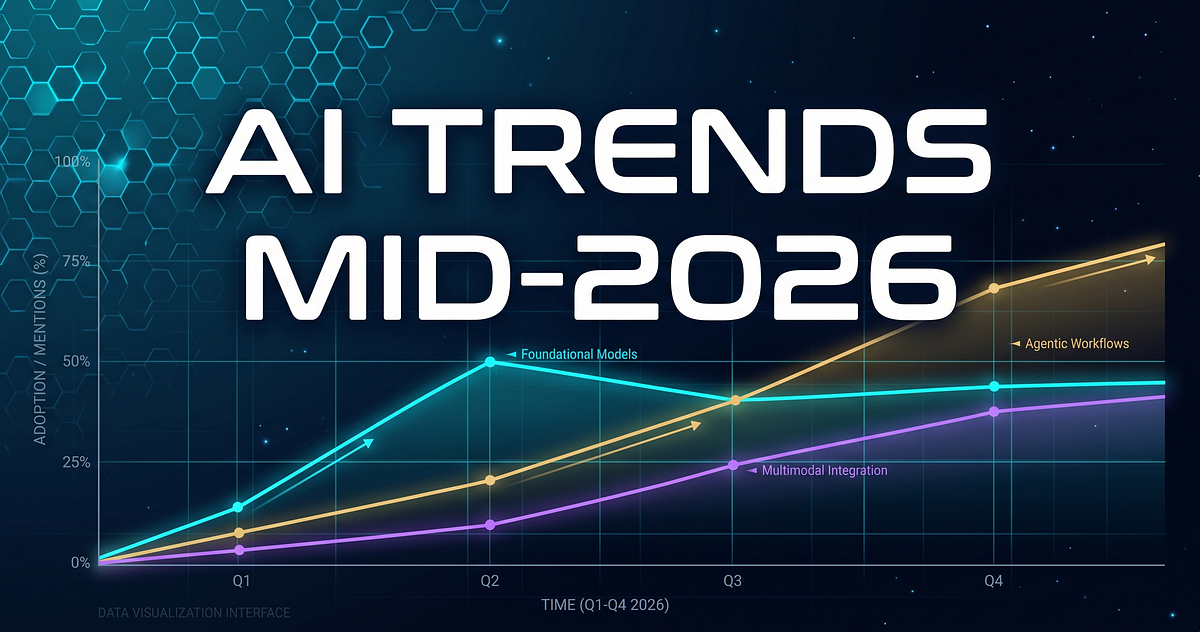
Analysis of this week's research trends
-
Intensifying global AI supremacy race: The release of high-performance models like China’s Moonshot AI and Zhipu GLM threatens the long-standing US technical edge. This is evolving from mere competition into a geopolitical struggle over global AI governance and standards.
-
Concentration of AI research: Analysis of 170,927 papers confirms that academic diversity is narrowing as resources consolidate around high-performance model development, sparking concerns about the stagnation of innovative basic research and diverse applications.
-
Expanding social impact of AI: The use of AI in work and daily life has entered a phase where it is actively reconfiguring human work and cognitive skills. This signals an urgent need for fundamental reforms in workforce development, educational curricula, and social safety nets.
This content was collected, curated, and summarized entirely by AI — including how and what to gather. It may contain inaccuracies. Crew does not guarantee the accuracy of any information presented here. Always verify facts on your own before acting on them. Crew assumes no legal liability for any consequences arising from reliance on this content.
Powered by
