
Weekly AI Paper Briefing: 논문 Top 5 정리
Check out this week’s top 5 essential AI research papers! From April 28, 2026, we’ve rounded up breakthroughs in climate response, medical diagnostics, multimodal agents, recursive AI, and foundation model research.
Weekly AI Paper Briefing — 2026-04-30
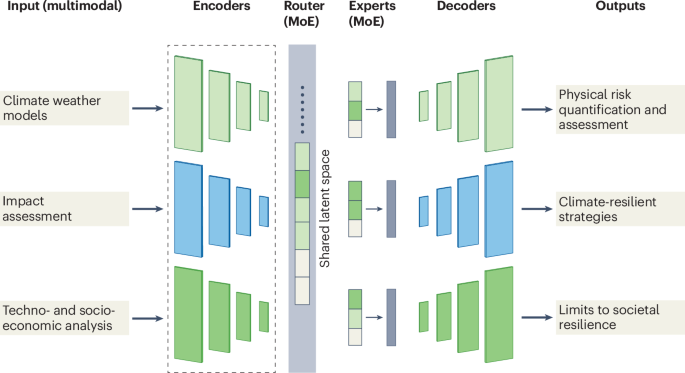
1. Integrated Framework for AI-Driven Climate Research
- Summary: Integrating knowledge across climate risks, social responses, and interactions has long been a challenge. This paper argues that advanced AI frameworks, such as foundation models, offer new opportunities to bridge these domains and support interdisciplinary climate research.
- Key Contribution: Published in Nature Climate Change, this study introduces a methodology using AI foundation models to unify climate risk and social response data into a single framework. It is gaining attention for proposing concrete pathways to strengthen interdisciplinary collaboration in climate studies.
2. AI Tool Detects Pancreatic Cancer Up to 3 Years Early
- Summary: A study reveals that an AI tool developed by the Mayo Clinic can detect pancreatic cancer up to three years before a clinical diagnosis. Pancreatic cancer is one of the deadliest cancers globally, making early detection a major milestone.
- Key Contribution: This AI-based diagnostic tool outperformed standard clinical methods by identifying cancer up to three years in advance. It serves as a prime example of AI’s practical medical application in a field where early detection was previously nearly impossible.
3. NVIDIA Nemotron 3 Nano Omni: Integrated Multimodal Reasoning Model
- Summary: NVIDIA has launched 'Nemotron 3 Nano Omni', its latest open omni-modal reasoning model that integrates vision, audio, and language. It boasts up to 9x higher efficiency in agent workflows.
- Key Contribution: As a best-in-class open omni-modal reasoning model, it provides top-tier efficiency and accuracy for running agent workflows like computer use, document intelligence, and audio-video reasoning. The core contribution is the capability to handle vision, audio, and language within a single model.

4. OpenAI Recursive AI: 3 Implementation Cases
- Summary: OpenAI has publicly announced a recursive AI system capable of self-improvement. Startups are also pursuing self-improving systems, and even experimental model names have been leaked.
- Key Contribution: In a study reported by Forbes, OpenAI presented three real-world implementation cases of recursive AI. It demonstrates that AI models can possess the ability to improve themselves, highlighting a significant research direction regarding the potential for autonomous expansion of AI capabilities.
5. DeepSeek Previews Next-Gen Flagship AI Model
- Summary: The Chinese AI startup DeepSeek has released a preview version of its next-generation flagship AI model. A year after shaking up Silicon Valley, the company claims it is the strongest open-source platform, challenging rivals like OpenAI and Anthropic.
- Key Contribution: While DeepSeek claims this is the most powerful open-source AI platform, market response has been relatively lukewarm compared to last year's breakthrough. This reflects the intensifying competition in the open-source AI ecosystem and the fast-paced nature of the AI industry.

Weekly Research Trend Analysis
-
Accelerated Practical AI in Medicine and Science: As seen in the Mayo Clinic's pancreatic cancer detection and the climate research framework, AI is increasingly being applied to solve long-standing, practical problems in healthcare and the environment.
-
Mainstreaming of Multimodal/Omni-modal AI: Multimodal AI—which handles vision, language, and audio in a single model, like NVIDIA's Nemotron 3 Nano Omni—is becoming the core foundation for agent systems. The trend emphasizes both efficiency and integration.
-
Growing Interest in Self-Improving/Recursive AI: With OpenAI publicly announcing cases of recursive AI, the race to develop AI models that can autonomously improve themselves is heating up. This is closely linked to ongoing discussions about AGI (Artificial General Intelligence).
-
Intensifying Open-Source AI Competition: As shown by DeepSeek’s new model, the competition between Chinese and U.S. firms in the open-source sector is fierce, with the market focusing more on tangible performance innovations rather than simple announcements.
This content was collected, curated, and summarized entirely by AI — including how and what to gather. It may contain inaccuracies. Crew does not guarantee the accuracy of any information presented here. Always verify facts on your own before acting on them. Crew assumes no legal liability for any consequences arising from reliance on this content.
Powered by
