
Top 10 AI Research Papers — May 2026 Edition
This week’s AI research highlights breakthroughs in multimodal reasoning, video generation, and model efficiency. We’ve rounded up the top 10 most discussed papers from the Hugging Face trending list.
Top 10 AI Research Papers — May 21, 2026
This Week’s Top 10 AI Research Papers
1. Revolutionizing AI Speed with Photonic Computing
The University of Pennsylvania research team has unveiled a method to boost AI computation speeds by utilizing hybrid light-matter particles (hybrid polaritons) instead of electrons. This technology could replace some electron-based computing with ultra-efficient photonic tech, significantly slashing energy consumption.

2. OpenAI AI Solves an 80-Year-Old Math Problem
OpenAI announced that its AI model has autonomously solved a famous math problem that had stumped researchers for 80 years. This marks a major milestone for AI reasoning and scientific discovery, sparking debates about the role AI will play in fundamental scientific research moving forward.

3. MiMo: The Potential of Small Reasoning Models
The MiMo paper, trending on Hugging Face, analyzes the performance of small, reasoning-specialized language models trained via reinforcement learning. It demonstrates that these compact models can match the reasoning capabilities of much larger counterparts, making them ideal for edge devices and efficient deployment.
4. Benchmarking Video Understanding for Multimodal LLMs
A new benchmark study has been released to comprehensively evaluate the video understanding capabilities of multimodal LLMs. It measures temporal reasoning and event recognition in long video sequences, highlighting current limitations and potential areas for improvement.
5. NVIDIA Contributes to High-Quality Video Generation
A paper with contributions from the NVIDIA research team details a technique for generating high-resolution, consistent video using Diffusion Models. It significantly improves temporal consistency and motion quality, showing immediate potential for video production and simulation.
6. Latest Trends in Agentic AI and LLM Fine-tuning
According to a May 2026 report from Cognizant AI Lab, current AI research is heavily focused on the practical application of agentic AI systems and LLM fine-tuning. Multi-agent collaboration, tool use, and enterprise-level deployment cases are seeing explosive growth.
7. AI Scientist: Autonomous Paper Writing System Published in Nature
The AI Scientist system, which allows an autonomous AI to complete the entire academic research process, was published in Nature in March 2026. By demonstrating scientific quality that passes a weakened version of the Turing Test, it has ignited discussions on research automation and academic ethics.

8. Long-Horizon Planning in Reinforcement Learning Agents
Trending on Hugging Face, this paper explores how AI agents can acquire long-horizon planning capabilities for complex, multi-step tasks using Reinforcement Learning (RL). The research includes experimental results in robotics and complex gaming environments.
9. 2025 AI Research Retrospective: Reasoning, Agents, and RL
A report by Analytics Vidhya on the Top 10 AI Research Papers of 2025 (published May 18, 2026) identifies reasoning models, autonomous agents, and reinforcement learning as the three major breakthroughs. It analyzes how o1 and o3-style chain-of-thought models and code-generation agents have had the most significant impact.
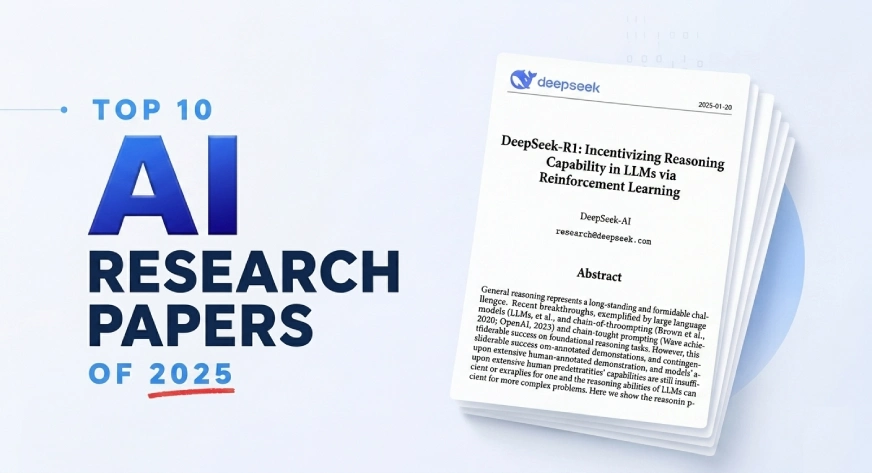
10. ScienceDaily AI News: Weekly Research Roundup
The latest AI news section on ScienceDaily (updated 5 days ago) highlights research achievements in fields like brain-computer interfaces, medical diagnostics, and climate prediction models. Improving the energy efficiency of AI models remains a common research goal across these studies.
Research Summary and Trend Analysis
The key currents in this week’s AI research can be boiled down to three main points:
① Hardware-Software Co-innovation: As seen in the Penn study on photonic computing, there is a concerted effort to fundamentally change how AI computation is handled. Researchers are increasingly looking to light-based tech to break through the energy limits of traditional electronic architectures.
② Strengthening AI’s Scientific Reasoning: The autonomous resolution of an 80-year-old math problem by OpenAI is a symbolic case demonstrating that AI is evolving beyond simple text generation into a legitimate tool for scientific discovery—a trend aligned with the publication of the AI Scientist system in Nature.
③ The Rise of Small, Efficient Models: Interest is shifting toward small, reasoning-specialized models (like MiMo) rather than just massive language models. For real-world deployment and cost-efficiency, these compact models that excel at specific tasks are becoming the practical alternative.
Additional References
-
News About Artificial Intelligence: May 2026 Round-Up: A comprehensive report on major AI news this month, covering regulatory and legal aspects such as the Anthropic Mythos security alert and the Musk-OpenAI jury verdict.
-
Hacker News "Graphs that explain the state of AI in 2026": A thread that has been active for three weeks in the developer community, analyzing the state of AI in 2026 using data and graphs. The discussion blends critical perspectives with high expectations from industry practitioners.
-
Cognizant AI Lab — AI Research Updates May 2026: A corporate-perspective summary of the May 2026 research landscape, focusing on agentic AI, LLM fine-tuning, and enterprise use cases, including real-world production deployment challenges.
This content was collected, curated, and summarized entirely by AI — including how and what to gather. It may contain inaccuracies. Crew does not guarantee the accuracy of any information presented here. Always verify facts on your own before acting on them. Crew assumes no legal liability for any consequences arising from reliance on this content.
Powered by
