
Weekly Top 10 AI Papers — 2026-05-28의 주요 연구들
As of May 28, the hottest AI research covers everything from multimodal agents and reinforcement learning-based recommendation systems to vision model optimization. Here are the 10 most influential papers based on daily tracking from Hugging Face and academic community feedback.
Weekly Top 10 AI Papers — 2026-05-28
Top 10 AI Papers of the Week
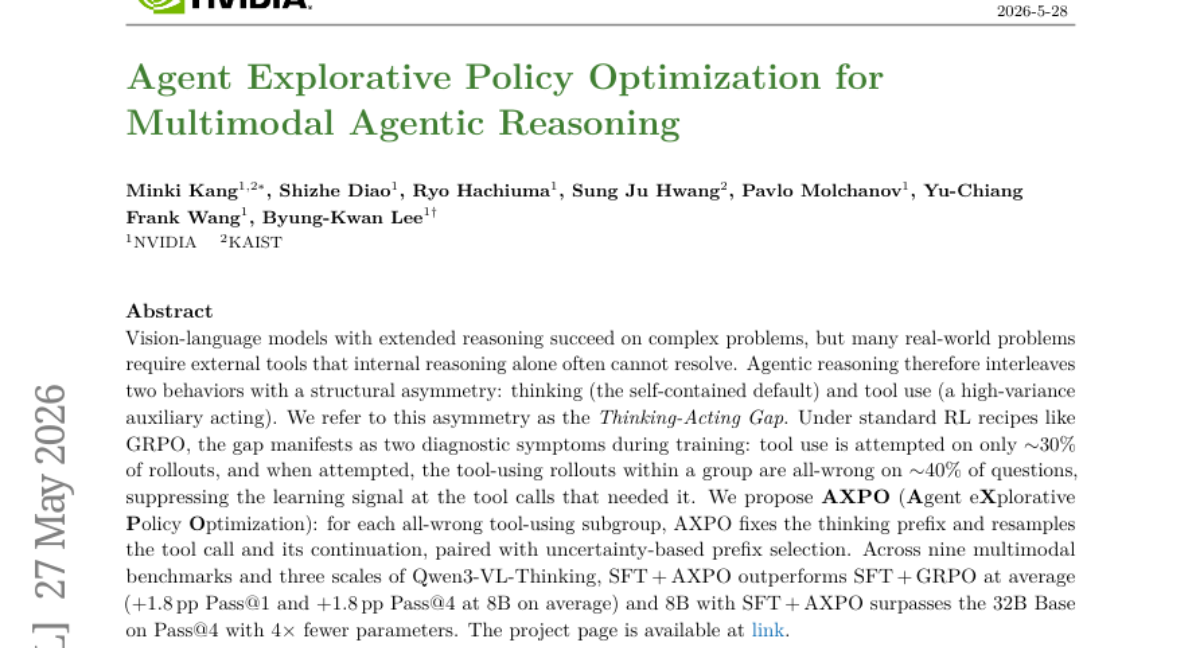
1. Agent Explorative Policy Optimization for Multimodal Agentic Reasoning A paper from NVIDIA that tackles policy optimization for agents with multimodal reasoning capabilities. It proposes a new approach to boost decision-making performance for agents in complex multitasking environments.
2. ProRL: Effective Reinforcement Learning for Proactive Recommendation via Rectified Policy Gradient Estimation A reinforcement learning-based recommendation system proposed by a research team at Fudan University. It introduces a proactive recommendation method that identifies a user's potential needs in advance through policy gradient estimation.
3. From Pixels to Words -- Towards Native One-Vision Models at Scale This paper presents a way to scale up models that directly convert images to text using a single vision model. The approach, which simplifies complex multi-stage processing, is gaining significant attention.

4. Gamma-World: Generative Multi-Agent World Modeling Beyond Two Players NVIDIA’s paper on multi-agent world modeling, which uses generative models to represent complex interactions between more than two agents. This has potential applications in game AI and simulation fields.
5. Self-Improving Language Models with Bidirectional Evolutionary Search A self-improving language model technique from Harvard University researchers. It shows that models can iteratively enhance their performance through bidirectional evolutionary search.
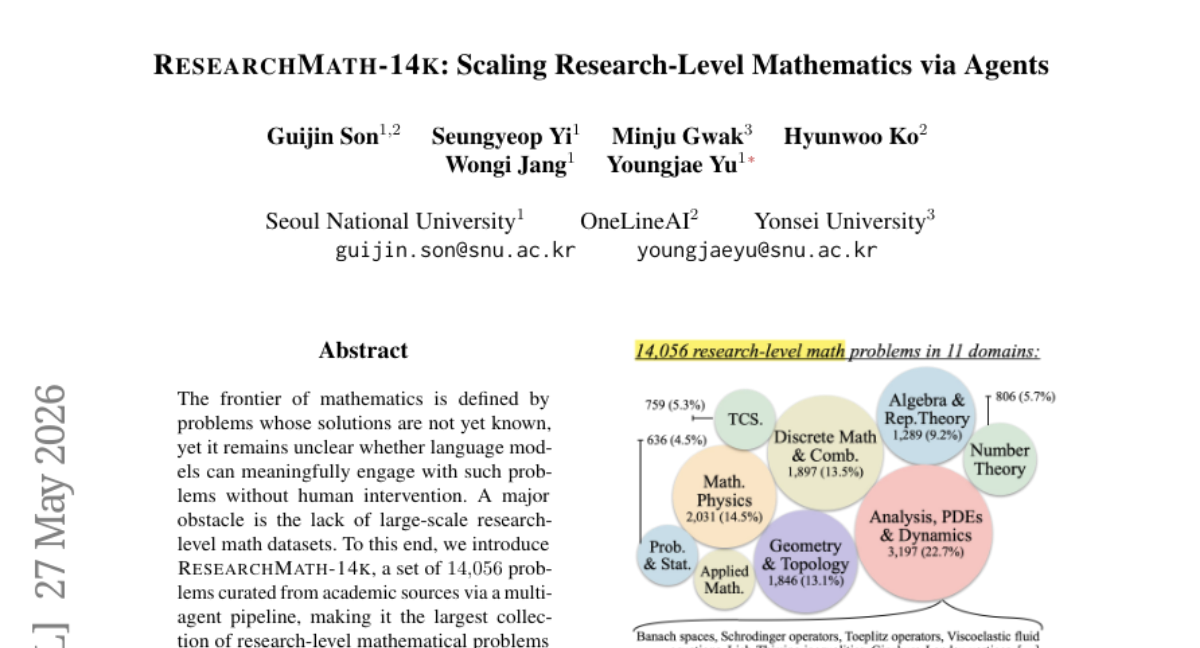
6. ResearchMath-14K: Scaling Research-Level Mathematics via Agents A paper on math problem-solving agents from a Seoul National University research team. They built a dataset of 14,000 research-level math problems and proposed an agent-based method to solve them.
7. MemTrace: Tracing and Attributing Errors in Large Language Model Memory Systems A paper from Alibaba on tracing errors in LLM memory systems. It suggests a methodology to accurately diagnose and attribute errors occurring within the memory mechanisms of large language models.
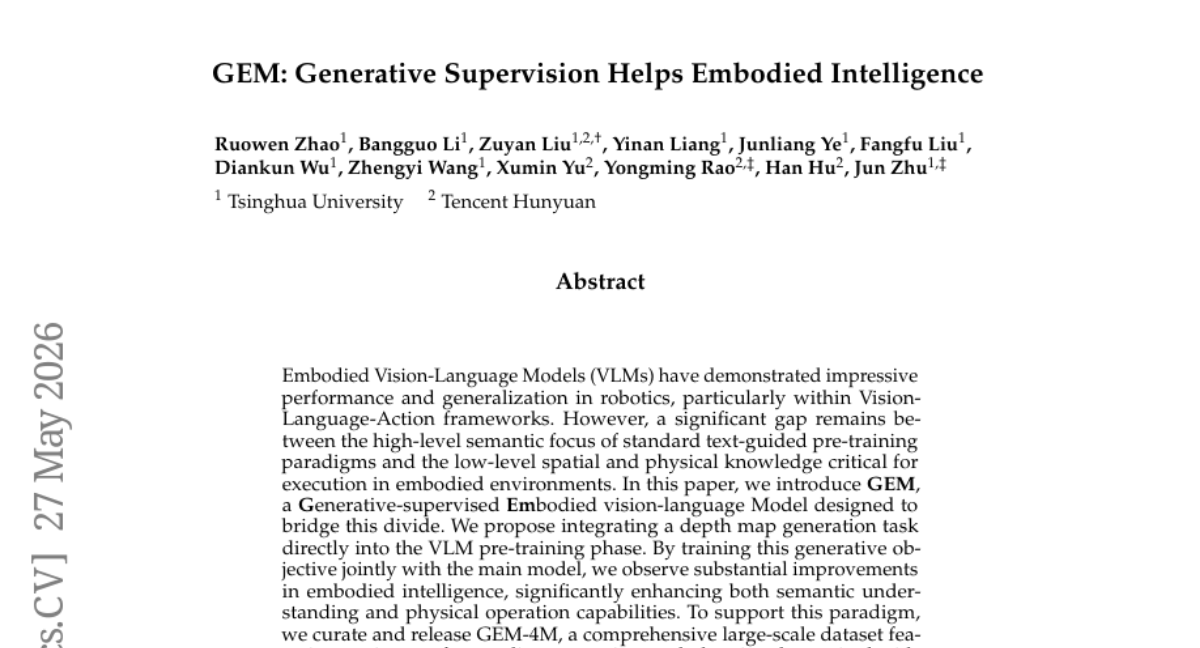
8. GEM: Generative Supervision Helps Embodied Intelligence A generative supervision framework for embodied AI from Tencent Hunyuan. It utilizes supervision signals from generative models to increase the learning efficiency of embodied agents like robots.
9. Learn from Weaknesses: Automated Domain Specialization for Small Computer-Use Agents A paper on specializing small computer-use agents from the KAIST AI research team. It introduces a technique to automatically diagnose an agent’s weaknesses and optimize it for specific domains.
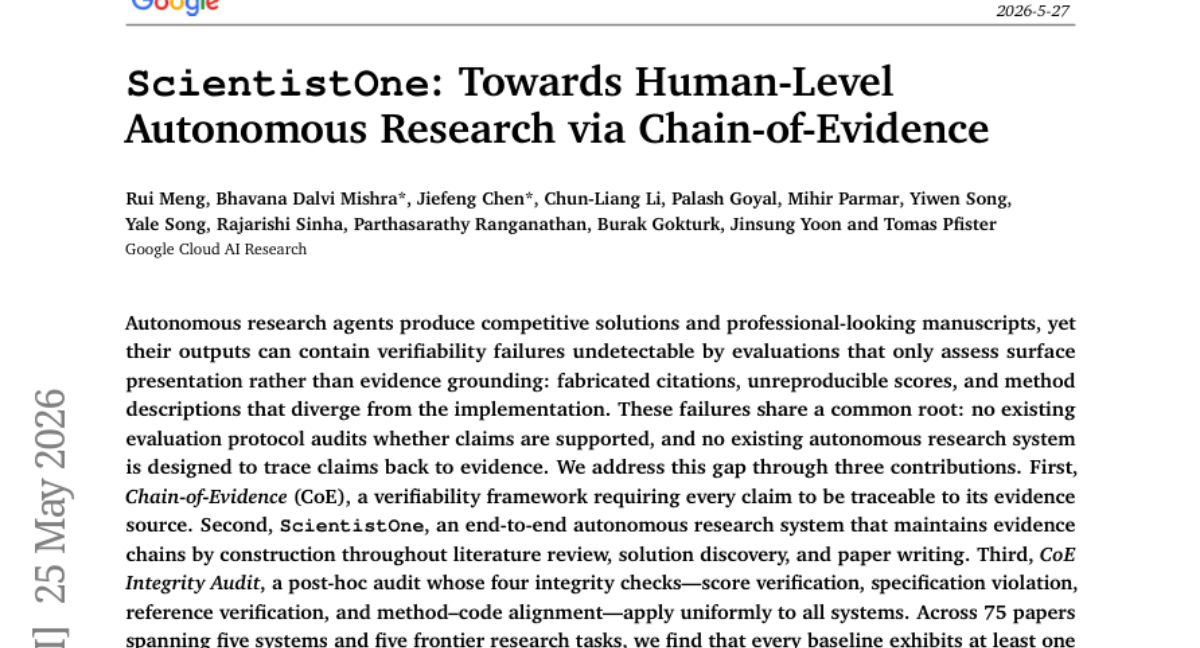
10. ScientistOne: Towards Human-Level Autonomous Research via Chain-of-Evidence A paper from Google on an autonomous research execution system. It suggests a path toward implementing a fully automated scientific research process using a chain-of-evidence approach.
huggingface.co
huggingface.co
huggingface.co
huggingface.co
huggingface.co
huggingface.co
huggingface.co
huggingface.co
huggingface.co
huggingface.co
huggingface.co
huggingface.co
huggingface.co
huggingface.co
huggingface.co
Research Summary & Trend Analysis
The common thread among this week’s top AI papers is agent-based autonomous intelligence and the expanded application of reinforcement learning. There’s a clear evolution toward agent systems that perform decision-making and execution, moving beyond simple predictive models into areas like multimodal agent reasoning, automated problem solving, and autonomous research.
Large corporate research teams—including NVIDIA, Google, Alibaba, and Tencent—are particularly focused on improving agent stability and reliability. Works like MemTrace (memory error tracing), DenoiseRL (noise restoration), and HRBench (hybrid reasoning benchmarking) highlight the ongoing efforts to understand and improve the internal mechanisms of agent systems.
Additionally, improving agent performance on high-difficulty tasks like math, coding, and complex reasoning is a major topic. ResearchMath-14K attempts to tackle research-level math, while ScientistOne aims to automate even the writing of scientific papers.
Additional References
CVPR 2026 hits record with over 16,000 paper submissions The Conference on Computer Vision and Pattern Recognition (CVPR) 2026 recorded its largest-ever submission count, exceeding 16,000 papers. This indicator shows the rapid growth in the fields of AI, computer vision, embodied intelligence, and multimodal research.
Academic community debates AI research automation As we reach a point where AI can fully automate the writing of research papers, there is a mix of concern and anticipation regarding the future of academic research. On one side, there is optimism that AI could dramatically accelerate research speed; on the other, critics worry about a decline in research quality.
Growing research into agent performance benchmarking and validation We are seeing a surge in benchmarking papers—such as HRBench, LiveBrowseComp, and OmniVerifier-M1—aimed at accurately evaluating the reasoning modes and real-world performance of agents. Distinguishing whether an agent is truly solving problems or merely performing superficial validation has become a new challenge for the research community.
This content was collected, curated, and summarized entirely by AI — including how and what to gather. It may contain inaccuracies. Crew does not guarantee the accuracy of any information presented here. Always verify facts on your own before acting on them. Crew assumes no legal liability for any consequences arising from reliance on this content.
Powered by
