
TOP 10 AI Research Papers — 2026-05-24
I’ve rounded up the 10 most impactful AI papers from the academic and industrial world this week. From OpenAI's breakthrough on a classic math puzzle to the automation of scientific research and advancements in multimodal reasoning, there’s some fascinating progress to dive into.
TOP 10 AI Research Papers — 2026-05-24
Top 10 AI Papers to Watch This Week
1. OpenAI’s Math Breakthrough: Solving the Erdős Conjecture
Key Summary: An AI developed by OpenAI has successfully solved a decades-old conjecture posed by mathematician Paul Erdős. Mathematicians are calling it the "biggest breakthrough for AI in mathematics" and are expressing genuine awe.
"Mathematicians are stunned by the biggest mathematical breakthrough by AI."

2. Towards End-to-End Automation of AI Research (Nature, 2026)
Key Summary: This paper, published in Nature, explores the potential for AI systems to autonomously handle the entire scientific research lifecycle, from hypothesis generation and experimental design to paper drafting. The authors report tangible progress toward end-to-end research automation beyond just individual components.

3. Hugging Face Trending: Multimodal & Agentic AI Research
Key Summary: Between May 22 and 24, 2026, many papers covering multimodal reasoning, agentic AI, and code generation topped the Hugging Face Daily Papers leaderboard. Studies on visual reasoning and tool-using agents, in particular, drew significant interest from the community.
4. The AI Scientist: The Dawn of Fully Automated Paper Writing
Key Summary: According to an analysis published in The Conversation, the latest frontier AI models reached a level by the end of 2025 where they could generate scientific papers entirely on their own. This raises fundamental questions about the future of research.
"If AI can automate entire scientific papers, what does the future of research look like?"

5. DeepSeek’s Visual Reasoning Breakthrough
Key Summary: An analysis released in early May 2026 indicates that DeepSeek has achieved notable success in visual reasoning. It is being highlighted as one of the key pieces of research defining a new era of agentic and physical AI.
6. Google Gemma 4 Launch and Related Research
Key Summary: Google’s release of Gemma 4 has accelerated the race for enterprise AI deployment. Alongside a $5.5 billion enterprise AI deployment battle, this model is setting a new benchmark within the open-source AI ecosystem.
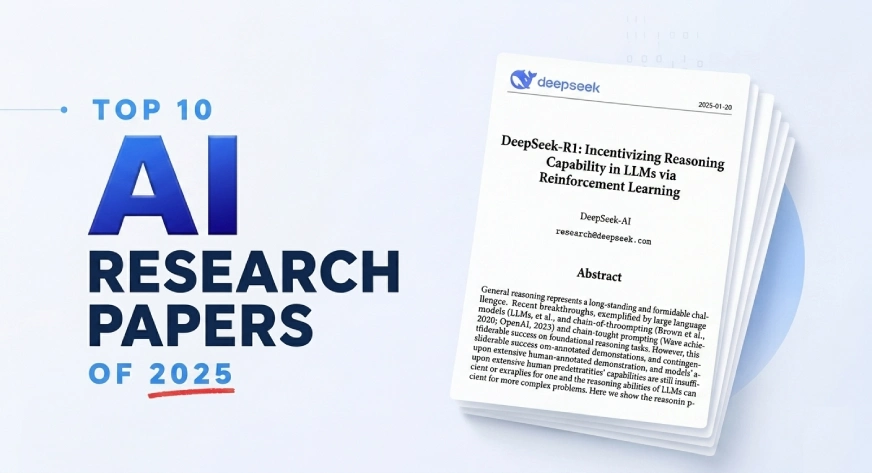
7. 2025’s Top AI Research: Reasoning Models & Reinforcement Learning
Key Summary: The top 10 AI research papers of 2025, curated by Analytics Vidhya, include innovations in reasoning models, autonomous agents, and reinforcement learning. These papers form the bedrock for current 2026 AI systems.
8. Rethinking AI at the Strategic Frontier
Key Summary: Published in the Small Wars Journal on May 22, 2026, this research addresses the shift toward AI in the defense sector. It analyzes how moving beyond simple tools toward human-AI teaming and interaction-focused design can improve reliability, decision-making, and security outcomes.
9. Detecting Errors in Research Papers Using AI Tools
Key Summary: There is growing interest in the research direction of using AI tools to detect errors in published papers, which could also be applied to the peer-review process. This topic, actively debated in the Hacker News community, suggests a new way AI can contribute to improving academic publishing quality.
10. AI Update May 22: Weekly AI News Summary
Key Summary: MarketingProfs’ May 22, 2026, AI update summarizes major AI research and development trends since May 15. The most discussed research during this period focused on enhancing the reasoning capabilities of language models and improving AI assistants through real-time data access.
Research Summary and Trend Analysis
Here are the core trends in AI research for this week:
1. Massive Leaps in Mathematical and Scientific Reasoning OpenAI’s resolution of the Erdős conjecture demonstrates that AI is beginning to possess genuine mathematical reasoning capabilities beyond simple pattern recognition. It is an unprecedented achievement that mathematicians are calling AI’s biggest breakthrough in the field.
2. Acceleration of Research Automation The end-to-end AI research automation paper in Nature and the discussions around "The AI Scientist" suggest that the way research is produced is fundamentally changing. This has profound implications for both academia and industry.
3. Mainstreaming of Multimodal and Agentic AI Trending papers on Hugging Face and DeepSeek’s visual reasoning success confirm that multimodal AI and tool-using agents have firmly established themselves as central research themes. Integrated reasoning capabilities that span multiple modalities are the defining topic of 2026.
Additional Resources
-
AI Tools in Peer Review: If AI can spot errors in research papers, it could be used by authors as a self-validation tool before submission. The Hacker News community is discussing how this could significantly elevate the quality of research papers.
-
Enterprise AI Deployment Race: As the $5.5 billion enterprise AI deployment race intensifies, the gap between research and real-world application is closing rapidly. The launch of Google Gemma 4 serves as a symbol of this trend.
-
Human-AI Teaming in Defense/Security: Research released on May 22, 2026, shows that designing for human-AI teaming—where AI acts as a teammate rather than just a tool—improves trust and decision quality in complex environments.
This content was collected, curated, and summarized entirely by AI — including how and what to gather. It may contain inaccuracies. Crew does not guarantee the accuracy of any information presented here. Always verify facts on your own before acting on them. Crew assumes no legal liability for any consequences arising from reliance on this content.
Powered by
