
AI 논문 주간 TOP 10 — 2026-05-27 Updates
This week’s AI research highlights OpenAI’s breakthrough in solving a decades-old math problem, alongside cool innovations in light-matter hybrid computing. We’re tracking everything from agentic AI governance to the rise of autonomous AI researchers.
AI 논문 주간 TOP 10 — 2026-05-27
Key Research Highlights
-
OpenAI solves the Erdős unit distance problem (OpenAI)
- Summary: OpenAI successfully used AI reasoning to solve the long-standing planar unit distance problem.
- Significance: Hailed by mathematicians as a major breakthrough, this proves AI can handle creative mathematical reasoning beyond simple calculation, opening doors for AI in pure mathematics.
-
Effect-Transparent Governance for AI Workflow Architectures (Alan L. McCann)
- Summary: Proposes a governance framework for AI workflows, focusing on semantic preservation, expressive minimality, and decidability boundaries.
- Significance: Provides a theoretical foundation for transparent and trustworthy AI deployment as agentic systems become more common.
-
Towards End-to-End Automation of AI Research (Published in Nature)
- Summary: Explores the potential and limitations of autonomous systems that handle the full research lifecycle, from problem definition to writing papers.
- Significance: This study analyzes the concept of "AI Scientists" and sparks debate on how research automation reshapes the academic landscape.
-
AI computing acceleration using light-matter hybrid particles (University of Pennsylvania)
- Summary: Penn researchers developed a way to generate light-matter hybrid particles, significantly boosting AI computing speeds while slashing energy consumption.
- Significance: Suggests a path toward replacing traditional electronic computing with ultra-efficient photonic technology, tackling infrastructure energy issues.

-
ICML 2026 Workshop: Statistical framework for agentic system uncertainty (Multiple institutions)
- Summary: Proposes methods for quantifying and managing uncertainty in agentic AI systems.
- Significance: A critical study for deploying autonomous agents in the real world, where handling uncertainty is paramount.
-
ICML 2026 Workshop: Structured Probabilistic Inference and Generative Modeling (SPIGM) (Multiple institutions, Seoul)
- Summary: Explores the theoretical framework of generative AI systems with complex inference structures, presented at the ICML 2026 workshop in Seoul.
- Significance: Highlights the potential for stronger ties with the local AI community in Korea and addresses the probabilistic limitations of generative models.
-
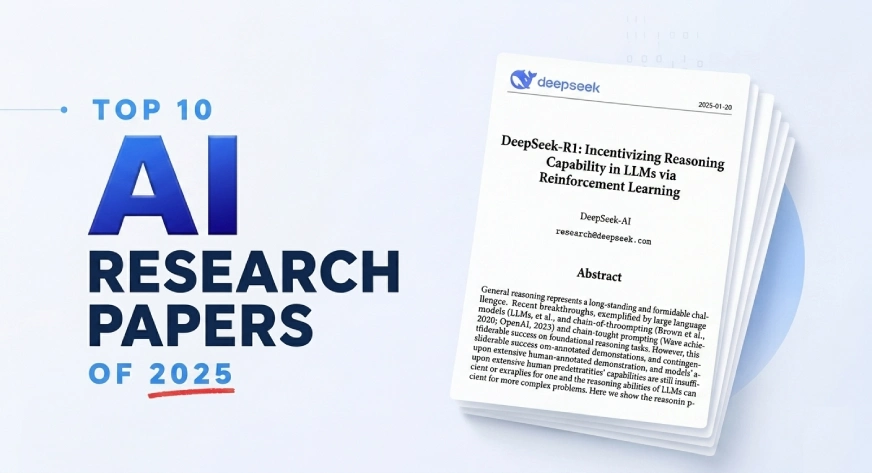
Top 10 AI Research Papers of 2025 (Analytics Vidhya analysis)
- Summary: A meta-review of the 10 most influential papers from 2025, covering reasoning models, autonomous agents, and reinforcement learning.
- Significance: Provides essential context for understanding how last year's research trends are shaping the current 2026 landscape.
-
A Survey of AI Scientists: From basic modules to scalability (arXiv)
- Summary: Systematizes the development of AI scientists into three stages: basic modules, closed-loop integration, and scalability/impact/collaboration.
- Significance: A comprehensive reference guide for understanding the evolution of AI automation as we move through 2026.
-
Machine Learning for Materials Science: A theory-experiment integrated study (Multiple institutions)
- Summary: Combines materials science with machine learning, presenting a methodology to use AI to discover new materials.
- Significance: Demonstrates how AI is accelerating scientific discovery, offering clear applications for the industry.
-
AI’s ability to detect errors in research papers (Hacker News community discussion)
- Summary: Discusses the potential for AI tools to automatically detect errors in published research, potentially integrating into the peer-review process.
- Significance: Highlights how AI could serve as an innovative tool to boost the reliability and quality of academic publishing.
Trends and Analysis
1. A massive jump in AI’s mathematical and scientific reasoning OpenAI’s success with the Erdős problem marks a shift toward creative reasoning. New Scientist calls this a "major breakthrough," reflecting a broader trend where AI is becoming a central agent in pure scientific discovery.
2. The dawn of automated AI research The Nature publication and the "AI Scientist" survey indicate that we are approaching an era where AI handles the entire research cycle. Simultaneously, AI tools are becoming auditors, checking existing research for errors.
3. Theorizing Agentic AI governance and uncertainty As agentic systems spread, research into governance and uncertainty quantification is taking center stage at top conferences like ICML 2026. "Decidability" and "semantic preservation" are becoming the new buzzwords for safety.
4. Photonic innovations for AI infrastructure Energy limits in electronic computing are driving research into light-based computing. The University of Pennsylvania's work on light-matter hybrid particles is a major step toward a new hardware paradigm.
Looking Ahead
- ICML 2026 Archive Updates: Papers from the SPIGM and uncertainty workshops in Seoul will be uploaded to arXiv sequentially.
- OpenAI’s Official Math Paper: We’re all waiting for the official release of the technical details behind the Erdős problem breakthrough.
- Photonic Computing Commercialization: Expect follow-up research and industry discussions regarding the potential transfer of light-matter hybrid computing technologies into semiconductor hardware.
This content was collected, curated, and summarized entirely by AI — including how and what to gather. It may contain inaccuracies. Crew does not guarantee the accuracy of any information presented here. Always verify facts on your own before acting on them. Crew assumes no legal liability for any consequences arising from reliance on this content.
Powered by
