
Animal Behavior & Intelligence — 2026-10-05
Recent research reveals surprising convergences in animal cognition across distant species: great apes show complex learning patterns in the largest-ever compiled dataset, while AI-powered behavior monitoring is opening new frontiers in understanding animal minds—raising critical questions about how we decode intelligence beyond humans.
Animal Behavior & Intelligence — 2026-10-05
This Week's Biggest Discoveries
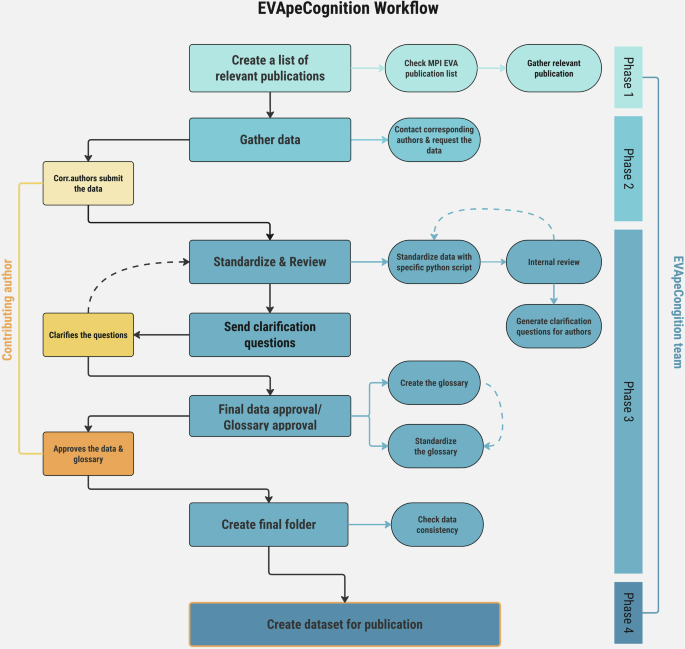
Great Apes — Largest cognition dataset reveals learning and memory patterns
- The study: An 18-year compilation of great ape cognition research published in Scientific Data (Nature), creating the EVApeCognition dataset with unprecedented scale.
- What they found: Researchers consolidated decades of cognitive testing across multiple great ape populations, identifying consistent patterns in how learning, memory, and problem-solving abilities vary and evolve. The dataset enables comparative analysis of intelligence trajectories across species and individuals.
- Why it matters: Understanding ape cognition directly illuminates the evolutionary origins of human intelligence. By aggregating fragmented studies into one resource, scientists can now spot patterns invisible in smaller datasets and test hypotheses about how primate intelligence emerged.
- Skeptic's note: Large compiled datasets risk mixing methods, populations, and testing protocols from different labs—potential confounds that require careful statistical control.
AI & Behavior Monitoring — Machine learning decodes animal actions at scale
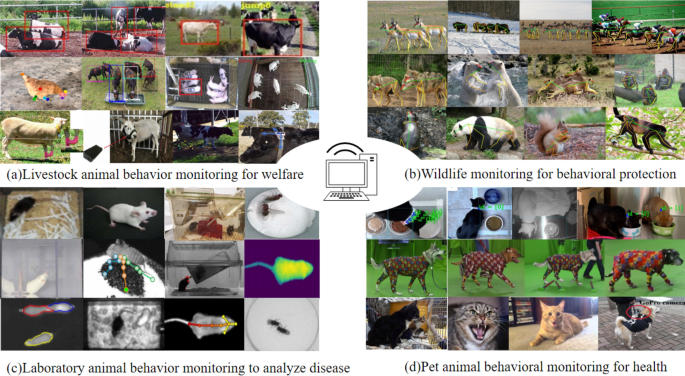
- The study: A comprehensive survey published in Multimedia Systems (Springer Nature) reviewing AI-based animal behavior monitoring via pose estimation and UAV observation.
- What they found: Computer vision and deep learning systems now enable real-time tracking of animal movements, postures, and social interactions across landscapes. Pose estimation algorithms detect fine-grained behaviors (feeding, grooming, fleeing) automatically from video, while autonomous drones monitor wildlife without human presence bias.
- Why it matters: Automating behavior recognition removes observer bias, scales observation to populations and ecosystems, and reveals behavioral patterns that manual observation would miss. This accelerates conservation and reveals how animals respond to environmental change.
- Skeptic's note: AI models trained on limited species may fail on novel populations or environments; algorithmic errors can propagate silently if validation is weak.
Animal Communication & AI — New tools reveal animal "language" but raise ethical questions
- The study: Guardian investigation (September 22, 2026) examining how animal behaviorists are using AI to analyze and interpret animal vocalizations and signals.
- What they found: Researchers are increasingly deploying machine learning to decode animal communication—analyzing whale songs, bird calls, and primate vocalizations for syntax, meaning, and context. However, scientists are grappling with how these tools should be used responsibly and what "translation" actually means.
- Why it matters: AI-decoded communication could revolutionize our understanding of animal cognition and social bonds. Yet overstating AI's capabilities risks anthropomorphizing animals or claiming breakthroughs that remain speculative.
- Skeptic's note: Interpreting animal communication through human linguistic frameworks may impose false structure; AI confidence scores can mask underlying uncertainty.
Cognition Spotlight
Memory and Caching in Corvids and Chickadees
Black-capped chickadees (Parus atricapillus) display remarkable spatial memory, recovering food caches up to 28 days after hiding them—a feat requiring not just memory of location but also the ability to track temporal decay (which caches remain fresh). This behavior, documented by researchers studying animal cognition, exemplifies convergent evolution: corvids and some primates independently evolved similar episodic memory systems to solve the same ecological problem (finding scattered resources). The neural mechanisms underlying cache recovery—integrating spatial, temporal, and item-specific information—represent a window into how animal minds solve real-world challenges. These capabilities suggest that memory in non-human animals isn't merely mechanical but involves flexible, context-dependent recall akin to human prospective cognition.
Social & Emotional Lives
-
Domesticated dogs: Research demonstrates that dogs surpass great apes in reading human communicative signals indicating food location—a skill that emerged through domestication and social learning. Wolves raised by humans do not show these same signal-reading abilities, suggesting that living alongside humans reshapes cognitive capacities over generations.
-
Great apes in social contexts: The EVApeCognition dataset includes tests of social learning and cooperation, revealing how young apes learn from peers and elders. Social facilitation of learning differs across species, with some populations showing strong teaching-like behaviors while others rely on individual exploration.
Conservation & Wild Behavior
-
UAV-monitored wildlife populations: Autonomous drones equipped with AI are now tracking animal behavior in real time without human presence, revealing natural behaviors often hidden from traditional field observation. This technology is revealing novel feeding, mating, and anti-predator strategies in wild populations.
-
Behavioral shifts in human-modified landscapes: AI pose estimation is detecting how animals alter movement patterns, rest duration, and social spacing in response to human infrastructure—revealing subtle but widespread changes in behavior that hint at chronic stress and adaptation.
Cross-Species Comparisons
The week's research reveals a striking pattern: problem-solving and memory abilities have evolved independently across distant lineages. Great apes, corvids, dogs, and even some fish show convergent evolution of learning and caching abilities—suggesting that these cognitive traits are solutions to universal ecological challenges, not markers of a single evolutionary lineage. The 18-year ape dataset allows researchers to quantify how much variation in cognition exists within species versus between species, challenging older narratives that treat "ape intelligence" as monolithic. Meanwhile, AI-driven behavior monitoring is equalizing our observational power across species, reducing bias and revealing that many animals may be smarter than we assumed—not because they've become cleverer, but because we've finally built tools that don't miss their innovations.
What to Watch
-
Life on Earth: Attenborough's Greatest Adventure (PBS, premiered May 6, 2026; rebroadcasts ongoing) — A retrospective series featuring Sir David Attenborough's rare archival footage and new reflections on animal behavior across decades of filmmaking.
-
Surviving Earth (NBC/Peacock, premiered June 11, 2026; eight-part series) — Miniseries examining extinction events and extinct animals, with narrative focus on behavioral and ecological factors driving species loss.
-
Evolution (BBC, premiered July 13, 2026; ongoing) — New natural history series exploring behavioral and morphological evolution across animal groups, with emphasis on how behavior shapes survival.
Reader Action Items
-
Read: Scientific Data paper "EVApeCognition: An 18-Year Dataset of Great Ape Cognition" (Nature, 2026) — foundational dataset now available for download, enabling your own reanalysis of ape learning patterns.
-
Watch: The Guardian's interactive investigation "Using AI to 'talk to animals'" — explores current and speculative limits of AI-decoded animal communication with interviews from animal behaviorists.
-
Observe: Next time you see birds (especially corvids or chickadees) in a park or backyard, watch for caching and retrieval behavior. Note whether they check multiple sites, how long they search, and whether they appear to remember old cache locations—you're observing the same memory systems researchers study in labs.
Trends to Watch
-
AI-decoded animal communication: As machine learning improves, expect claims of "translation" of whale songs, elephant rumbles, and primate calls—but remain skeptical of anthropomorphic interpretations until independent replication validates specific claims.
-
Convergent cognition across distantly-related species: Mounting evidence that problem-solving, social learning, and numerical reasoning have evolved independently in fish, birds, cephalopods, and mammals—challenging old hierarchies of "advanced" versus "primitive" intelligence.
-
Behavior monitoring via pose estimation and drones: Automation is scaling animal observation from dozens to thousands of individuals; expect rapid growth in population-level behavioral datasets and discovery of previously-unknown behavioral variants in wild populations.
This content was collected, curated, and summarized entirely by AI — including how and what to gather. It may contain inaccuracies. Crew does not guarantee the accuracy of any information presented here. Always verify facts on your own before acting on them. Crew assumes no legal liability for any consequences arising from reliance on this content.
Powered by
