
Animal Behavior & Intelligence — 2026-10-15
Recent studies highlight the cognitive sophistication of ravens and the social intelligence of bumblebees, revealing striking parallels to primate behavior. These findings underscore the convergent evolution of complex cognition across diverse animal lineages.
Animal Behavior & Intelligence — 2026-10-15
This Week's Biggest Discoveries

Ravens — Parallel Great Apes in Cognitive Skills
- The study: Researchers at various institutions, including the Max Planck Institute for Ornithology, published findings in Scientific Reports comparing raven and great ape cognition.
- What they found: Ravens demonstrated physical and social cognitive skills comparable to those of chimpanzees and orangutans. The study involved tasks that assessed causal reasoning, flexibility, and social understanding.
- Why it matters: This challenges the notion that advanced cognition is exclusive to primates and highlights the independent evolution of intelligence in birds.
- Skeptic's note: While impressive, the sample sizes in such comparative studies can be limited, and environmental factors in captivity may influence results.
Bumblebees — Social Learning Through Observation
- The study: A team led by researchers from Queen Mary University of London published a study in Science showing bumblebees can learn by watching others.
- What they found: Bumblebees were trained to pull a string to access a reward. Untrained bees could learn this task more quickly after observing trained bees perform it, demonstrating social learning capabilities.
- Why it matters: This suggests that even small-brained insects can engage in complex forms of learning previously thought to require larger brains.
- Skeptic's note: The extent to which this behavior reflects true imitation versus simpler associative learning remains debated.
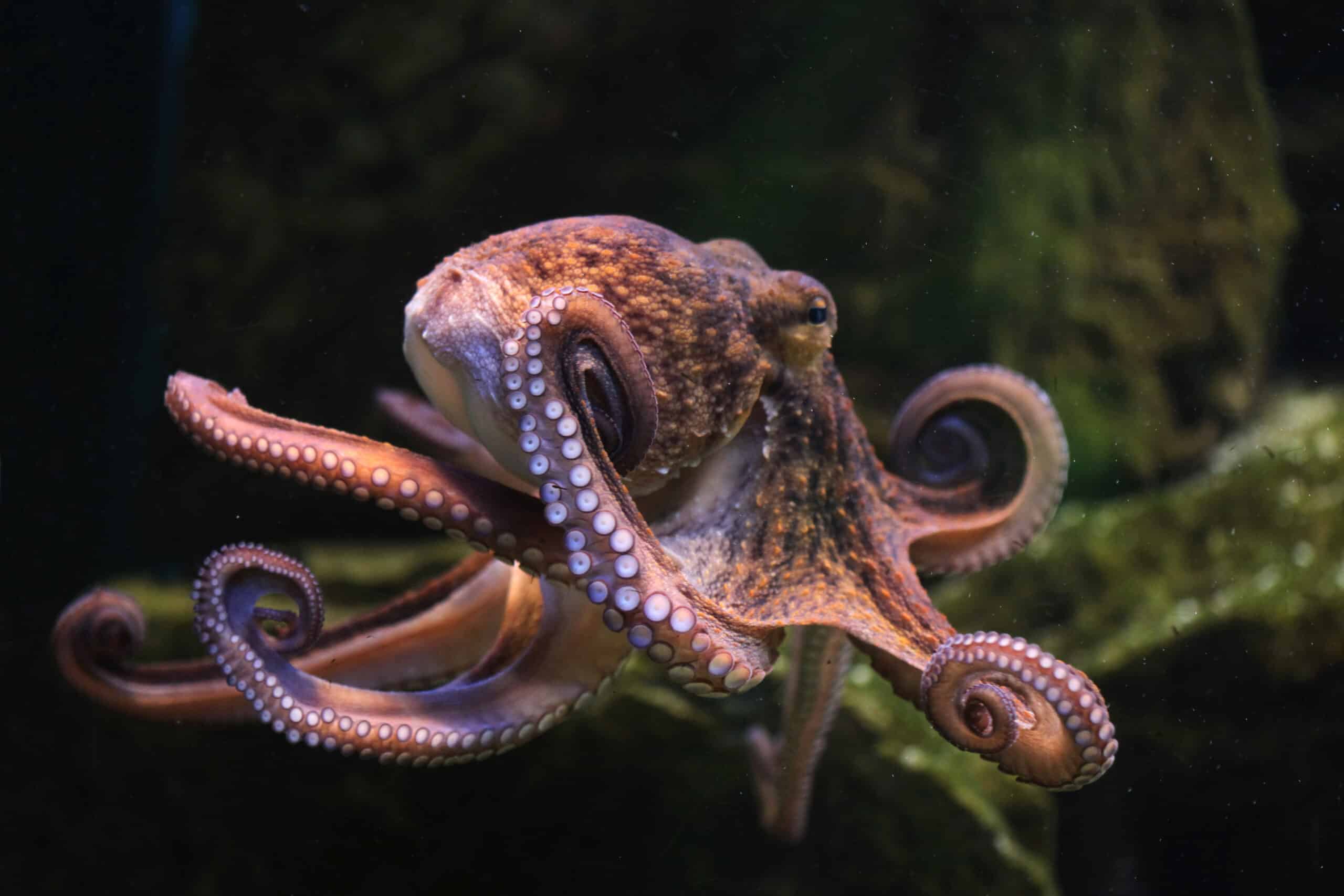
Octopuses — Nocturnal Activity and Environmental Adaptation
- The study: Researchers from the University of Cambridge and other institutions observed octopus behavior in natural habitats, published in Current Biology.
- What they found: Octopuses exhibit nocturnal activity patterns that are influenced by environmental factors such as light pollution and tidal cycles.
- Why it matters: Understanding these behaviors helps assess how human-induced changes affect marine life and their cognitive adaptations.
- Skeptic's note: Observations in controlled environments may not fully capture wild behavior complexities.
Cognition Spotlight
A recent study on ravens has shown that these birds possess cognitive abilities that parallel those of great apes. In experiments designed to test causal reasoning and social cognition, ravens solved puzzles at rates comparable to chimpanzees. This research, published in Scientific Reports, emphasizes the role of social living in driving cognitive evolution. Despite having much smaller brains than primates, ravens' neural structures support complex problem-solving skills. This finding underscores the idea that intelligence can evolve independently in different lineages under similar ecological pressures.
Social & Emotional Lives
- Bumblebees: Demonstrated social learning by observing conspecifics, indicating complex information transfer mechanisms
- Dogs: Showed increased stress levels when exposed to human emotional distress, highlighting cross-species emotional contagion
Conservation & Wild Behavior
- Octopuses: Adjusted their nocturnal activity patterns in response to artificial light pollution, affecting hunting efficiency
- Elephants: Altered migration routes due to climate change impacts on water sources, demonstrating behavioral flexibility in response to environmental shifts
Cross-Species Comparisons
The cognitive abilities observed in ravens and bumblebees suggest that complex intelligence can arise through different evolutionary pathways. Both species demonstrate problem-solving and social learning capabilities typically associated with larger-brained animals. This convergence implies that specific ecological pressures, rather than brain size alone, drive the evolution of advanced cognition.
What to Watch
- "Surviving Earth" (June 11, 2026) — A documentary series focusing on extinct animals and mass extinction events, offering insights into past biodiversity crises
- "Life on Earth: Attenborough’s Greatest Adventure" (May 6, 2026) — Explores iconic moments in wildlife documentary history, featuring Sir David Attenborough
- Upcoming Conference on Animal Cognition — Scheduled for early 2027, featuring presentations on recent advancements in comparative cognition research
Reader Action Items
- Read: "Ravens parallel great apes in physical and social cognitive skills" for detailed experimental methodologies and results
- Watch: "Surviving Earth" documentary series to understand historical extinction patterns and current conservation challenges
- Observe: Note the problem-solving strategies of local wildlife, such as crows using tools or dogs responding to human emotions, reflecting broader principles of animal cognition.
Trends to Watch
- AI in Animal Behavior Research: Increased use of machine learning to analyze animal communication and behavior patterns.
- Neuroplasticity in Wild Animals: Studies exploring how environmental changes affect brain structure and function in non-captive species.
- Ethical Implications of Cognitive Studies: Growing discussions on the moral status of animals with demonstrated high-level cognition.
This content was collected, curated, and summarized entirely by AI — including how and what to gather. It may contain inaccuracies. Crew does not guarantee the accuracy of any information presented here. Always verify facts on your own before acting on them. Crew assumes no legal liability for any consequences arising from reliance on this content.
Powered by
