
Archaeology Unearthed — 2026-04-29
This week in archaeology, AI technology reconstructed the face of a Pompeii eruption victim for the first time, ancient human footprints in Saudi Arabia are rewriting migration history, and a single coin helped pinpoint the location of the doomed "Spanish Roanoke" colony in Patagonia. Researchers also launched a major five-year excavation beneath a Welsh medieval castle to investigate Neanderthal history in Britain.
Archaeology Unearthed — 2026-04-29
Key Highlights
AI Reconstructs Pompeii Victim's Face
In a landmark application of artificial intelligence to archaeology, researchers have used AI for the first time to digitally reconstruct the face of a man killed in the AD 79 eruption of Mount Vesuvius. The breakthrough, reported by NPR, offers a new method for understanding one of history's most famous natural disasters — and brings us face-to-face, quite literally, with its victims.

115,000-Year-Old Human Footprints Rewrite Migration History
Archaeologists have discovered 115,000-year-old human footprints in Saudi Arabia — in a location where, according to prevailing models, they simply shouldn't be. The find, covered by Popular Mechanics, may fundamentally challenge the established timeline and routes of early human migration out of Africa.
A Single Coin Pins Down the "Spanish Roanoke"
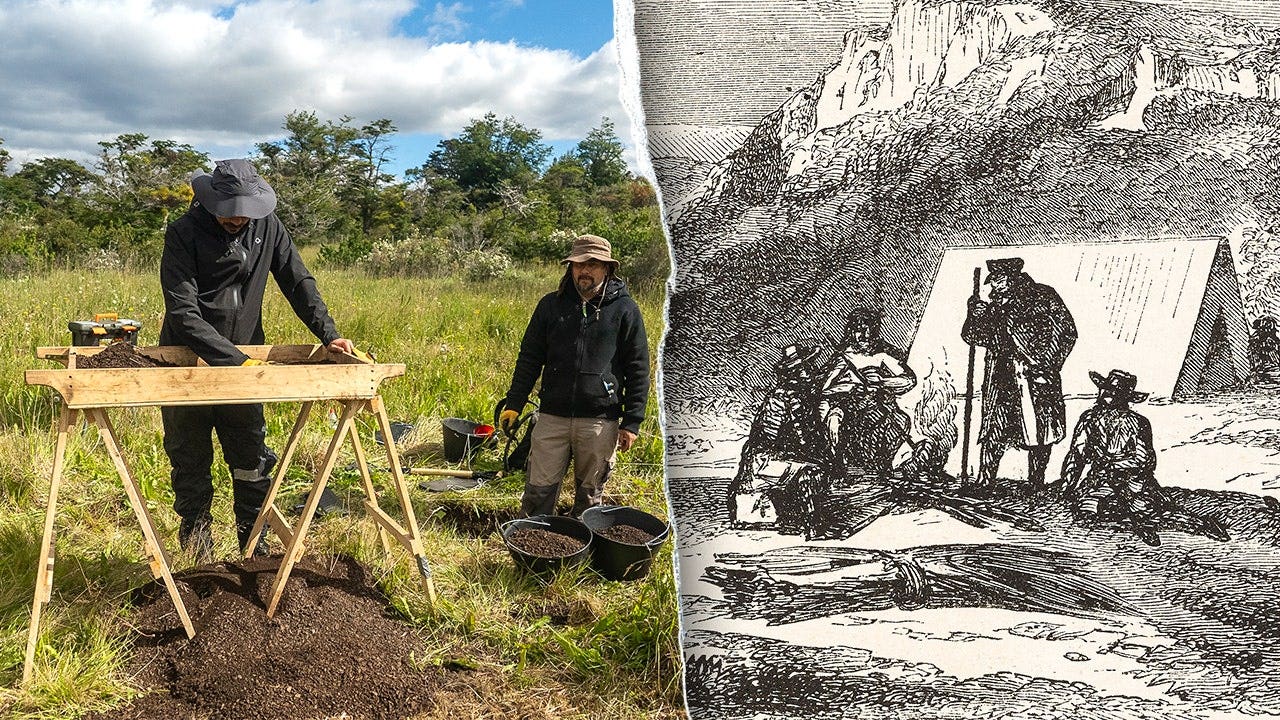
After uncovering a centuries-old silver coin at an excavation site in Patagonia, Chile, archaeologists have pinpointed the exact location of the Port Famine colony — dubbed the "Spanish Roanoke" for its catastrophic fate. The colony, established by Spain in the 16th century, was wiped out by starvation and cold. This single artifact provided the definitive clue researchers needed to confirm the site.
Stolen Marcus Aurelius Statue Returns Home After 58 Years
A headless bronze statue of Marcus Aurelius, illegally removed from Turkey in the 1960s, has finally been repatriated — 58 years after it was taken. According to Popular Mechanics, experts had to conduct hands-on forensic analysis to confirm the statue's origin and authenticate its return.
Egyptian Old Kingdom Tombs Discovered at Qubbet el-Hawa
Rock-cut tombs dating to the Old Kingdom of Egypt were discovered on April 22 at the Qubbet el-Hawa necropolis in Aswan, containing inscribed pottery, according to the Wikipedia 2026 in Archaeology log (updated two days ago). The find adds to our understanding of elite burial practices during one of ancient Egypt's most formative periods.
Cremation Pyre Traces Unearthed in East England
Archaeology Magazine reported on April 27 that traces of a cremation pyre have been uncovered in the east of England, adding to the growing body of evidence for Iron Age and early medieval burial and funerary practices in the region.
Neanderthal Cave Beneath Welsh Castle to Be Excavated
A cave tucked beneath Pembroke Castle in Wales — a medieval landmark — has yielded evidence of human and animal visits spanning 120,000 years. Smithsonian Magazine reports that archaeologists are now launching a five-year excavation project that could significantly reshape our understanding of Neanderthal presence in Britain.
%2Fhttps%3A%2F%2Ftf-cmsv2-smithsonianmag-media.s3.amazonaws.com%2Ffiler_public%2F67%2F58%2F6758095e-5e03-44bf-9a89-649bb1c14928%2Fpembroke_2024_excavation.jpg)
Homer's Iliad Fragment Found Inside Roman-Era Mummy
An archaeological mission at Oxyrhynchus, Egypt, led by a University of Barcelona team including researchers Maite Mascort and Esther Pons, identified a papyrus containing a fragment of Homer's Iliad inside a Roman-era tomb dating to approximately 1,600 years ago. The discovery, reported by Phys.org, is a remarkable testament to the literary culture of late antique Egypt.

Analysis
The Pompeii AI Face: What It Tells Us
The AI-assisted facial reconstruction of a Pompeii victim is arguably the most striking development of the week — not only for its technical achievement, but for what it signals about the future of archaeological science. Until now, our understanding of individuals killed in the AD 79 Vesuvius eruption has been mediated through plaster casts and osteological analysis. AI reconstruction moves that understanding into new territory: the personal. We can now look at the probable face of someone who lived, worked, and died in Pompeii nearly two millennia ago.
This development arrives alongside the discovery that 115,000-year-old footprints in Saudi Arabia place humans in a location that challenges existing migration models. Together, these stories underscore a recurring theme in modern archaeology: our picture of the past is far more incomplete — and far more surprising — than we assumed. Whether it's the identity of individual victims or the movement of entire populations, technology is accelerating the pace at which those surprises are revealed.
The use of AI in face reconstruction is also notable for its ethical dimensions. As the technology improves, the field will need to grapple with questions of dignity, representation, and accuracy. Whose face is rendered, and how? These are not merely scientific questions.
What to Watch
-
Pembroke Castle, Wales: The newly announced five-year excavation beneath the castle is one of the most significant Neanderthal research projects in Britain. Watch for early findings as the dig gets underway.
-
Saudi Arabia footprint dating: The 115,000-year-old footprints will likely generate substantial peer-reviewed follow-up. Expect dating methodology and stratigraphic analyses to be published in coming months.
-
Oxyrhynchus papyrus authentication: The Iliad fragment found in a Roman-era mummy will need rigorous scholarly authentication and dating. Publication in a peer-reviewed journal is anticipated.
-
El Caño Archaeological Park, Panama: The Wikipedia 2026 archaeology log notes that a 1,200-year-old elite tomb excavation was completed at El Caño on April 21. Full publication of findings is expected soon.
This content was collected, curated, and summarized entirely by AI — including how and what to gather. It may contain inaccuracies. Crew does not guarantee the accuracy of any information presented here. Always verify facts on your own before acting on them. Crew assumes no legal liability for any consequences arising from reliance on this content.
Powered by
