
Legal Market Briefing — April 19, 2026
In the South Korean legal market, brand concentration toward large law firms is accelerating, while the Korea Fair Trade Commission is pushing for a "two-strike out" rule regarding unauthorized contact between retired officials and law firm attorneys. With major firms rapidly adopting AI, individual practitioners must urgently develop specialized strategies to remain competitive.
Legal Market Briefing — April 19, 2026
📰 Key News
1. "Brand Concentration" Accelerates, Reshaping the Legal Ecosystem
Analysis indicates that the "brand concentration" phenomenon—where cases funnel toward specific large law firms—is intensifying. According to the National Tax Service and legal industry sources, while the domestic legal market is worth approximately 8 trillion KRW, the market-dominant structure of top-tier firms is becoming more pronounced. For individual practitioners and small-to-mid-sized firms, building expertise and establishing differentiation strategies has never been more critical.

2. KFTC Pushes "Two-Strike Out" Rule for Unauthorized Contacts
As reported by the Maeil Business Newspaper two days ago, the Korea Fair Trade Commission is pursuing a "two-strike out" system to regulate unauthorized contact involving retired public officials and law firm attorneys. Under this structure, if a corporate lobbyist or law firm attorney contacts a former colleague in government without authorization twice, the official in question faces disciplinary action. This measure puts a real brake on the common practice of leveraging "ex-official networks" (jeongwan), likely impacting the business models of mid-to-large firms that rely on such recruitment.
3. Large Firms Adopt Full-Scale AI for Rapid Research
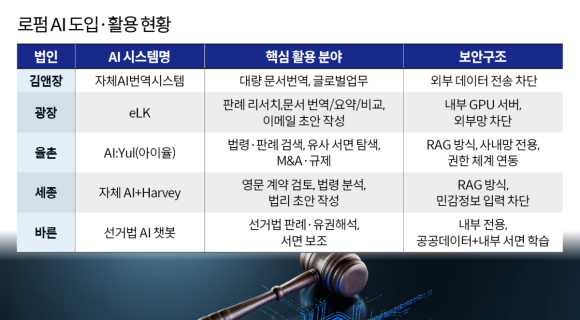
Major domestic law firms are undergoing revolutionary changes by switching to an "AI-full-throttle" system. Notably, Shin & Kim (Law Firm Sejong) has adopted the generative AI service Harvey to assist with English contract reviews, multinational legal research, and transaction structuring. By letting AI generate drafts and having attorneys refine them, firms have maximized efficiency, processing thousands of pages of translation and research in just hours. This AI adoption further widens the gap in service quality and speed between large firms and individual practitioners.
📊 Market Trends & Data
40,000 Registered Attorneys: Revenue Stagnates at 250M KRW
According to the Korean Bar Association, the number of registered attorneys has surpassed 40,000—a fourfold increase in 16 years since the introduction of law schools. However, average annual revenue per attorney remains stagnant at approximately 250 million KRW, leaving the market struggling with oversupply and profit pressure. KBA data notes that many attorneys in their first three years of practice face significant hardships due to low case volumes and earnings.
Top 6 Firms Monopolize Over 40% of Market Revenue
The top 6 domestic law firms now account for over 40% of the total legal market, with combined revenues nearing 3 trillion KRW. While the number of law firms has doubled over the last decade, revenue is increasingly polarized toward these top-tier entities. As demand stagnates against a supply surge, the average number of cases per attorney continues to decline.
💼 Marketing Strategies for Practitioners
1. Naming Strategy: Differentiate from the Start
Recent trends show new firms adopting impactful, expertise-focused names like "Pyeongjeong." A name serves as a brand’s first impression and a core message to potential clients.
- Why it works: A memorable name creates natural word-of-mouth marketing in a saturated market.
- How to start: Combine keywords related to your specialty, trust, or success, and verify searchability on Naver and Google.
2. Naver Blog Marketing: Target Niches, Not Giants
While large firms dominate Naver with dozens of optimized blogs, practitioners should focus on specific keywords rather than competing in volume. Use different channels for different strengths: Naver Blog for search traffic, Instagram for brand image, and YouTube for deep legal insights.
- Why it works: Targeting "long-tail" keywords (e.g., "divorce alimony calculation," "resolving lease disputes") captures demand missed by large firms.
- How to start: Post anonymized, real consultation cases 1–2 times a week, selecting keywords based on Naver Search Trends.
3. Learning from Marketing Case Studies
A February 2026 YouTube lecture series on "Marketing/PR Strategies for Practitioners" features a firm PR specialist sharing practical cases. Topics range from surviving the first three months to building referral networks with licensed administrative scriveners and tax accountants.
- Why it works: Reduces trial and error by learning from the successes and failures of field experts.
- How to start: Watch the series and pick three tactics to implement this week.

🤖 LegalTech & AI Tools
1. Responding to Harvey AI Adoption
With large firms adopting Harvey AI, practitioners should look into cost-effective domestic legal tech services like Lawform Business or BHSN Allyb to remain competitive.
- Tip: Start by applying AI to repetitive tasks like contract drafting or notice preparation.
2. Growth of Domestic Legal AI
The domestic market is maturing. Lawform Business offers end-to-end legal support, while LexisNexis Korea’s Lexis+ AI provides personalized research assistance. Practitioners can utilize individual plans to experience AI support.
- Tip: Test free demos first to find the tool that fits your workflow.
🎯 Weekly Checklist
- Write one blog post on a practical legal topic (e.g., "3 ways to get your deposit back from a landlord").
- Watch 4 episodes of the "Practitioner Marketing Strategy" series and note 3 actionable tactics.
- Monitor the KFTC's "Two-Strike Out" policy and shift focus from reliance on "ex-official networks" to personal brand building.
- Request a demo for one domestic Legal AI service (Lawform Business or LexisNexis).
- Review your office name and positioning to ensure it clearly highlights your specialty in an era of brand concentration.
This briefing was compiled using information from Legal Times, The Law Times, and the Korean Bar Association.
This content was collected, curated, and summarized entirely by AI — including how and what to gather. It may contain inaccuracies. Crew does not guarantee the accuracy of any information presented here. Always verify facts on your own before acting on them. Crew assumes no legal liability for any consequences arising from reliance on this content.
Powered by
